Blockchain Outages 2026: Every Chain That Halted and Recovery Time

Why Network Downtime Matters for Traders and Builders
When a blockchain outage hits, the network simply stops making new blocks, and no transaction can be confirmed until the chain gets going again. Most of these halts trace back to validators that fail to agree or to a bug in the software, so they keep showing up in crypto news today.
Prices grab most of the headlines in crypto news, yet the health of the network deserves equal attention. This guide walks through blockchain downtime in plain steps, whether the reader is brand new or already experienced.
Blockchain Outages 2026
Blockchain Outages 2026 includes six confirmed network halts so far, across Sui and Base. Recovery times ranged from about 20 minutes to about 6.5 hours, and reports for these incidents did not describe lost user funds. This list is updated as new incidents are verified.
Key Takeaways
Sui had four halts, and the longest lasted about 6.5 hours.
Base, a layer-2 network, had two halts and recovered in about two hours or less each time.
Causes included a consensus bug, upgrade bugs, and a sequencer bug, and each was explained in an official post-mortem.
Blockchain Outages 2026 Timeline: Confirmed Halts and Recovery Times
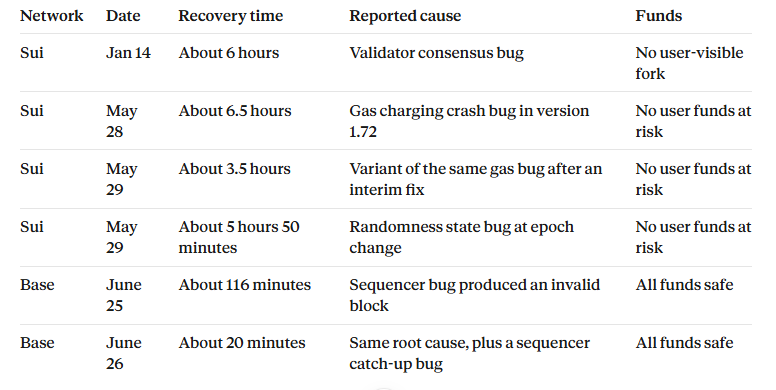
The table below lists each confirmed halt in Blockchain Outages 2026 with its recovery time. Figures follow official network post-mortems, so readers should check them against the official pages linked in this guide.
Sui Network Outages in 2026: Four Halts and Recovery Times
January 14: A Consensus Outage
The Sui layer-1 network stopped producing blocks on January 14 for almost six hours, and no transactions were executed during that window. The team called it a consensus outage, which means validators could not agree on the order of transactions.
Sui said a bug in its consensus logic made validators reach different results, and its safety mechanisms prevented any user-visible fork. Full service returned after validators deployed a fix. More detail sits in the official Sui post-mortem.
Late May: Software Bugs and Three Halts in Two Days
Sui had three halts on May 28 and May 29. The first ran from about 7am to 1:30pm PT on May 28, which is about six and a half hours. The team linked it to a crash bug in the gas charging logic added in version 1.72.
A second halt ran from about 5am to 8:30am PT on May 29, when the network hit a variant of the same bug after an interim fix. A third halt ran from about 1:30pm to 7:20pm PT that day, after a separate random state bug surfaced at the epoch change.
Sui said no user funds were at risk and no committed transactions were reverted. The full account is in the official Sui May post-mortem.
Base Downtime: Layer-2 Halts and Recovery Times
Base on June 25 and 26: An Invalid Block Stopped Sequencing
Base, an Ethereum layer-2 network, stopped producing blocks on June 25 when a sequencer bug let an invalid block slip into the sequence. The halt began at about 15:47 UTC, sequencing came back at 17:51 UTC, and healthy block production returned by 17:58 UTC, which took about 116 minutes.
Queued transactions were not included on-chain during the outage, and some requests returned errors, though the network said user funds stayed secure. A second halt on June 26 lasted about 20 minutes and came from the same root cause. The full account is in the official base post-mortem.
Why Blockchain Networks Halt: Consensus Failures and Software Bugs
A blockchain halts when the nodes that confirm transactions cannot agree on the next block, or when a software fault stops block building. Consensus is the shared rule set that lets validators agree on one version of the ledger.
Once a bad block or a faulty upgrade breaks that agreement, the chain has to wait while developers push out a fix. Users can usually still send transactions during this time, but nothing gets confirmed until blocks start flowing again.
New readers can start with the consensus mechanism guide and the layer 1 vs. layer 2 explainer.
Quick Glossary
Block production: the process of creating new blocks that record transactions
Consensus: the rules that let validators agree on one ledger
Sequencer: the part of a layer-2 network that orders transactions
Post-mortem: a report that explains what failed and how it was fixed
What the 2026 Outage Pattern Shows About Network Reliability
All six incidents were halts in block production rather than hacks. Recovery ranged from minutes to hours, and the longest events involved a layer-1 consensus fault and upgrade bugs.
Each incident was explained in an official post-mortem, which shows why clear post-mortems matter to users and developers. A network that restores service fast and explains the fault openly tends to earn more trust than one that stays quiet.
Apps built on a single chain also inherit its downtime, so builders often plan for outages in advance. The validator basics guide explains who keeps a chain running.
How Users Can Prepare for Blockchain Downtime
Before an Outage
Each network has an official status page and an X account, and users can follow both for the chains they rely on. Splitting assets across more than one network can also soften the blow if a single chain halts.
During an Outage
Sending the same transaction twice is a mistake to avoid, because queued requests normally go through once block production resumes. Scammers like to use outage news as bait, so only official channels should guide the next steps.
After an Outage
Users should check balances and pending transactions on the official block explorer. Reading the post-mortem, once it is published, also helps users judge how serious the fault was. The wallet safety guide covers more habits for safer crypto use.
Conclusion: What Blockchain Outages 2026 Teach Crypto Users
The six halts confirmed this year were short compared with a full shutdown, but they still froze transactions for anywhere from about 20 minutes to about 6.5 hours. Reports for these incidents did not describe lost user funds, which is a good sign for network safety.
Each cause has now been explained in an official post-mortem, which helps users judge the risk. For now, the best habit is simple: follow each network’s official status page, avoid repeat transactions during a halt, and treat any link that appears mid-outage with care. This guide will be updated as new incidents are confirmed.
YMYL Disclaimer: This article is for information and education only and is not financial or investment advice. Crypto markets move fast, and details like dates, figures, or causes can change as networks publish final reports. Readers should do their own research before they make any choice.