
BOJ DLT Sandbox: Japan Tests Tokenized Money Beyond Today's Payments

BOJ DLT Sandbox: Three Tests That Could Reshape Japan's Money Payments
The Bank of Japan has shared new details on how it plans to test digital money.
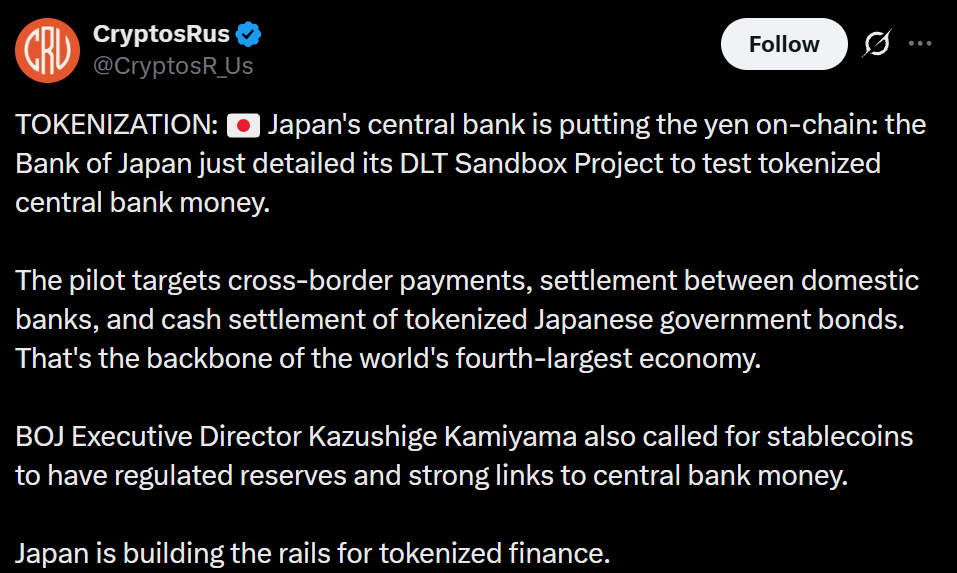
In a keynote speech, Executive Director Kazushige Kamiyama explained that the BOJ DLT Sandbox will examine whether blockchain-style technology can make payments and settlement faster and safer.
In simple words, this is a careful experiment, not the launch of a new currency.
Source: Post on X
What Did the Bank of Japan Announce?
Kamiyama spoke on 27 November 2026 at the IMF MCM-OAP Seminar in Tokyo. His talk was titled "Digital Money and Payments: Transitioning Toward a New Paradigm."
According to the official speech text, the Bank has launched the BOJ DLT Sandbox Project to study what distributed ledger technology (DLT) and tokenization mean for money and financial market infrastructure.
That includes the possibility of offering central bank money in tokenized form.
The testing environment is being built together with holders of current accounts at the bank.
The work follows real business needs and tries to solve practical and technical problems.
Quick facts
-
Speaker: Kazushige Kamiyama, Executive Director, Bank of Japan
-
Date: 27 November 2026
-
Event: IMF MCM-OAP Seminar, Tokyo
-
Partners: Current account holders at the Bank
-
Stage: Exploration; no decision yet on issuing a retail digital currency
Three Use Cases Inside the BOJ DLT Sandbox
The speech names three areas of focus:
| Use case | Goal |
| Cross-border payments | Improve how money moves between countries. |
| Domestic interbank settlement | Strengthen settlement between banks inside Japan. |
| Tokenized Japanese government bonds | Test the funds (cash) settlement of these bonds. |
The bank says the point is not just to show that transactions can run on a blockchain.
It wants to know whether the technology can cut existing frictions, improve business processes, connect with current systems and meet market needs.
Tokenizing the Bank's own money is one option. Linking existing infrastructure with new platforms is another, and the Bank will decide based on market needs.
The speech also notes that Japan's current infrastructure, including large-value settlement through BOJ-NET, already offers a high level of convenience, safety and reliability.
The Bank's approach is to keep improving existing systems while exploring new ones in parallel, rather than switching everything at once.
Why Tokenization Matters: The Opportunities
The speech highlights two features of DLT:
-
Around-the-clock operation: trading and settlement could run at any hour.
-
Programmability: smart contracts can automatically carry out set actions when conditions are met.
Take a cross-border securities deal. Today, the transfer of the security, the payment, the compliance checks, and the messaging often run on separate systems with several intermediaries.
With tokenization, a smart contract could link the transfer and the payment so that either both happen or neither does. The speech calls this atomic settlement.
It could reduce manual work, shorten settlement times, and potentially lower settlement risk.
The Bank also says that combining these features with artificial intelligence could further change how transactions are started and executed. It adds that AI could bring extra risks, especially in cybersecurity.
Five Challenges the Bank Wants to Solve
The Bank is open about the risks. The speech lists five challenges:
-
Financial stability: new links between institutions could amplify market moves in stressful periods, for example through automated margin calls.
-
Liquidity and fragmentation: if tokenized markets run 24/7 while payment systems keep fixed hours, firms may need to hold extra liquidity.
-
Migration costs, interoperability, and governance: the switch needs large investment, common technical standards and clear rules on who is responsible when failures or fraud occur.
-
Cybersecurity and resilience: smart contracts, key management, and third-party providers can add weak points.
-
Legal certainty: it must be clear that moving a token transfers legal rights in the underlying asset. Technical finality on a DLT platform is not always the same as legal finality.
Stablecoins, Global Projects and the Road Ahead
The Bank describes most stablecoins as tokens designed to hold a stable value against a reference currency, mainly the U.S. dollar.
Tokenized deposits are commercial bank deposits in tokenized form. For stablecoins, the speech says appropriate regulation of reserves and arrangements, together with well-designed links to central bank money, will be important.
Japan's work is part of wider efforts:
-
The government has set a policy to promote "on-chain finance," and the Financial Services Agency is leading public-private talks on a roadmap.
-
The Bank is taking part in Project Agorá, a BIS Innovation Hub project with several central banks and more than 40 private financial institutions. It studies a shared programmable platform for wholesale cross-border payments.
-
The Bank continues retail central bank digital currency work, including a pilot with private-sector participants, though no decision to issue one has been made.
The speech also mentions that the Eurosystem launched Pontes in September 2026 and that the Bank of England is working on a synchronization mechanism with its renewed RTGS system.
Conclusion
The BOJ DLT Sandbox shows that Japan's central bank wants to explore tokenization step by step while protecting trust in money.
The message is clear: innovation is welcome, but central bank money must remain the anchor of trust, and money must be convertible at face value with finality. This article is for information only and is not financial advice.
Disclaimer
This article is for educational and informational purposes only and is not financial or investment advice. Crypto assets are high risk, their prices can be very volatile, and you can lose some or all of your money. Always do your own research and consider speaking with a licensed financial advisor before making investment decisions.






