
Cardano News Today: Why ADA Falling Despite Node and Fork Update?

Cardano blockchain investors got a reality check this week. The network just rolled out some of its biggest technical wins in months. Yet ADA's price did not throw a party. It fell instead. So why is Cardano price down today, even as the Dijkstra hard fork gets closer and a new node joins the mainnet? And where is all that money actually going?
Here is what is happening, in plain terms, as part of cardano news today.
Key Takeaways
-
ADA dropped 2.2% in the past day even as Cardano confirmed five node implementations now produce blocks on its mainnet.
-
Midnight's NIGHT token jumped 25.1% this week, and its thawing period ends December 4, which may explain where ADA's money is going.
-
The Fed meets on December 9, and traders are pricing in a rate hike that could add more pressure on ADA and other risk assets.
Cardano News Today: Why Is ADA Price Crashing Right Now?
As per CoinGecko data, at the time of writing on November 28, 2026 at 09:35 am, Cardano price today sits at $0.1478. That is a 2.2% drop in 24 hours. ADA's market cap stands at $5.556 billion, with $194.723 million traded in the last day.
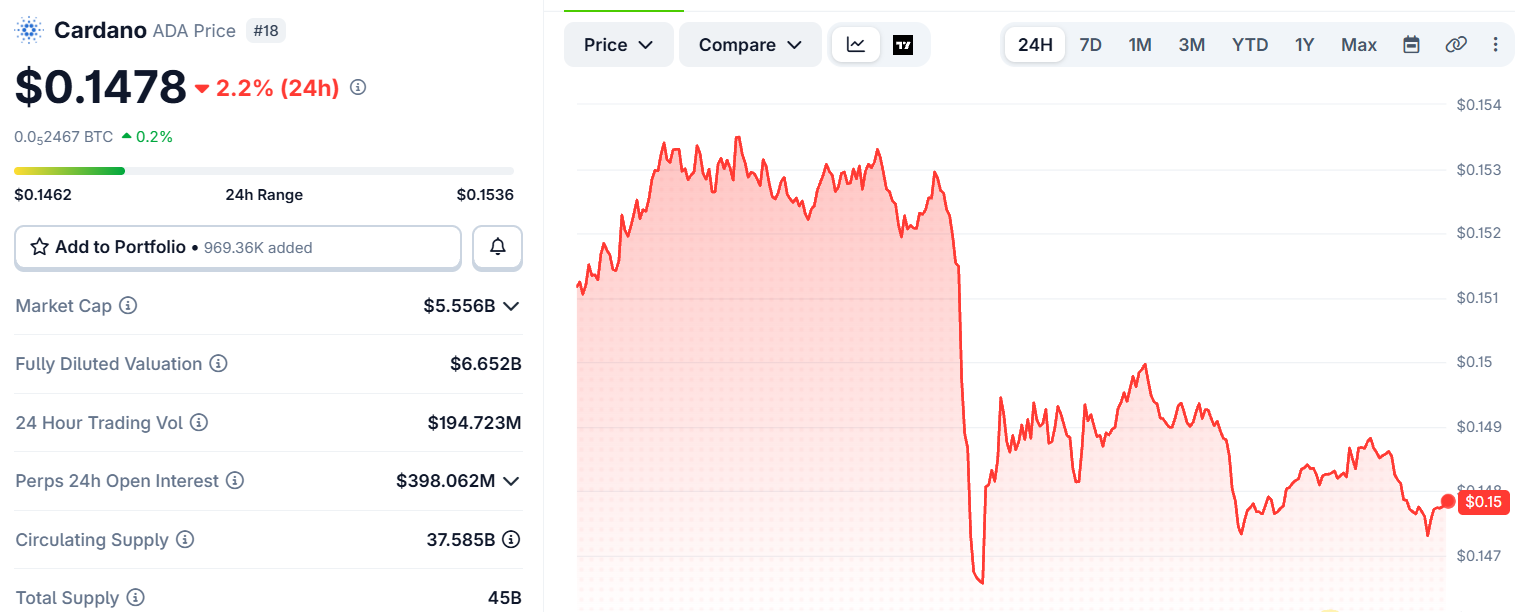
Source: CoinGecko Data | November 28, 2026 | Time: 09:35 am
Within that single day, ADA slid from $0.1529 down to $0.1465 before settling where it is now. Zoom out to the weekly chart, though, and the picture flips. ADA is still up over 9.0% for the week. So this is a short, sharp pullback, not a month-long slide.
Meanwhile, Midnight's NIGHT token is doing the opposite. It trades at $0.05008, up 2.6% in a day and a strong 25.1% across the week, with a market cap of $831.834 million and $32.98 million in 24-hour volume.
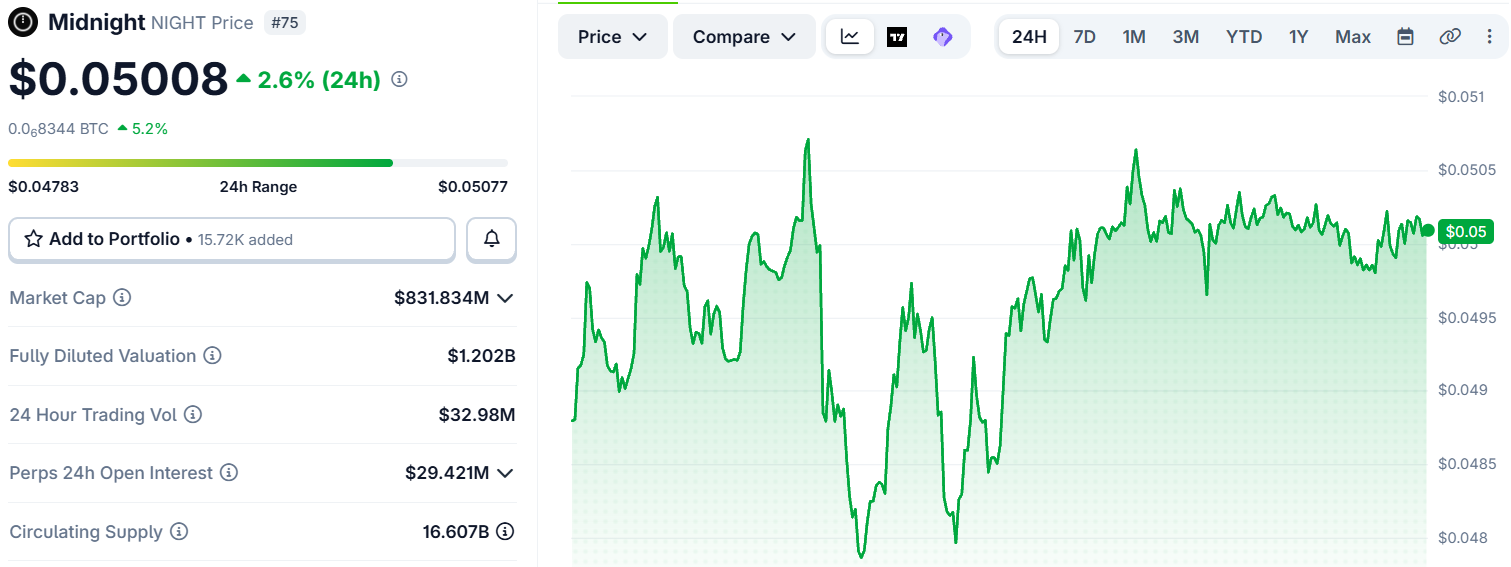
Source: CoinGecko Chart | November 28, 2026 | Time: 09:35 am
ADA vs NIGHT: Quick Market Snapshot
| Metric | ADA (Cardano) | NIGHT (Midnight) |
| Price | $0.1478 | $0.05008 |
| 24h Change | -2.2% | +2.6% |
| 7-day Change | +9.0% | +25.1% |
| Market Cap | $5.556B | $831.834M |
| 24h Volume | $194.723M | $32.98M |
Data source: CoinGecko, as of November 28, 2026, 09:35 am.
Five Nodes, One Mainnet: Cardano's Quiet Network Win
Here is the part that makes the price drop confusing. Per a Cardano post on X, five separate node implementations are now producing blocks on the Cardano mainnet. The original cardano-node software finally has company, which spreads out the risk of relying on just one piece of software to run the whole chain.
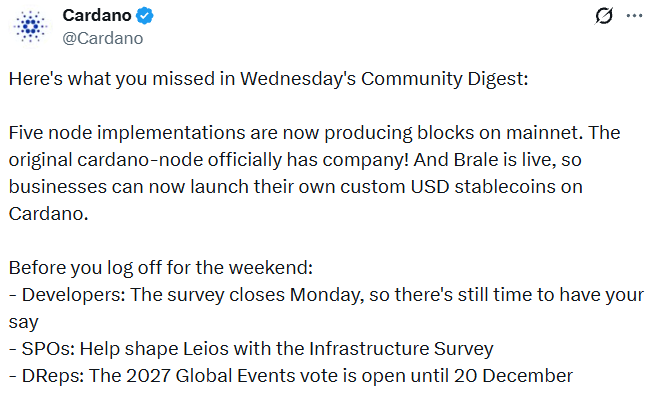
Source: X Post
On top of that, Brale is now live, letting businesses launch their own custom USD-backed stablecoins on Cardano.
Before the weekend, Cardano's team also flagged a few open community items:
-
A developer survey that closes Monday, so there is still time to respond.
-
An Infrastructure Survey for stake pool operators, built to help shape Leios.
-
A DRep vote on the 2027 Global Events calendar, open until December 20.
Dijkstra Hard Fork and the Road to Ouroboros Leios
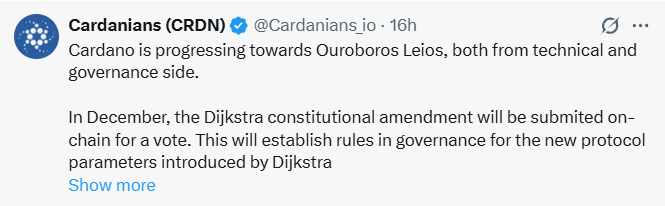
As per a Cardanians post on X, Cardano is moving forward on Ouroboros Leios from both a technical and governance angle. In December, the Dijkstra constitutional amendment goes on-chain for a vote. This sets the governance rules for new protocol parameters that come with the Dijkstra hard fork and Leios.
Source: X Account
On the technical side, the team still aims to finish Ouroboros Leios mainnet readiness by the end of this year. The actual vote for the Dijkstra hard fork is targeted for Q1 2027, possibly as early as January.
Once Dijkstra passes, Leios can switch on as soon as enough stake pool operators are ready to support it. After that, any future Leios parameter changes will also go through on-chain governance, not a backroom decision.
Cardano News Today: Is Money Moving From ADA Into NIGHT?
So despite all these upgrades, why does Cardano price keep sliding? One likely answer sits inside Midnight's own token unlock schedule.
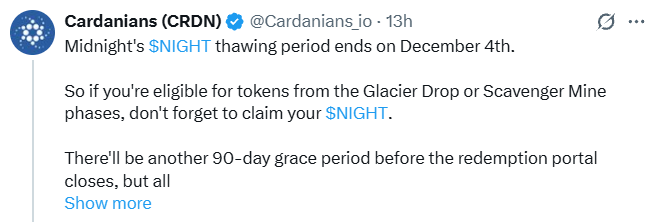
Per a Cardanians post on X, Midnight's NIGHT thawing period ends on December 4. Anyone eligible for tokens from the Glacier Drop or Scavenger Mine phases needs to claim NIGHT before then. There is a further 90 day grace period after that before the redemption portal shuts for good, but every token should be unlocked by December 4.
Source: Cardanians X
This kind of unlock event tends to pull trading attention and capital toward the token being unlocked. It is a reasonable explanation, not a confirmed fact, but the timing lines up. ADA slips while NIGHT climbs, right as its biggest unlock window opens.
What Next for Cardano? All Eyes on the December Fed Meeting
As November wraps up, traders are now watching the Fed's December 9 meeting closely. The CME FedWatch tool currently prices in a 99.8% chance of a 25 basis point rate hike, which would push the Fed funds rate to a range of 400 to 425 basis points. The odds of the Fed holding rates steady at 375 to 400 basis points have fallen to just 0.2%.
A rate hike like this usually makes borrowing more expensive. That, in turn, can pull money away from riskier assets, and crypto tends to sit near the top of that risk list. If the hike plays out as priced, ADA and the wider market may feel it fast.
For now, Cardano news today looks like a tug of war. Real network progress on one side. A token unlock and a looming rate decision pulling attention and capital the other way. The next two weeks, through December 4 and December 9, could decide which side wins out.
Expert Opinion: Cardano news today tend to separate network health from price action, and this week shows exactly why. Five live node implementations and a scheduled hard fork vote are structural wins that rarely move price in the short run. Token unlock events like Midnight's thawing period, paired with a looming Fed rate decision, carry far more weight over a two-week window. Analysts generally view short-term ADA weakness alongside long-term protocol progress as two separate stories, not one.
Disclaimer: This content covers cryptocurrency markets, which are highly volatile and carry financial risk. Nothing here is financial, investment, tax, or legal advice. Figures reflect data available at the stated time and can change quickly. Always do independent research and consult a licensed financial advisor before making any investment decision.






