
Canton Coin Tokenomics Update: Burns, Mints, and CIP-0129

What the Canton Coin Tokenomics News Means for CC Holders
Canton Network has shared a fresh update on how Canton Coin (CC) works: CC is burned to pay for network traffic. This Canton Coin tokenomics update came in two posts on X that also point to CIP-0129, a governance proposal approved on October 23 that would extend burning to more of the network.
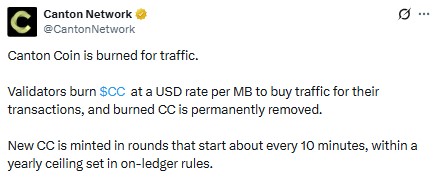
According to the posts, validators burn CC at a USD rate per megabyte (MB) to buy traffic for their transactions, and the burned coins are permanently removed. New CC is minted in rounds that start about every 10 minutes, within a yearly ceiling set by on-ledger rules.
The Canton documentation describes the same model. Here, traffic means the bandwidth a synchronizer uses for each transaction. A synchronizer is the part of the network that orders, confirms, and delivers messages.
How Burning CC Pays for Canton Synchronizer Traffic
Every message sent to a synchronizer consumes traffic, and the sending validator pays for it. Recipients are not charged. Each validator first receives a free allowance that regenerates over time. Once that runs out, the validator, or a service provider acting for it, burns Canton Coin to buy more.
Fees are priced in USD but settled by burning Canton Coin.
Free base-rate traffic is used first.
Extra traffic is bought at a USD-per-MB price.
Small holding fees discourage dust, while CIP-0078 largely removed transfer and lock fees.
To convert USD fees into CC, each Super Validator publishes a preferred CC-USD rate. The median of those rates is recorded for each round, which makes it harder for one party to manipulate. The technical reference lists these parameters, and they can be queried through the Scan API.
How the Burn and Mint Cycle Aims to Balance Supply
Over the long term, CC burned through real usage is meant to roughly balance Canton Coin minted within the annual issuance ceiling. That link between supply and usage is the core of Canton Coin tokenomics, often called a burn-mint equilibrium.
Network usage | Burn | Effect on net supply |
High | Rises | Net growth slows, supporting the conversion rate. |
Low | Falls | More net supply until balance returns |
The balance is a design goal, not a fixed ratio. The Canton Coin overview gives background on the concept. The material reviewed for this crypto news report does not include a current burn-to-mint figure.
Who Earns New CC in Each Ten-Minute Minting Round
CC is minted in roughly 52,560 rounds a year. Each round's issuance is split into tranches for validators, featured apps, and Super Validators.
Recipient | Reward basis |
Validators | CC their users burned |
Featured apps | Recorded activity or traffic |
Super Validators | Weight, from the remainder |
A development fund takes a share before the split, 5% by default under CIP-0082. Caps apply within each tranche. Liveness-only validator rewards were phased out under CIP-0096, with a $0 cap from April 30, 2026, so earnings now follow activity.
CIP-0129 Universal Burn: Timeline and What Stays Unclear
Until now, only Global Synchronizer traffic burned Canton Coin, while dedicated synchronizers were paid for through license fees to Digital Asset.
This crypto update matters because CIP-0129 would make every production synchronizer on MainNet burn Canton Coin at the Global Synchronizer's list price, with rewards under the same rules.
The CIP-0129 text puts that list price at $60 per MB, about $1 for a typical transaction before rewards. It also makes running a dedicated synchronizer permissionless. Test and development environments do not burn real CC.
Phase | Target | What goes live |
Approval | Oct 23, 2026 | Framework approved |
Phase 1 | Q1 2027 | Universal burn, with case-by-case interim discounts |
Phase 2 | Q3 2027 | Volume pricing and commitment discounts, after a second CIP |
The CIP calls these dates ambitious estimates, not deadlines. Universal burn is therefore not live yet and is not reducing supply today.
The curve, discount sizes, and collateral rules are left to the second CIP. Prices and caps can change by a two-thirds Super Validator vote, so check the Scan API or the latest CIPs for current values.
Canton Coin tokenomics ties supply to real traffic, but the balance depends on usage and on the 2027 rollout. Readers following this news should watch for the second CIP.
Disclaimer: This crypto news report is informational and is not financial or security advice. Verify details on official channels.






