Cardano Ecosystem: Mapping the Network's Main Projects and Tools

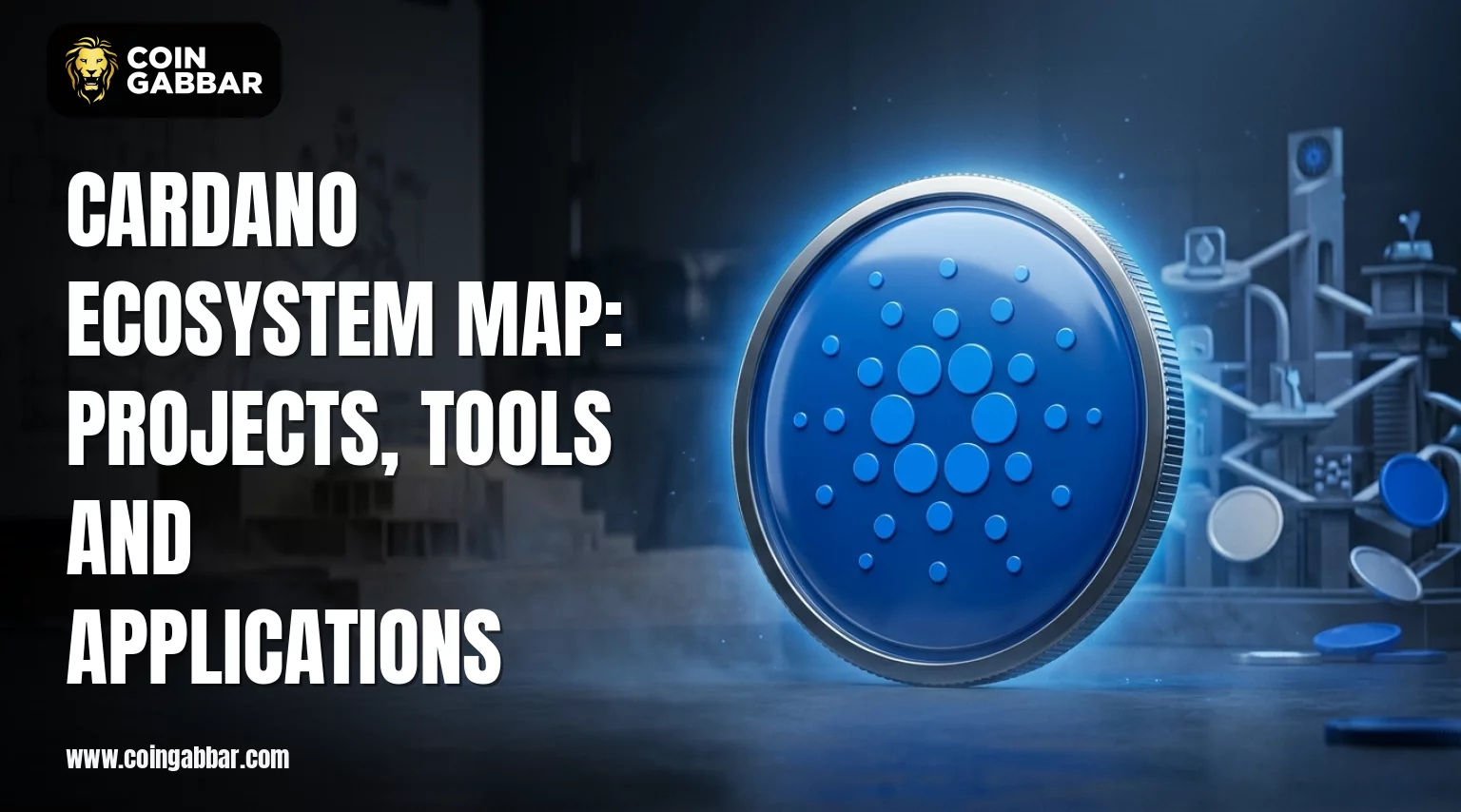
Cardano Ecosystem: Which Tools and Applications Drive the Network?
Cardano covers a lot of ground. Wallets, exchanges, lending apps, NFT markets, voting tools and enterprise pilots all run on one chain, yet most guides cover only a single slice.
This Cardano ecosystem map brings the pieces together. Every fact comes from official pages, including cardano.org and the Cardano Foundation, so readers can verify each number.
Key Takeaways
The apps directory lists 104 curated apps live on mainnet, from wallets to games.
Minswap leads activity with 93.2K transactions in 30 days, per the 21 September 2026 snapshot.
The Foundation's developer survey shows Aiken as the leading contract language, with documentation as the top pain point.
What Is the Cardano Ecosystem?
The Cardano ecosystem is the full network of people, apps and tools built around the Cardano blockchain and its native coin, ada. At its base sits a proof-of-stake chain developed through peer-reviewed research.
On top of it run wallets, decentralized exchanges, lending platforms, NFT marketplaces, governance tools and developer software, while stake pools keep the network running. Organizations such as the Cardano Foundation, Input Output, EMURGO and Intersect support its growth. The official apps directory alone lists 104 curated apps, and community directories track hundreds more.
Source: official website
How the Cardano Ecosystem Works
Cardano is a proof-of-stake blockchain built on peer-reviewed research. The how Cardano works guide explains the moving parts.
Part | How it works |
Consensus | Ouroboros; pools are chosen in proportion to delegated ada |
Time | 1-second slots, 5-day epochs, a block about every 20 seconds |
Ledger | eUTXO: unspent outputs that can carry data and scripts |
Fees | 155,381 lovelace plus 44 per byte, about 0.17 ada for a typical transfer |
Staking | Non-custodial, no lock-up, no slashing |
Network | Close to 3,000 registered pools, about 1,000 producing blocks per epoch |
Source: Cardano ecosystem
Fees follow a formula, not an auction, so they stay steady when the network is busy. Wallets also show the exact outcome before signing. That one design choice shapes nearly every app below.
The Ecosystem at a Glance
The Cardano ecosystem is easiest to read by category. The apps directory offers guided paths for staking, trading, voting, minting NFTs, playing and building, and every Cardano ecosystem project below appears there.
Category | Examples |
Wallets | Lace, Eternl, VESPR, Typhon |
DEXs | Minswap, WingRiders, Splash, CSWAP, SundaeSwap |
Lending | Dano Finance, Liqwid, Indigo |
NFTs | Wayup, NMKR |
Governance | CGOV, DRepTalk, Tempo |
Bridges | WanBridge, Chainport, Finitum Bridge |
Explorers and pool tools | AdaStat, PoolTool |
Cardano Wallets: Account, Login and Signature
A wallet is the account, the login and the signature in one. Lace comes from IOG with Web3 integrations, Eternl suits power users on browser and mobile, VESPR is a beginner-friendly mobile option, and Typhon adds an NFT gallery. Teams can use Multisig Wallet for shared treasuries.
Cardano DEXs and DeFi Explained
The DeFi guide describes decentralized finance as finance run by smart contracts instead of companies. Nobody can freeze an account, and nobody can undo a mistake.
Cardano DEXs let users swap ada for native tokens without a company-run order book. Activity over the last 30 days looks like this:
DEX | Transactions |
Minswap | 93.2K |
WingRiders | 40.8K |
Splash | 17.0K |
CSWAP | 12.5K |
SundaeSwap | 10.5K |
A UTXO can be spent only once, so many DEXs settle orders in batches. A swap may therefore take a block or two longer.
Cardano DeFi also works differently from account-based chains because it has no token approvals. A DApp can spend only what the signed transaction spends. Lending is covered too: Dano Finance recorded 30.2K transactions, Liqwid offers non-custodial lending with liquid staking, and Indigo handles synthetics for real-world asset exposure.
The wider Cardano DeFi ecosystem carries real risks. The guide lists contract bugs, stablecoin depegs, scams, irreversible transactions and lost recovery phrases. It also calls bridges among the most attacked pieces of DeFi anywhere.
Cardano NFTs
Tokens are native to the ledger, so no contract is needed to create one. An NFT is a token minted in a quantity of one under a policy that never mints it again.
Wayup, which continues JpgStore, handles the marketplace side with 4.7K transactions. NMKR covers minting with fiat and crypto checkout. Standards such as CIP-25 and CIP-68 tell wallets how to read metadata.
Cardano Governance
Protocol changes, treasury spending and the constitution are all decided on-chain. Ada holders vote directly or delegate to a DRep, while stake pool operators and a constitutional committee add checks.
CGOV shows proposals and voting, DRepTalk handles delegation and discussion, and Tempo serves DReps. Since 2025, even a hard fork is a governance action.
Cardano Smart Contracts Explained
The smart contracts page explains that a contract is a validator: a script that approves or rejects a transaction. Funds sit in an output locked by the script. A datum records the agreement's state, and a redeemer is the argument that tries to spend it.
Costs are known before signing. If a script still fails on-chain, collateral covers the network's work, currently one and a half times the fee.
Contracts are written in Aiken, Plinth or Plutarch and compiled to Plutus Core. Native scripts cover simpler cases like multi-signature wallets and time locks. A script's code cannot change after deployment, so projects upgrade by deploying a new version.
Cardano dApps connect to wallets through CIP-30, which is why one wallet works with many apps. The app never holds keys and cannot move funds without a signature.
Source: official documentation
Developer Tools and Foundation Solutions
The Foundation's tools and solutions page lists the main building blocks.
Tool | Purpose |
Aiken | Smart contract language with easy syntax |
Amaru | Block-producing node client in Rust, from PRAGMA |
Rosetta | Enterprise integration stack |
Tool Compass | Guide for choosing blockchain data tools |
Yaci Store | Open-source indexer and datastore |
The annual survey's fourth edition drew more than 100 developers in 2025. Its 2024 edition (196 developers) found Aiken still on top, with Mesh, Lucid Evolution, Mithril and Dolos gaining ground. Documentation remained the main challenge.
Real-World Use Cases
The use cases page shows that Cardano blockchain applications reach beyond finance.
Area | What it does |
Education | Tamper-proof academic credentials |
Digital identity | Credentials users own and control |
Supply chain | Farm-to-table traceability, anti-counterfeiting |
Payments | Low-cost cross-border transfers |
Tokenized assets | Fractional ownership of real-world assets |
Voting systems, healthcare records and music royalties are listed as emerging areas.
Cardano Ecosystem Projects to Watch
No official ranking of the best Cardano ecosystem projects exists, so on-chain activity works as a rough guide. Minswap, Dano Finance and Wayup top that list.
Three names look worth following:
Cardano Accelerator Program: On 21 September 2026 the Foundation named eight ventures for its fall cohort, building digital product passports, traceability and identity tools.
Amaru: An alternative node client written in Rust.
DRepTalk and Bending AI: Both were recently added to the directory.
For a longer list of Cardano dApps and projects, CardanoCube tracks more than 650. It shows why the ADA ecosystem is wider than any single directory.
How Users Can Start Safely
Set up a wallet and back up the recovery phrase.
Get some ada, since every transaction needs a little for fees.
Reach apps through official links on the apps directory.
Start small and read every transaction before signing.
Never enter the recovery phrase into any app.
Final Thoughts
The Cardano ecosystem is broader than price charts suggest, with real tools for trading, voting, building and enterprise work. Activity is uneven, though. A few apps dominate transactions while many others are early.
Readers should explore the official pages, test with small amounts and verify everything independently.
Disclaimer: This article is for information only and isn't financial advice. Always do your own research.






.webp)