Chain Intellect Coin: The Technology Powering Its Ecosystem


What Is Chain Intellect Coin, and Why Are Readers Searching for It?
Chain Intellect Coin, with the ticker HAIN, is a crypto project built on Ethereum. It wants to mix artificial intelligence tools with blockchain technology. The official website talks about AI tools, automation, digital identity, and systems that no single company controls.
Readers mostly want three answers: what the token does, how the supply is shared out, and what the roadmap says.
Everything below comes from the official website, the VC whitepaper, and the tokenomics page, checked in October 2026.
How Does Chain Intellect Coin Work Behind the Scenes?
The whitepaper calls the big idea a decentralized intelligence economy. In plain terms, people would pay for AI services, data, and computing power with tokens, so a few huge companies wouldn’t hold all the control.
Smart contracts handle the payments. These are small programs that run on their own on a blockchain. They’re meant to move value between users, developers, and compute providers, the people who supply processing power.
HAIN is an ERC-20 token on Ethereum. That’s a common token standard, and it lets the coin work with popular wallets and DeFi apps.
The project points to four problems it wants to fix. AI is controlled by big firms. Data use in model training is unclear. Contributors get little reward. And AI and blockchain tools sit apart from each other.
Key Features That Make Chain Intellect Coin Stand Out
Most of the listed features are plans, not finished products.
Ethereum support, which brings wallet access and DeFi links through the ERC-20 standard.
AI automation, with agent tools named only as possible future layers.
Community governance, where token holders are meant to vote on where the project goes.
A compute marketplace, planned as a place to pay for processing power with HAIN.
Here’s the thing: the material reviewed doesn’t point to a live AI product yet. That gap between the vision and a working tool is the main thing to watch.
Chain Intellect Coin Token Utility: What HAIN Is Meant to Do
The whitepaper gives the token four jobs. HAIN would pay for AI services, give holders a vote, earn staking rewards, and cover the cost of computing.
The project says money could come from AI service fees, platform fees, and deals with businesses. Staking lockups, where holders lock tokens for a set time, are meant to cut circulating supply, which is the number of tokens free to trade.
But a use on paper isn’t a use in real life. Demand for HAIN depends on whether real people ever pay for these services, and crypto price usually follows demand.
Chain Intellect Coin Tokenomics: Supply and Allocation
A launch graphic from the project shows a total supply of 5Q, which means 5 trillion tokens. The tokenomics page splits that supply like this.
Allocation | Share | Stated purpose |
Presale and public sale | 45% | Public token sale |
Liquidity and exchange listing | 15% | Reserved for liquidity and listings |
Development fund | 10% | Ecosystem, core tech, and operations |
Staking and rewards | 10% | Community incentives |
Team and advisors | 10% | Vested, long-term |
Marketing and partnerships | 10% | Growth and partnerships |
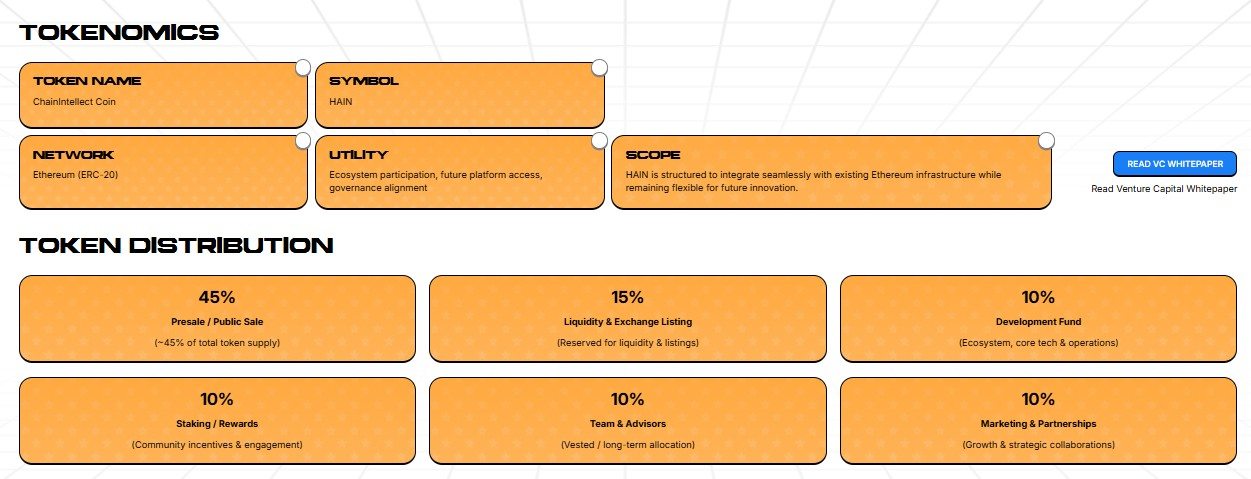
The shares add up to 100%. Almost half goes to the public sale, so a big chunk of tokens could hit the market once trading starts.
Vesting is the schedule that decides when tokens can be sold. The team share is called vested, yet the pages reviewed show no start dates or unlock dates.
With 5 trillion tokens, a very low token price says little about value. Market cap, which is price times circulating supply, tells more. Fully diluted value counts locked tokens too.
Chain Intellect Coin Roadmap: What the Team Plans Next
The roadmap has six phases.
Conceptualization: settle the project idea, set the tokenomics, and fix goals for Q1 2025.
Development: deploy smart contracts, launch the website, and start community work in Q2 2025.
Presale: Hold the token presale from April 1 to 28, 2025, with a fundraising event and community building.
Exchange listings: list on decentralized and centralized exchanges in a Q3 2029 rollout.
Ecosystem expansion: launch staking, build partnerships, and develop dApps in Q4 2029.
Governance integration: Start DAO governance and a community voting system in Q1 2030.
The launch graphic also shows a token generation event, the day tokens are first created and shared, set for July 15, 2029. That first seemed like a typo. Then the date matched the listing phase, so it seems deliberate.
Still, a presale in April 2025 and a crypto listing in 2029 leave a gap of over four years. The pages reviewed don’t explain it, and they don’t share presale results or funds raised.
No crypto airdrop shows up in the official material. Any airdrop offer using the HAIN name should be checked on the official site first.
Risks and Red Flags to Check Before Investing in Chain Intellect Coin
The whitepaper itself names four risks. They are unclear rules from regulators, price swings, technology problems, and slow adoption.
No audit report appeared in the pages reviewed, even though the whitepaper calls audits essential.
Team names, vesting dates, and presale totals are also missing from those pages. And the whitepaper’s talk of exposure and long-term growth is a project claim, not proof.
An audit isn’t a safety guarantee, and a roadmap isn’t a promise. A crypto presale price also never equals a future market price.
What Does the Data Say About Chain Intellect Coin?
The stronger signal is a published ERC-20 contract and a clean allocation table.
The main worry is distance. The roadmap runs to 2030, while proof of delivery so far is thin.
The biggest unknown is the unlock schedule for the 45% public share.
Readers can check the contract on a public Ethereum explorer, ask for the audit report, and read the vesting terms. No price prediction is made here.
Final Verdict: Is Chain Intellect Coin Worth Researching?
Chain Intellect Coin is a crypto project on Ethereum that wants HAIN tokens to pay for AI services, data, and computing. The split of tokens is clear, and the whitepaper is easy to read.
What stays uncertain is delivery. Audits, vesting dates, team details, and presale results need confirming before any decision, and the next official update is the best place to start.
Disclaimer
This article is for information only and isn’t financial advice. Crypto assets carry high risk; prices can fall sharply, and losses are possible. Readers should research independently and consult a licensed adviser before investing.