Chainlink Data Feeds Explained for DeFi Applications

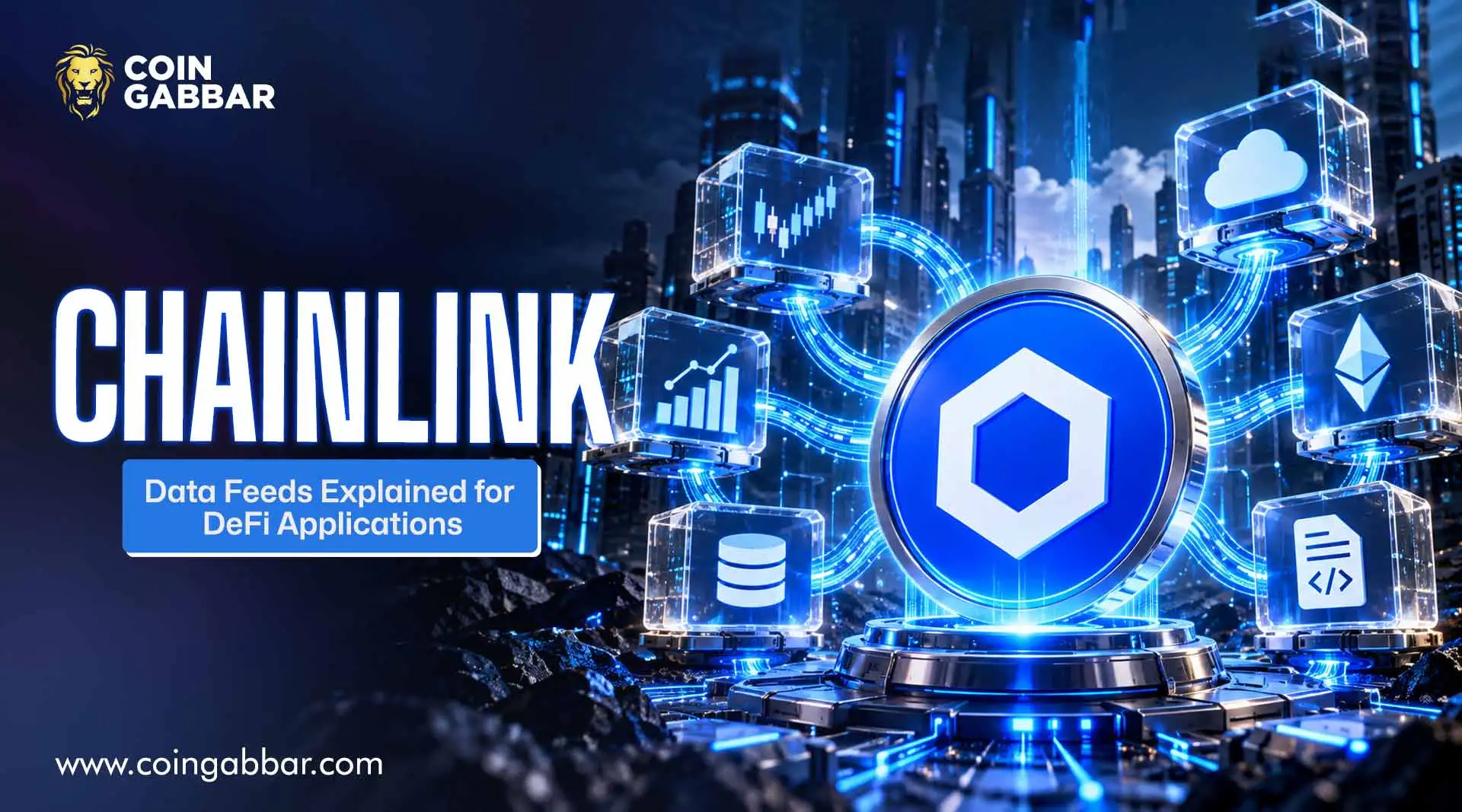
How Chainlink Data Feeds Power DeFi Applications
Smart contracts run entirely inside a blockchain. That's the point of them: no server, no middleman, no single company pulling the strings.
But it creates a problem. A lending app needs to know an asset's current price to decide when to trigger a liquidation. A blockchain, on its own, has no way to fetch that price from the outside world.
This is where Chainlink Data Feeds come in. They're one of the most widely used tools for getting real-world data, especially asset prices, onto a blockchain in a way smart contracts can read and trust.
What Are Chainlink Data Feeds?
A Data Feed is a continuously updated stream of information, most commonly an asset price, published on-chain so a smart contract can read it directly.
According to Chainlink's own documentation, Data Feeds connect smart contracts to real-world data such as asset prices, reserve balances, and other reference values. A lending protocol might use a Data Feed to check ETH's current price before approving a loan against it.
The smart contract never leaves the blockchain to get this data. It simply reads a value already delivered and stored on-chain by the oracle network.
Why Does DeFi Need Chainlink Data Feeds?
Blockchains are deliberately closed systems. They can verify transactions and run code, but they can't independently confirm what an asset is trading for on outside markets.
That's known as the oracle problem, and it's the reason the wider Chainlink oracle network exists. Without a reliable way to bring outside data in, a smart contract would have to trust a single source, or none at all.
For lending platforms, stablecoins, and derivatives protocols, this is a serious risk. If a price feed is wrong, delayed, or easy to manipulate, the entire protocol built on top of it can be exploited.
DeFi apps need data sourced from multiple places, checked for consistency, and hard for any single party to manipulate. That's the specific gap Data Feeds were built to close.
How Do Chainlink Data Feeds Work?
The process, as Chainlink's own decentralized data feeds overview describes it, involves several steps before a number ever reaches a smart contract.
Data Is Collected From Multiple Sources
Price data for a given feed is pulled from numerous data providers and trading venues, rather than a single exchange. This spreads out the risk of any one source reporting a bad or stale price.
Independent Nodes Fetch and Report the Data
A set of independent Chainlink oracle nodes each retrieve pricing data separately. No single node controls what value ultimately gets published.
The Network Aggregates the Results
The individual reports are aggregated into one value, commonly a volume-weighted average, before anything is written on-chain. This filters out outliers from any single node or source.
The Aggregated Value Is Published Onchain
Once aggregation is complete, the resulting price sits in an on-chain contract that any smart contract can query. This is the point where off-chain data becomes on-chain data.
Key Components of Chainlink Data Feeds
Chainlink's official data feeds documentation identifies a few core pieces behind a typical feed setup:
Consumer contract – the smart contract (a lending app, for instance) that reads the price data
Proxy contract – a stable contract address consumers call, which can point to an updated aggregator without breaking integrations
Aggregator contract – the on-chain contract storing the aggregated price and its update history
Oracle nodes – the independent operators fetching and reporting the raw data feeding into aggregation
This layered design means the underlying aggregator can be upgraded over time without every connected app changing its code. Node operators are compensated in LINK, and their incentives tie into the Chainlink staking model that secures the network.
How Chainlink Data Feeds Are Used in DeFi
Lending protocols use price data to value collateral in real time and trigger liquidations when that value drops too far. Stablecoins lean on it to monitor collateral ratios and time mint or burn actions. Derivatives platforms use it for pricing and settlement, since contracts often settle based on an underlying asset's price at a specific moment.
Beyond these core categories, other DeFi apps use price data to automatically trigger actions, from rebalancing a portfolio to adjusting interest rates.
Chainlink's own writeup on price feeds securing DeFi lists lending, derivatives, stablecoins, and tokenized assets among the main use cases for Data Feeds, which lines up with how widely they show up across the space.
What Types of Data Feeds Does Chainlink Offer?
Chainlink's product lineup has expanded past basic price feeds:
Feed Type | What It Provides |
Price Feeds | Real-time asset price data |
SmartData Feeds | Data tied to tokenized and real-world assets |
Rate and Volatility Feeds | Interest rate and market volatility data |
L2 Sequencer Uptime Feeds | Status data for Layer 2 sequencer availability |
SmartData Feeds, for instance, overlap with reserve-verification, a related use case explained in our Proof of Reserve explainer. Using the wrong feed, or one built for a different asset class, is a real integration mistake developers need to avoid.
How Developers Read a Chainlink Data Feed
For a smart contract to use a Data Feed, a developer generally needs to:
Identify the correct feed contract address for the asset and network
Connect to it using the AggregatorV3Interface standard Chainlink provides
Call a function like latestRoundData() to retrieve the most recent price
Handle the returned value, including its decimals and update timestamp, correctly in the contract logic
This interface has become a fairly standard pattern across DeFi protocols that integrate price data.
Benefits of Chainlink Data Feeds for DeFi
Data pulled from multiple sources rather than one exchange
Aggregation designed to reduce the impact of any single bad data point
Prices delivered directly on-chain, so contracts don't need external calls
Feeds available across multiple blockchain networks, with the cross-chain interoperability protocol helping apps keep data consistent when they span more than one chain
A widely adopted standard many DeFi teams are already familiar with
Risks and Limitations to Consider
No oracle system removes risk entirely, and Chainlink itself recommends developers evaluate the specific risks of each feed before integrating it.
Stale data risk – a feed can lag behind fast-moving markets during extreme volatility
Source concentration risk – if too few sources feed into a price, the aggregation benefit shrinks
Feed selection risk – using the wrong feed for an asset or network can produce inaccurate results
Network-specific risk – conditions vary by blockchain, and Layer 2 deployments need sequencer status considered too
Integration risk – incorrect handling of decimals, timestamps, or heartbeat intervals can cause real errors
None of this means Data Feeds are unreliable. It means the responsibility for careful integration sits with the developer using them, not just the oracle network itself.
Chainlink Data Feeds vs Traditional Oracles
Feature | Chainlink Data Feeds | Centralized Oracle |
Data sources | Multiple providers | Often one or few |
Aggregation | Decentralized process | Typically centralized |
Single point of failure | Reduced | Higher |
On-chain delivery | Yes | Varies by provider |
DeFi adoption | Extensive | Depends on provider |
Conclusion
Chainlink Data Feeds exist to solve a basic but critical problem: blockchains can't natively see outside data, and DeFi apps depend on accurate prices to function safely.
By pulling data from multiple sources, aggregating it through an oracle network, and publishing the result on-chain, Data Feeds give lending platforms, stablecoins, and derivatives protocols a way to price assets without relying on a single point of trust.
Disclaimer: This article is for informational purposes only and does not constitute financial or investment advice. Crypto markets and DeFi protocols carry risk, and readers should verify details through official sources before making decisions.