CIFORUS Token Explained: Utility, Tokenomics, and Presale Guide

What Makes the CIFORUS Token Different From Other Presale Tokens?
Most presale tokens start with a promise. The CIFORUS Token starts with an app. Ciforus is a privacy platform for encrypted email, wallet messaging, and storage, and the token acts as its economic layer.
So what does the token actually do? This guide covers CIFORUS utility, tokenomics, presale stages and the burn model, using data from the project's official CIFORUS token page and whitepaper.
What Is CIFORUS Token?
The Token is an ERC-20 utility token on Ethereum Mainnet. ERC-20 is Ethereum's common standard for tokens that work with wallets and apps. Total supply is fixed at 100,000,000 tokens, and the project says no new tokens can be minted.
The official page describes CIFORUS crypto as the economic layer of the platform. The token coordinates discounts, access, and rewards.
The whitepaper says the token is not mandatory for paid plans. Users can also pay with USDT, USDC, ETH, or BNB.
How Does the CIFORUS Ecosystem Work?
The Ciforus crypto project packs several privacy tools into one account:
Encrypted email and wallet-based messaging
Encrypted storage and private notes
Wallet identity verification
PayLinks, which create crypto payment request pages
A security center with two-factor login
The official page showed about 199,800 private transfers and 2,900 registered users on October 7, 2026.
Ciforus Platform and CIFORUS Token Connection
The platform already runs on Free, Pro and Elite tiers. The Token plugs into that structure for upgrades and discounts.
Why Does the Ecosystem Need a Native Token?
The project argues stablecoins alone cannot reward long-term users or tie usage to supply reduction. That only works if people use the app.
CIFORUS Token Utility and Use Cases
CIFORUS utility is tied to the app. Some are live, and some are planned.
CIFORUS for In-App Payments
The project says paying with CIFORUS Token is meant to earn an extra 20% discount against standard crypto checkout pricing once fully active.
CIFORUS for Tier Upgrades
The CIFORUS Token is designed to help activate Free, Pro and Elite access. Staking can also support tier benefits.
CIFORUS for Staking and Rewards
Staking is live in the app's Token dashboard and is voluntary. More on that below.
Future CIFORUS Utility
Planned areas include storage expansion, messaging, and identity modules. These are plans, not live features.
CIFORUS Tokenomics and Supply
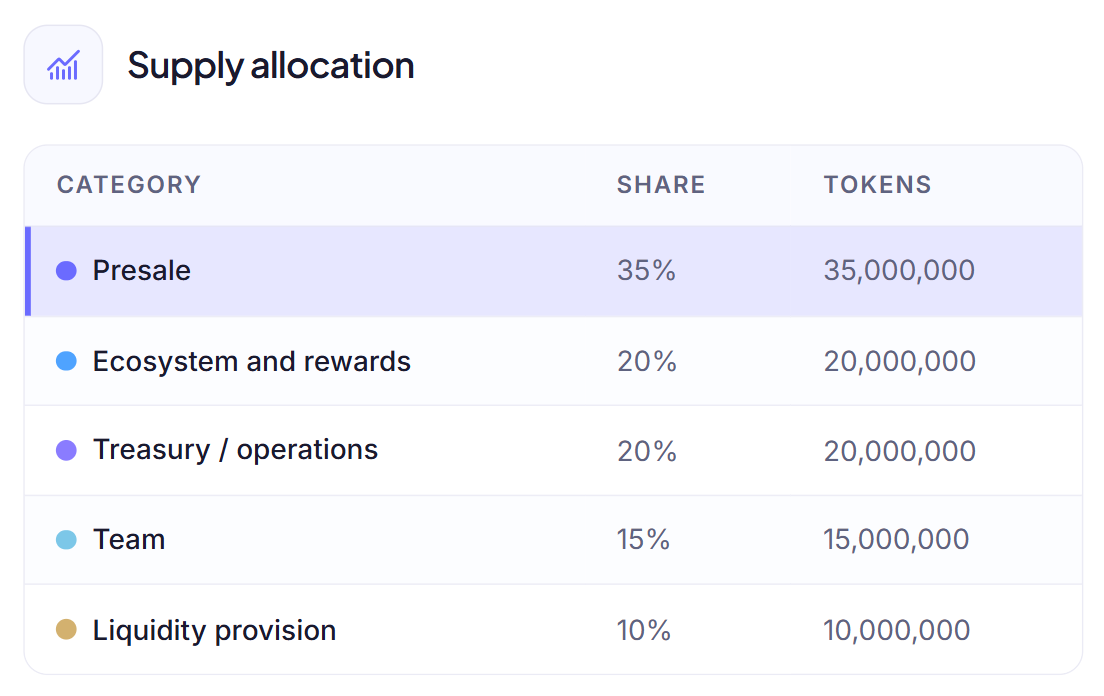
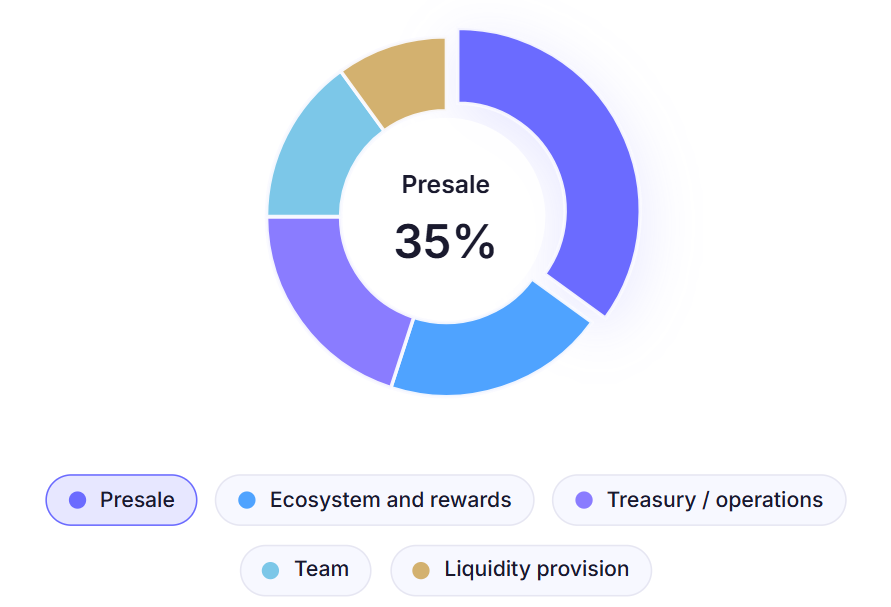
Total supply is 100,000,000 CIFORUS, split like this:
Allocation | Percentage | Tokens |
Presale | 35% | 35,000,000 |
Ecosystem and Rewards | 20% | 20,000,000 |
Treasury and Operations | 20% | 20,000,000 |
Team | 15% | 15,000,000 |
Liquidity | 10% | 10,000,000 |
These figures match the project's published whitepaper and token page.
Is the CIFORUS Token Supply Fixed?
According to the listed contract details, yes. There is no minting and no inflation. Supply can only shrink through the burns described later.
CIFORUS Token Allocation Explained
The presale holds the biggest slice of the Token supply at 35%. Treasury covers development and audits. The ecosystem pool releases over roughly three to four years.
CIFORUS Team Vesting and Unlocks
Token vesting is the schedule that controls when tokens become available. Under the token vesting schedule, team tokens have a six-month cliff, with nothing unlocked at TGE, then a linear release over 24 months.
That works out to roughly 625,000 tokens a month. TGE is the token generation event, when trading is planned to begin.
CIFORUS Liquidity Allocation
Ten million tokens are reserved for DEX liquidity at TGE, with a planned lock. The whitepaper says a centralized exchange listing is not guaranteed.
CIFORUS Presale: Stages and Prices
Stage | Allocation | Price | Max Raise | Implied FDV |
Stage 1 (Seed) | 8,000,000 | $0.025 | $200,000 | $2.5M |
Stage 2 (Growth) | 15,000,000 | $0.035 | $525,000 | $3.5M |
Stage 3 (Final) | 12,000,000 | $0.05 | $600,000 | $5.0M |
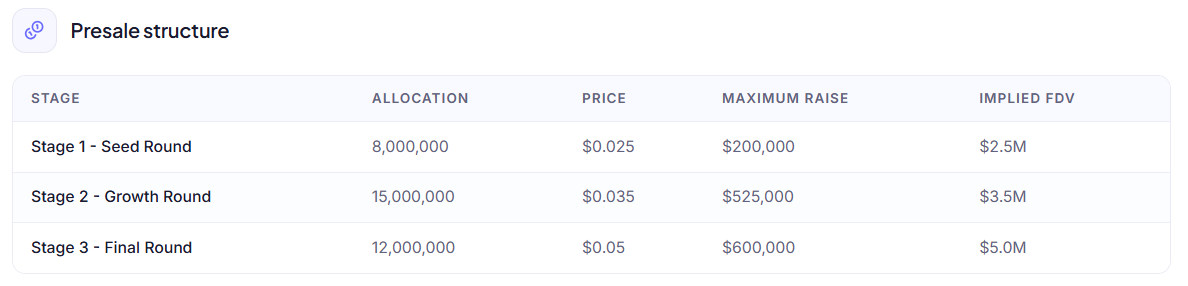
The stages add up to a $1,325,000 maximum raise. FDV means fully diluted valuation, which is price times total supply. Market cap counts only circulating tokens, so the two differ.
CIFORUS Presale Price
Stage 1 was live at $0.025, with about 7.6 million tokens sold, roughly 95.1% of that stage. The project lists a planned TGE reference of $0.10, which implies a $10 million FDV.
It calls this a strategic reference, not a promised listing, price, or return. A presale price is never a future market price, and any token price predictions remain opinions.
CIFORUS Presale Stages
Prices rise by stage, and each stage has its own cap.
Is There a Buyer Vesting Period?
No. The project states there is no mandatory presale vesting. Buyers can keep tokens, stake them, or claim them to their own wallet with no Ciforus claim fee. A claim is final for that amount.
CIFORUS Deflation and Burn Mechanism
A token burn permanently removes tokens by sending them to an address nobody controls. Knowing how token burns work separates real supply reduction from marketing noise.
How Does the CIFORUS Burn Mechanism Work?
Under the current model, eligible usage paid in CIFORUS splits three ways: 40% burned, 40% to treasury, and 20% to liquidity support. Burns run weekly through transfers to a dead wallet. The contract has no special burn function, which keeps it simpler to audit.
If 1,000,000 CIFORUS are spent, 400,000 are burned.
What Happens When CIFORUS Tokens Are Burned?
They are gone for good, and the transfers are visible on-chain.
Can Token Burns Affect CIFORUS Supply?
Only if people spend CIFORUS tokens in the app. Low usage means small burns. The whitepaper itself says deflation does not guarantee price appreciation.
CIFORUS Staking and Rewards
How Does CIFORUS Staking Work?
Staking happens inside the Token dashboard, which shows a live position and earned amount. Thresholds, lock rules, and APR were not published in the materials reviewed.
What Rewards Can CIFORUS Holders Receive?
The ecosystem allocation holds 20,000,000 tokens, including a 2,000,000 early incentive reserve. The project favors upgrade credits over liquid emissions.
Is CIFORUS Staking Mandatory?
No. Eligible tokens can stay in Ciforus for staking or move to an external wallet.
CIFORUS Token Contract and Ethereum Network
What Blockchain Is CIFORUS On?
The CIFORUS Token runs on Ethereum Mainnet as an ERC-20 token with 18 decimals. The contract address is 0x2D125Cba88516832AE1CDc1d39211fC259182c60.
How to Verify the CIFORUS Contract
The official page links to the public explorer, where the code is verified. Common checks include matching the address, confirming the 100,000,000 supply, and reading the contract functions.
CIFORUS Token Supply on Ethereum
The Token specs show no minting, no inflation, no transfer tax, no pause function, and no upgrades. The project links an audit report, but an audit is not a guarantee of safety.
CIFORUS Roadmap and Future Utility
The project's official roadmap section lists six phases. Five matter most today for the Token.
Phase 1: Foundation
Q4 2024 and 2025: architecture and token framework.
Phase 2: Product Build
Q1 2026: main build and token deployment.
Phase 3: Public Launch and Presale
Q2 2026: launch, presale, and early utility. PayLinks and wallet verification are marked done.
Phase 4: Growth and Optimization
Q3 2026: messaging, storage, and email upgrades.
Phase 5: Expansion and Integrations
Q4 2026: partnerships, PayLinks growth, and liquidity expansion. Exchange listing efforts are plans, not confirmed events.
Future utility stays separate from live features. Planned areas include storage, messaging, and identity, while 2027 items mention governance exploration and multi-chain support.
CIFORUS Token Risks to Consider
Presale risk: early projects can fail.
Adoption risk: demand depends on app usage.
Liquidity risk: thin markets make exits hard.
Execution risk: roadmap items may slip.
Market and regulatory risk: prices swing and rules change.
Is CIFORUS a Risky Investment?
Any crypto presale carries high risk, and returns are never guaranteed. Nothing here is financial advice.
What Should Buyers Check Before Buying CIFORUS?
Common checks include the official domain, contract address, audit report and claim rules.
Is CIFORUS Worth Watching?
The project offers a working app, a deployed token, a fixed supply, a staged presale, and a usage-linked burn. The risks are real too. Whether CIFORUS is a good crypto project depends on evidence that appears over time.
Conclusion
The CIFORUS Token connects a live privacy app to an ERC-20 economy, and that link is what stands out. Fixed supply, no presale lock and usage-linked burns stand out.
Adoption, liquidity and execution remain unproven. Its future will depend mainly on platform growth, real token usage, liquidity and ecosystem expansion.
Disclaimer: This article is for information only and is not financial, legal or tax advice. Crypto presales carry high risk, including total loss. Details can change, so check official project pages before any decision.









.webp)




