CLARITY Act Revival: Why America's Crypto Bill Hit a Major Senate Wall

CLARITY Act Revival: Why Did America's Crypto Bill Stall After 49–50?
The odds of a quick comeback for America’s biggest crypto market structure bill have shrunk.
Patrick Witt, who served as executive director of the President’s Council of Advisers for Digital Assets until last month, told an audience at Solana’s Breakpoint conference in London that a CLARITY Act Revival in the near term is unlikely.
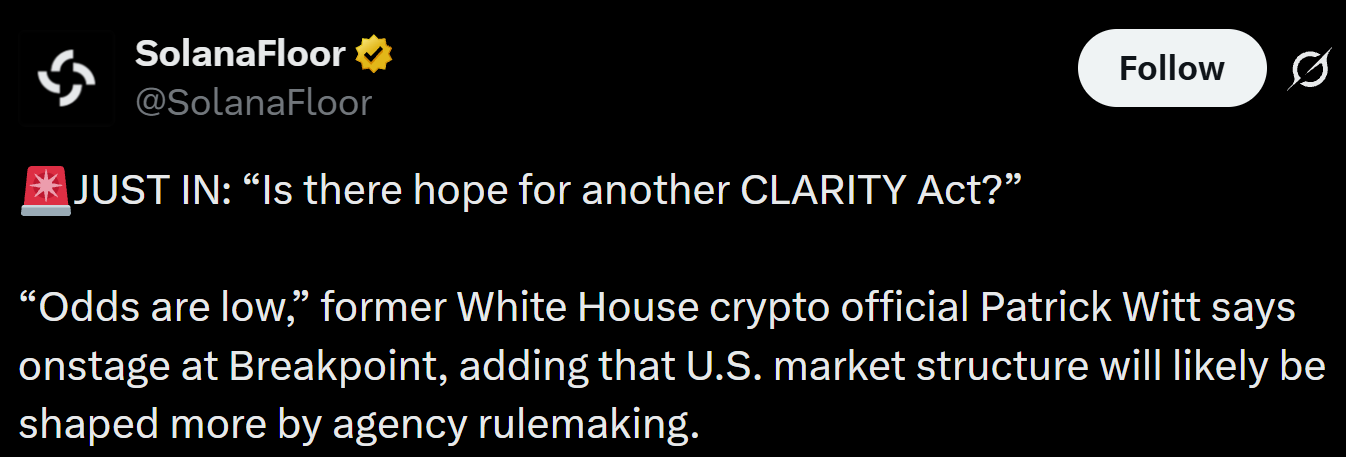
Source: SolanaFloor Post
In his view, the effort failed because time ran out, not because the policy was bad. Here is a clear, step-by-step look at what happened, backed by official records.
What the CLARITY Act Was Built to Do
The legislation is formally titled the Digital Asset Market Clarity Act of 2025 and carries the number H.R. 3633.
According to the Congressional Research Service summary, it creates a regulatory framework for “digital commodities,” meaning digital assets that rely on a blockchain for their value.
Key elements include:
The CFTC would generally oversee digital commodity transactions, including exchanges, brokers and dealers.
A digital commodity qualifies for trading if its blockchain is mature or decentralized, or if its issuer files certain reports.
Certain digital commodities on mature blockchains would be exempt from SEC registration if annual sales stay under set limits.
Exchanges, brokers and dealers would follow the Bank Secrecy Act for anti-money laundering purposes.
Timeline: From House Passage to a Stalled Floor Vote
The table below follows the bill through official records. The House result is also printed in the Congressional Record, which lists 294 yeas, 134 nays, and 4 not voting.
Date | Milestone | Official record |
May 29, 2025 | Introduced in the House | |
July 17, 2025 | House passes it, 294 to 134 | |
Sept. 18, 2025 | Referred to the Banking Committee | |
May 14, 2026 | Committee advances it, 15 to 9 | |
Sept. 15, 2026 | Cloture vote fails, 49 to 50 |
Inside the 49–50 Tally
The vote on September 15, 2026 was not a final yes-or-no on the bill.
According to the official roll call, the question was cloture on the motion to proceed, which needed three-fifths support, or 60 members. Supporters fell 11 short.
In plain terms, cloture is the procedural step that lets lawmakers begin formal consideration of a measure.
Without it, the measure never reaches the stage where amendments and a final decision happen.
The breakdown:
All 49 “yea” votes came from Republicans.
Four Republicans, Collins, Hawley, Moran and Tillis, voted “nay,” joining 46 Democrats and independents.
One member, Coons, did not vote.
The daily floor log records that Tillis then moved to reconsider the vote, a procedural step that keeps the question technically open.
Banking Committee Chairman Tim Scott blamed Democrats in an official statement, saying nearly all Republicans backed advancing the bill.
The official vote list shows no later roll call on it at the time of writing.
Why Witt Sees Little Chance for a CLARITY Act Revival
Witt called the outcome a failure of American leadership. He said the effort “lost against the clock” and argued that most policy differences had been settled.
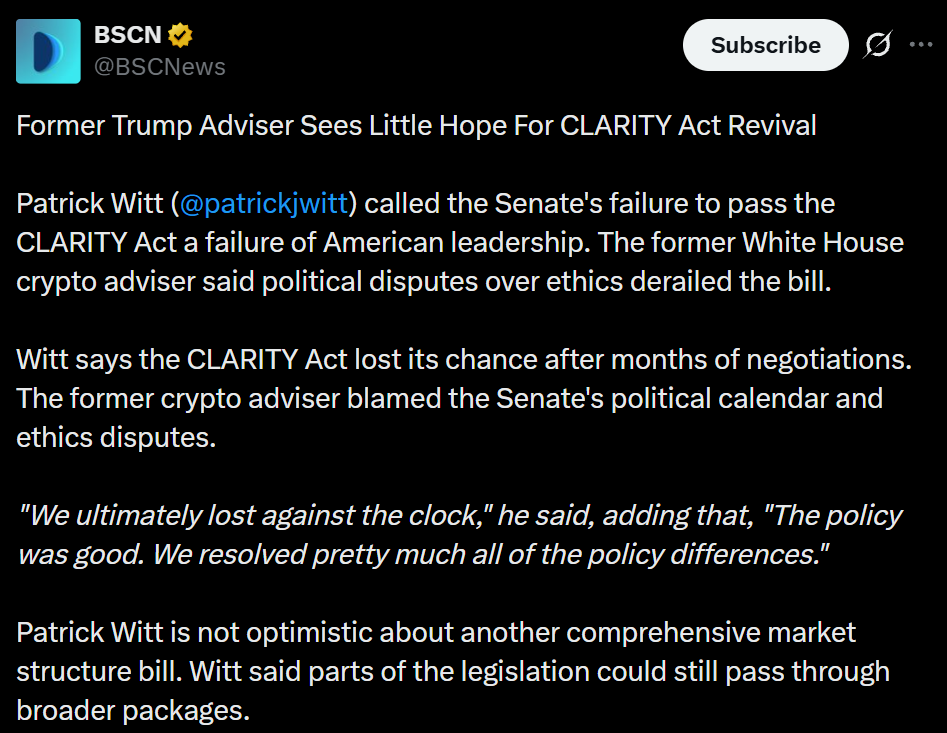
Source: BSCNews Post
The main obstacle, in his words, was the political fight over ethics as the midterm elections approached, even after President Trump agreed to two ethics provisions covering crypto holdings.
He described the second provision as one that would have barred federal officials, including the president, from issuing or sponsoring digital assets, required certain divestments or a blind trust, and allowed state attorneys general to enforce violations.
He also compared the situation to the GENIUS stablecoin law, which recovered after an early procedural setback because it moved early in the president’s term.
This time, he said, supporters knew they had one shot. Looking ahead, he rated the chances of another comprehensive bill as low.
What Could Happen Next
Witt expects U.S. crypto rules to be shaped more by agency rulemaking than by lawmakers.
He pointed to the SEC and CFTC, which he said already hold ample authority.
Two other paths remain open:
Smaller packages: pieces of the legislation could ride along in broader measures.
Targeted powers: lawmakers could still give the CFTC authority over spot crypto markets.
He said he is not bearish on the industry overall, because regulators and the president remain in place.
Any CLARITY Act Revival would also face a tight calendar, since the current session of Congress ends in early January 2027.
Conclusion
H.R. 3633 cleared the House by a wide margin and the Banking Committee by a bipartisan vote, yet it stalled on a 60-vote hurdle in the upper chamber.
Official records show a clean, party-heavy tally and no later roll call. For now, a CLARITY Act Revival depends on a narrow lame-duck window, while regulators carry on with their own rulemaking.
Disclaimer
This article is for educational and informational purposes only and is not financial or investment advice. Crypto assets are high risk, their prices can be very volatile, and you can lose some or all of your money. Always do your own research and consider speaking with a licensed financial advisor before making investment decisions.






