Coinbase News Today: Final US Trust Charter Changes Crypto Custody


Coinbase News Today: What Federal Trust Approval Means for Crypto
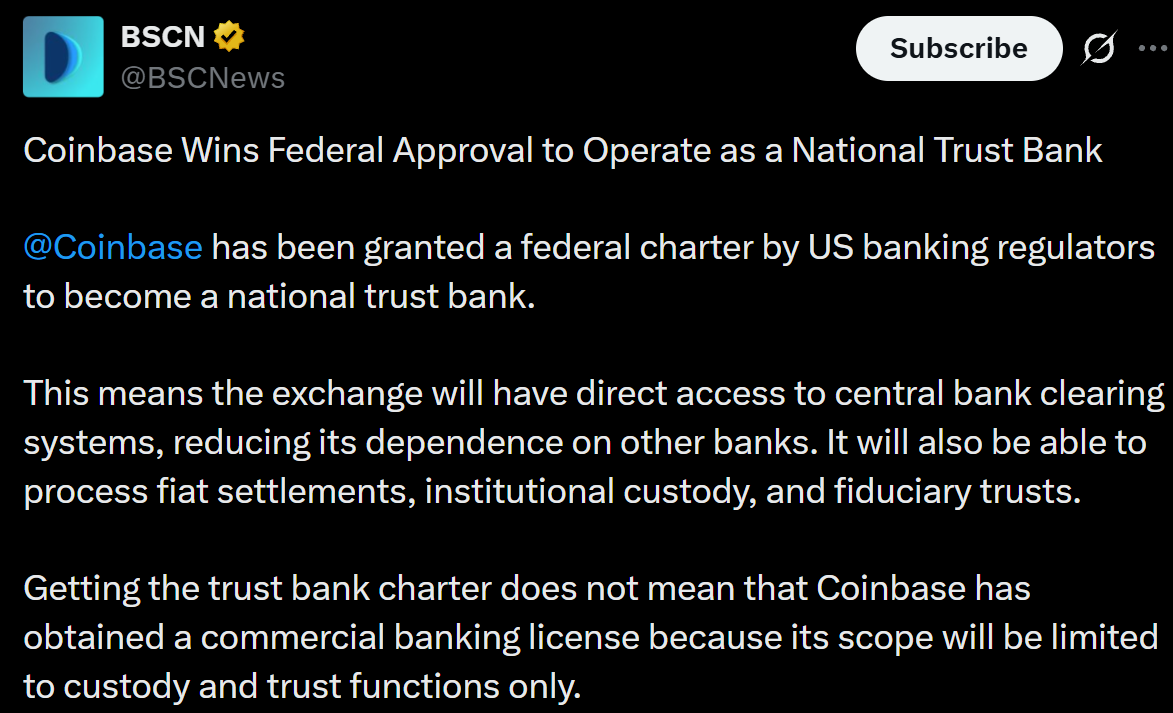
Here is the latest coinbase news today: a top US bank regulator has given its final yes to a new federally supervised company that will hold crypto for clients.
The step moves a large part of the exchange’s custody business under federal rules.
Source: BSCNews on X
Below, we explain what happened, what the new setup can and cannot do, and why it matters, in plain language.
What Happened: The Regulator Gives Its Final Yes
The Office of the Comptroller of the Currency (OCC), the main federal regulator for national banks, has granted final approval to charter Coinbase National Trust Company (CNTC).
The exchange shared the update in its official post on 9 November 2026.
The OCC’s public record shows the charter took effect on 6 November. In simple words, a new company supervised by the US government can now look after digital assets for clients. It replaces an earlier, conditional go-ahead with a full one.
The Road to Approval: About a Year of Steps
This did not happen overnight. The application was filed in October 2025.
On 2 April 2026, the OCC issued a preliminary decision, known as Corporate Decision 1370, which listed conditions to meet before opening.
Once those were cleared, the final sign-off followed. This long timeline is a big reason why today’s coinbase news today story is getting so much attention.
| Date | Milestone |
| October 2025 | Application filed with the OCC |
| 2 April 2026 | Preliminary approval issued (Decision 1370) |
| 6 November 2026 | Charter effective, per OCC records |
| 9 November 2026 | Final approval announced |
What the New Trust Bank Can and Cannot Do
The charter is narrow on purpose. It is built for safekeeping, not everyday banking.
According to the OCC’s decision letter, CNTC can:
-
Accept, hold and move both digital assets and regular money (fiat currency) inside customer custody accounts
-
Act as a fiduciary, meaning it has a legal duty to handle client assets with care and in the client’s interest
-
Serve mainly institutional clients, such as funds and large firms
It cannot:
-
Take deposits or make loans like a high-street bank
-
Practice fractional reserve banking, which means lending out customer money. The firm has said it will not do this
-
Offer insured bank accounts, because this is a non-insured trust bank
The letter also sets safety cushions for the first three years. These include at least $60 million in core capital, plus enough easy-to-sell assets to cover 180 days of running costs.
Why Federal Supervision Matters for Clients
Until now, the custody business has been shaped by New York state oversight, including a limited-purpose trust charter granted in 2018.
A federal charter puts it under one national regulator and one set of standards. For anyone following coinbase news today, that consistency is the main point.
Large institutions often prefer custodians that are supervised in a familiar, bank-like way.
Here is what this could mean in practice:
-
One national rulebook instead of a mix of state rules
-
Oversight that big clients already know from traditional finance
-
A clearer base for new services later
Joining Ripple and Circle: A Wider Industry Shift
CNTC is not alone. Circle received its final OCC approval in July 2026, and Ripple followed in October 2026.
Other crypto firms are still at the conditional stage. Together, these decisions show a clear trend: crypto firms are no longer only partnering with banks, they are becoming federally chartered institutions themselves.
What comes next? The immediate focus is custody. The exchange has said a federal charter could later open the door to payments and related services.
Conclusion
In short, this Coinbase news today update is about rules and trust, not about turning an exchange into a regular bank.
The new entity can safeguard assets under federal supervision, while deposits and lending stay off the table. Watch for how client custody moves to the new entity and for any future product news.
Disclaimer
This article is for educational and informational purposes only and is not financial or investment advice. Crypto assets are high risk, their prices can be very volatile, and you can lose some or all of your money. Always do your own research and consider speaking with a licensed financial advisor before making investment decisions.






