CoinDCX Plotline Data Breach: Names, Emails, and Bank Names Exposed

Key Takeaways
In a mail sent to users, CoinDCX says an unauthorized party accessed user data held by its vendor Plotline, including names, email addresses, and linked bank names.
The exchange says its trading platform, wallets, and customer funds were not affected.
Phishing messages are the main risk, so users should avoid clicking links or sharing OTPs.
The CoinDCX Plotline Data Breach exposed customer names, email addresses, and the names of linked banks, but CoinDCX says customer funds, wallets, and trading systems were not touched.
According to a user sharing the update on X, the exchange told users on November 17, 2026, that an unauthorized party accessed data held by Plotline, a third-party tool used to send in-app messages and notifications.
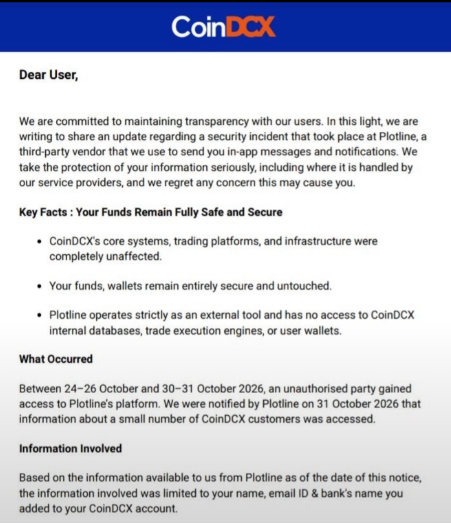
Bank account numbers were not listed among the exposed fields, and CoinDCX described the affected group as a small number of customers without sharing an exact count.
What Did the CoinDCX Plotline Data Breach Expose?
According to the customer notice, unauthorized access to Plotline happened in two windows, from October 24 to 26 and from October 30 to 31, 2026.
Plotline informed CoinDCX about the incident on October 31, and the exchange says it worked with the vendor to confirm that the issue was fully contained.
The notice also states that Plotline has no access to CoinDCX internal databases, trade execution systems, or user wallets, which is why the exposure is limited to vendor-held data.
Is My Crypto Safe After the CoinDCX Data Breach?
CoinDCX says customer funds, trading platforms, and wallets were unaffected, and users can keep using the app as usual. Still, names, emails, and bank names are enough for scammers to write a believable message that pretends to come from the exchange.
How to Protect Your Crypto Account From Phishing Scams
Treat any email, SMS, or call that mentions CoinDCX, your bank, or your KYC details with caution, and never share your OTP, password, or seed phrase with anyone.
Open the exchange only through the official app or website instead of tapping links inside messages. Turn on two-factor authentication, review your recent login activity, and change your password if anything looks unfamiliar.
If you lose money to a scam, you can file a report on the National Cyber Crime Reporting Portal, and security incidents can also be reported to CERT-In.
Earlier CoinDCX Security Incidents Explained
This is not the first security issue the exchange has faced in the past two years, and the earlier cases involved different systems. On July 19, 2025, attackers compromised an internal operational account used for liquidity provisioning, and CoinDCX said it would cover the loss of about $44.2 million from its own treasury.
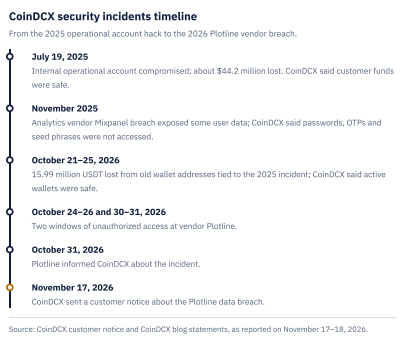
In November 2025, the exchange said some user data was exposed through a breach at its analytics vendor Mixpanel, and it stated that passwords, OTPs, seed phrases, and critical KYC data were not accessed.
In October 2026, CoinDCX confirmed a loss of 15.99 million USDT tied to old wallet addresses from the July 2025 incident, and it said its active wallets and customer assets stayed safe.
Why Third-Party Vendor Risk Matters for Crypto Exchanges
Crypto exchanges depend on outside tools for messaging, analytics, and customer support, so a weakness at one vendor can expose user details even when the exchange itself is not hacked.
Users can lower their own risk by using a unique password for every exchange, keeping only the funds they need for trading on the platform, and moving long-term holdings to a wallet they control.
Source status: This report is based on CoinDCX’s customer notice as shared by users and publications on November 17 and 18, 2026.
YMYL Disclaimer: This article is for information only and is not financial or investment advice. Crypto assets are volatile and carry a risk of loss, so always verify details with official sources.






