Autheo Network: Building the Digital Backbone of Web3 Infrastructure

Autheo Network: Inside the THEO Token and Ecosystem
Web3 Infrastructure refers to the underlying technology that allows decentralized applications, blockchain networks, digital identities, smart contracts, and other Web3 solutions to operate. Within this concept, a Layer-0 operating system acts as a foundational coordination layer that helps different blockchain networks, applications, and services communicate and work together. It can be compared to the basic operating environment that organizes and connects different components of a Web3 ecosystem.
On top of this foundation, a Layer-1 blockchain provides the core blockchain network where transactions are processed, smart contracts are executed, and data is recorded securely and transparently.
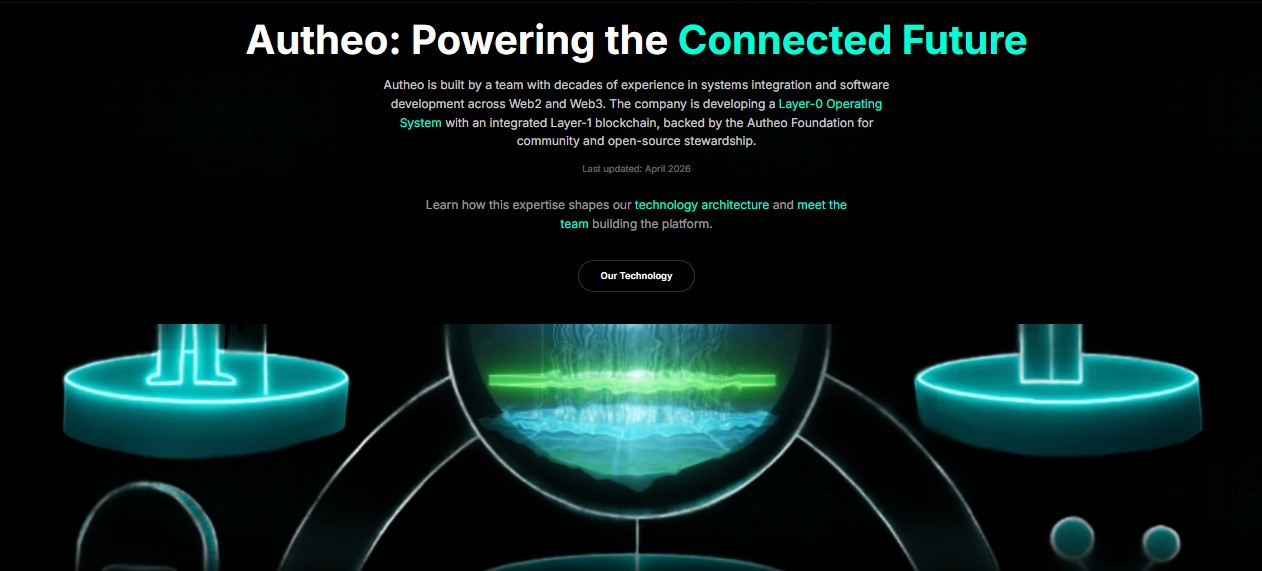
Autheo combines these three concepts by positioning itself as a Layer-0 operating system with an integrated Layer-1 blockchain, creating a unified infrastructure for Web3 applications and services. The project has evolved from an initial vision in 2020 to testnet development in 2024 and further network and product development in 2025. According to Autheo's official website, its ecosystem has already recorded more than 1 million wallets, 350,000 smart contracts, and 5 million transactions.
What Is Autheo Network?
Autheo Network is a blockchain infrastructure focused on solving one of the biggest challenges. According to Autheo, the platform is built for the Layer-0 Operating System with an Integrated Layer-1 Blockchain. Its ecosystem combines blockchain infrastructure with identity, decentralized computing, storage, developer tools, and AI capabilities.
Its architecture includes Decentralized Compute Cloud (DCC) for computing workloads, TheoID for identity and authentication, ABW34 for decentralized storage, and THEO AI for AI inference.
Autheo's mainnet is already live, with staking and transaction-fee functionality available. Other services, including compute, storage, AI inference, and identity capabilities, are being introduced in phases.
Key Features That Define Autheo
-
Layer-0 and Layer-1 Infrastructure: The network combines a Layer-0 coordination layer with an integrated Layer-1 blockchain, creating a foundation for applications and interconnected networks.
-
Decentralized computing: Decentralized computing is designed to provide computing resources for applications, smart contracts, and AI-related workloads.
-
Sovereign Digital Identity: TheoID is designed for identity, authentication, and digital-asset ownership within the Atheo ecosystem.
-
Decentralized Storage: ABW34 provides the storage layer for persistent data and decentralized applications.
THEO Token Utility: How the Token Powers Autheo
THEO is the utility token of the Autheo Network. It is designed to power multiple activities across the ecosystem:
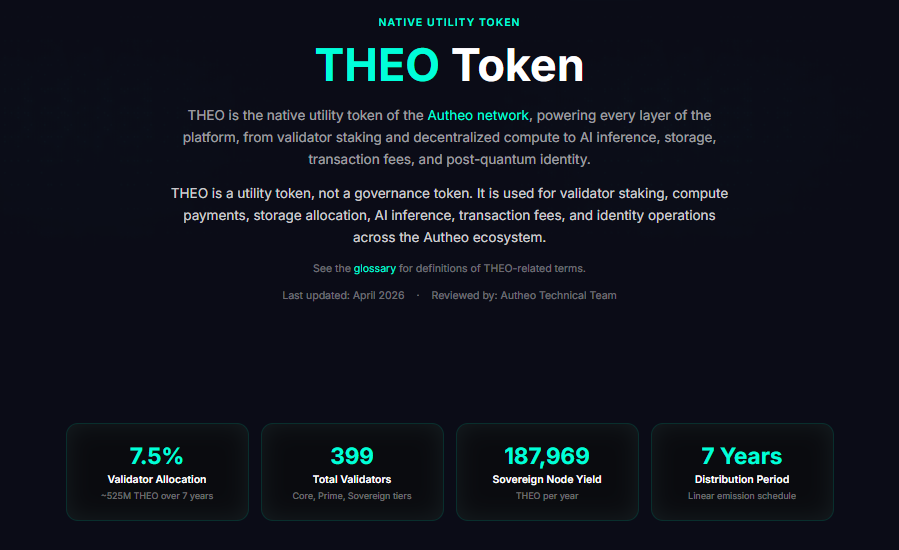
The major utility areas are:
Validator staking – THEO is used to participate in network validation.
Transaction fees – Users pay network fees in THEO.
Compute payments – THEO can be used to access decentralized computing resources.
Storage payments – THEO is designed to pay for decentralized storage.
AI inference – AI inference services can use THEO for payment.
Identity operations – THEO is also planned for identity-related operations through TheoID.
Autheo Tokenomics
According to Autheo’s Documentation, the maximum supply is 7 billion Theo. The allocation documentation divides the supply across the ecosystem:
| Allocation | Percentage |
| Ecosystem | 20% |
| Validator Nodes | 7.5% |
| Infrastructure Nodes | 15% |
| DevHub Economy Rewards | 7.5% |
| Liquidity | 5% |
| Reserve and Treasury | 6.5% |
| Launch Legends | 2% |
| Protocol Innovation and IP Funds | 2% |
| Advisory | 2% |
| Airdrop | 2% |
| Strategic Operations | 10% |
| Team | 17% |
| Early Seed Investment | 2% |
| Early Investors and Team Unlock | 1% |
| Presale and Launch Related | 0.5%
|
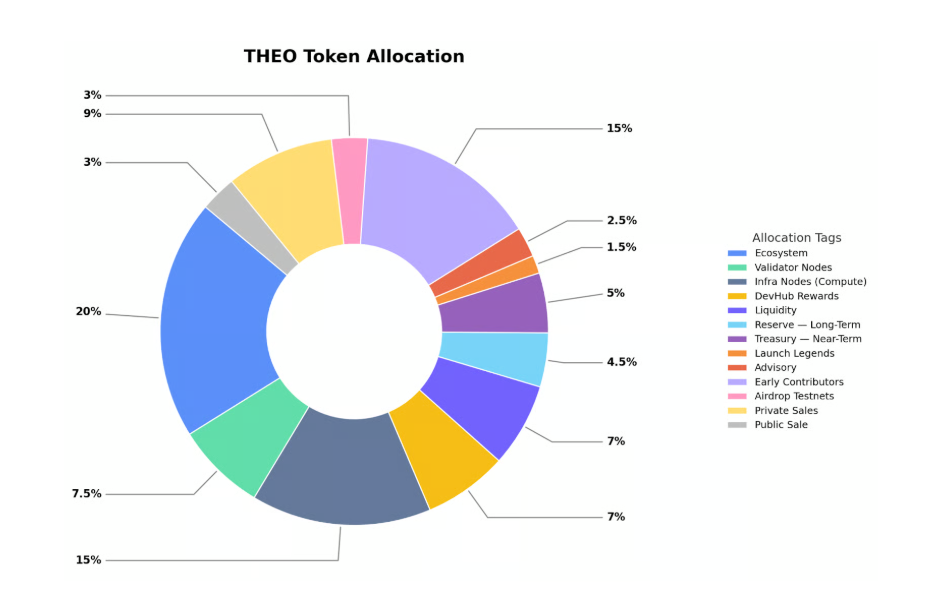
Autheo's Tokenomics says token releases are structured through cliffs and linear vesting to reduce sudden increases in circulating supply. It also states that 7.5% of the total supply, or 525 million THEO, is allocated to validator nodes, with the validator allocation released over seven years.
Autheo Roadmap: From Vision to the Network
Autheo's development journey began with the vision of creating an integrated Web3 network. Its official timeline highlights several major stages:
Phase 1 — Building the Foundation
The first phase established DevHub, core APIs, secure sandbox environments, and the initial quantum-ready virtual machine.
Phase 2 — Expanding Utility
The next stage focuses on appchain deployment, predictive AI analytics, expanded DeFi modules, beta programs, and stronger interoperability.
Phase 3 — Growing the Ecosystem
This phase expands modular features, compliance tools, cross-chain communication, and third-party developer participation.
Phase 4 — Commercial Expansionment tools, and THEO AI for AI-enabled workflows. The idea is that these services can work together rather than operating as completely separate infrastructure layers.
The project emphasizes
The final phase targets enterprise-scale deployment, white-label solutions, sector-specific modules, advanced security infrastructure, and deeper industry partnerships.
What Makes Autheo Interesting?
Autheo stands out because it takes a full-stack approach to Web3 infrastructure. Many blockchain networks primarily focus on core functions such as transaction processing, consensus, and smart-contract execution. Developers then often need to connect additional services for identity, storage, computing, AI, and other infrastructure requirements. It aims to reduce this fragmentation by bringing these capabilities together into a single coordinated Layer-0 operating system with an integrated Layer-1 blockchain.
The Autheo stack is designed around several interconnected components, including TheoID for digital identity, DCC for decentralized computing, ABW34 for storage, DevHub for post-quantum security, developing tooling, and enterprise-oriented infrastructure, making security and interoperability central themes of its architecture.
Conclusion
Autheo aims to provide a unified infrastructure layer for the next generation of Web3 and AI applications. Its combination of Layer-0 coordination, Layer-1 execution, decentralized compute, storage, identity, and AI gives the network a broader scope than that of a conventional blockchain. The THEO token connects these services through staking, transaction fees, compute, storage, AI inference, and identity operations. With mainnet already live, Autheo's next stage centers on expanding network utility, developer adoption, and commercial-scale ecosystem growth.
Disclaimer
This article is intended for informational purposes only and should not be treated as financial, investment, or legal advice. Cryptocurrency projects involve risks, including market volatility, technical issues, regulatory changes, and shifts in tokenomics or development plans. Autheo's documentation also states that certain token allocation and emission figures are current estimates and may change. Always verify the latest information through Autheo's official website and documentation before making any investment or participation decision.
Also read:







.webp)