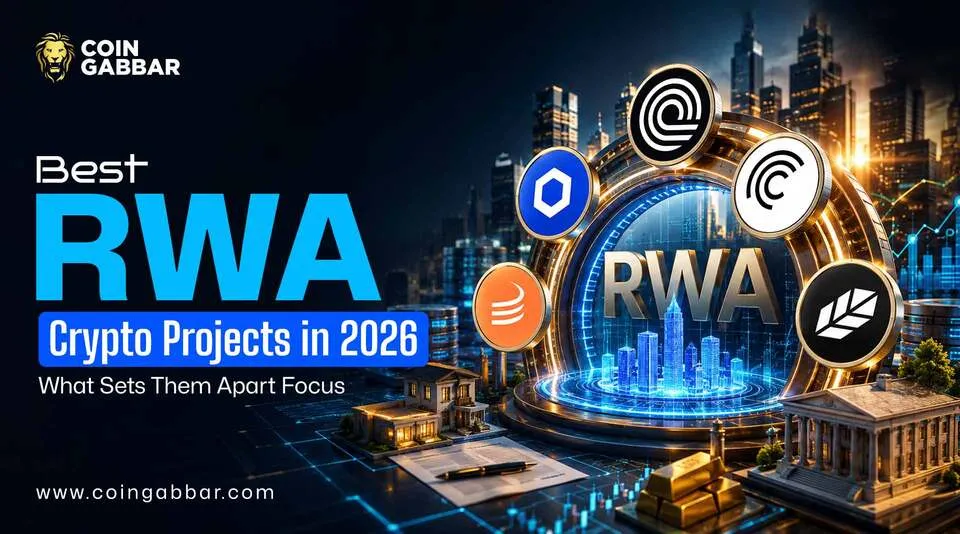
Best RWA Crypto Projects in 2026: What Sets Them Apart Focus

Real-world assets are no longer just focused on the concept of placing existing assets on the blockchain.
The true benefit lies in what comes next: assets becoming more easily transferable, compatible with DeFi protocols, distributable worldwide, and able to interact with programmable financial infrastructure.
That shift changes how investors should assess the best RWA crypto projects. The importance of the project is not necessarily defined by its representation of the largest asset class or having the most prominent token.
The part it plays within the RWA ecosystem, the services it delivers, the assets it manages, and the infrastructure it is surrounded with may be equally important.
This guide compares five RWA-focused crypto projects—five of the more established RWA crypto picks for 2026—Ondo Finance, Chainlink, Centrifuge, Maple Finance, and Plume.
What Are RWA Crypto Projects?
RWA crypto projects bring assets or financial activities from traditional markets onto blockchain networks.
These could be Treasury bonds of the United States, stocks, funds, private credit, loans, commodities, and others.
The token itself is basically a digital representation of an underlying economic exposure.
Nevertheless, the blockchain token is not the whole story.
Ownership, custody, redemption, data, compliance, and distribution can make or break the usefulness of the token outside of trading.
This is why the best RWA crypto projects can look very different from one another.
One may issue tokenized securities, while another provides the oracle infrastructure needed to price those assets or move them between networks.
How Does RWA Tokenization Create Utility?
Tokenization usually starts with an issuer establishing a legal and custody structure for an underlying asset.
Tokens can then be issued on a blockchain to represent ownership, exposure, or a claim connected to that asset.
The real advantage comes when the token can interact with blockchain-based applications.
A tokenized Treasury product, for example, may be transferable, integrated with wallets, or used within eligible DeFi applications.
The model still depends on traditional financial infrastructure.
A blockchain does not automatically eliminate custody, credit, legal, or counterparty risk.
Investors therefore need to examine both the onchain technology and the offchain structure supporting the asset.
What Makes the Best RWA Crypto Projects Different?
The most effective physical asset cryptos usually address a particular issue associated with the tokenization process itself instead of adding tokens to already existent financial assets.
A comprehensive assessment tool will contain the following:
Asset focus: What real-world assets or financial products are involved?
Utility: What can users actually do with the token or network?
Institutional access: Are regulated institutions, asset managers, or financial platforms involved?
Infrastructure: Does the project provide issuance, credit, data, settlement, or distribution?
Liquidity: Can eligible users buy, sell, redeem, or deploy the asset efficiently?
Risk structure: What custody, regulatory, credit, smart-contract, and counterparty risks remain?
This framework is more useful than simply asking which token has the highest price or market capitalization.
Why Is Ondo Finance One of the Leading RWA Projects?
Ondo Finance has built its physical asset strategy around tokenized Treasuries, funds, stocks, and ETFs.
That makes it one of the clearest examples of an issuer-focused RWA platform among today's tokenization projects to watch.
Ondo Finance (ONDO) — data as of Aug. 24, 2026, via CoinMarketCap ONDO
Price: $0.3853 (+2.66% in 24h)
Market cap: ~$1.88 billion (rank #41)
24-hour trading volume: ~$212.39 million
Circulating supply: 4.87 billion ONDO
Total supply: 10 billion ONDO
Ondo's model is important because it attempts to connect traditional securities with onchain distribution.
According to Ondo's own product documentation, Ondo Stocks provides eligible non-U.S. investors with onchain exposure to thousands of publicly traded U.S. Stocks and ETFs fully supported by the corresponding securities being in custody under jurisdictional limitations.
Key point here is that tokenized securities will still be restricted by certain legal and jurisdictional limitations.
All of the above factors should be considered together with the ONDO token.
How Does Chainlink Support RWA Tokenization?
Chainlink occupies a different position from Ondo.
It does not primarily issue a portfolio of tokenized assets.
Instead, it provides infrastructure that can connect tokenized assets with external data, financial systems, and other blockchains.
This role becomes important because tokenized assets need reliable information. Prices, net asset values, reserve information, identity data, and other offchain information may need to reach smart contracts before an asset can function properly in an onchain financial application.
Chainlink (LINK) — data as of Aug. 24, 2026, via CoinMarketCap LINK
Price: $11.43 (-3.79% in 24h)
Market cap: ~$8.55 billion (rank #13)
24-hour trading volume: ~$591.37 million
Circulating supply: 748.10 million LINK
Total supply: 1 billion LINK
Per Chainlink's own documentation, its Cross-Chain Interoperability Protocol (CCIP) is designed to let data and tokens move securely across more than 60 public and private blockchains through a single integration, with built-in compliance and modular security features.
That infrastructure role, alongside its data and automation services, is what makes LINK an infrastructure-oriented physical asset project.
Why Is Centrifuge Important for RWA Infrastructure?
Centrifuge aims at putting credits, funds, and other financial assets on-chain. Instead of focusing on developing one single consumer-focused tokenized offering, Centrifuge offers an infrastructure that can be used by financial institutions and asset managers for creating and distributing tokenized assets.
According to Centrifuge's own Q1 2026 quarterly update, posted to its governance forum, JTRSY—its tokenized Treasury product—surpassed $1.5 billion in TVL, protocol version 3.1 went live across ten networks, and its deSPXA tokenized S&P 500 product launched on Base.
Independent research from AltStreet's Centrifuge review put combined protocol TVL at roughly $1.64 billion, down from a nearly $2 billion peak reached in April 2026.
Centrifuge (CFG) — data as of Aug. 24, 2026, via CoinMarketCap CFG
Price: $0.143
24-hour trading volume: ~$10.51 million
Circulating supply: 577.15 million CFG
Total supply: 697.16 million CFG
For CFG, the important things to consider include ecosystem adoption, the utility of the token, liquidity, and the quality of the physical asset products that it enables.
How Does Maple Finance Approach RWA Credit?
Maple Finance approaches the physical asset market primarily through institutional credit and onchain asset management.
Instead of focusing mainly on tokenized public securities, Maple provides lending infrastructure for institutional borrowers and capital providers.
Maple's credit model makes the underlying borrower, collateral, loan structure, and repayment profile particularly important.
These are traditional financial risks that remain relevant even when lending activity is represented or managed through blockchain infrastructure.
Maple Finance (SYRUP) — data as of Aug. 24, 2026, via CoinMarketCap SYRUP
Price: $0.1963
Market cap: ~$233.74 million (rank #120)
24-hour trading volume: ~$8.94 million
Circulating supply: 1.19 billion SYRUP
Per Maple's own Q2 2026 Ecosystem Update, the company closed H1 2026 with $5.4 billion in year-to-date loan originations, assets under management of $4.6 billion (up 81% year-over-year), and Q2 revenue of $4.4 million, putting annualized recurring revenue at roughly $17.5 million.
This gives Maple a different physical asset profile from Ondo.
When doing analysis for SYRUP, investors need to look into the institutional use of the platform, its creditworthiness, collateral system, liquidity, protocol activity, and token utility.
How Is Plume Building an RWA-Focused Blockchain?
Plume takes a chain-first approach to real-world assets.
Instead of functioning primarily as an issuer or credit marketplace, Plume is building blockchain infrastructure designed around physical asset issuance, distribution, and onchain applications.
Its model focuses on bringing assets such as Treasuries, private credit, and other financial products into an environment where they can interact with blockchain applications.
Plume (PLUME) — data as of Aug. 24, 2026, via CoinMarketCap PLUME
Price: $0.0138 (-0.52% in 24h)
Market cap: ~$88.26 million (rank #190)
24-hour trading volume: ~$18.59 million
Circulating supply: 6.39 billion PLUME
Total supply: 10 billion PLUME
Its focus on distribution is particularly relevant because tokenization is only useful at scale when eligible investors can access and use the resulting assets.
For PLUME, the key question is therefore ecosystem adoption.
A dedicated RWA blockchain can provide specialized infrastructure, but its long-term relevance depends on whether issuers, users, applications, and liquidity actually develop around it—a test that applies to most altcoins in this sector, not just Plume.
Which RWA Projects Offer Different Types of Utility?
The five projects cover different parts of the RWA market, which is why comparing them only through token price can be misleading.
Project | Main RWA focus | Ecosystem role | Key utility | Major consideration |
Ondo (ONDO) | Treasuries, stocks, and ETFs | Asset issuer | Tokenized financial exposure | Regulation and asset access |
Chainlink (LINK) | Data and tokenized finance | Infrastructure | Data and interoperability | Indirect RWA exposure |
Centrifuge (CFG) | Credit and funds | RWA infrastructure | Asset issuance and distribution | Adoption and liquidity |
Maple (SYRUP) | Institutional credit | Credit platform | Lending and asset management | Borrower and collateral risk |
Plume (PLUME) | Multiple RWA categories | RWA blockchain | Issuance and distribution | Ecosystem development |
This comparison also explains why there is no single way to define the best RWA crypto projects.
Ondo has direct exposure to tokenized financial products, while Chainlink benefits from infrastructure demand across multiple issuers.
Centrifuge and Maple are more closely connected to credit markets, while Plume is positioning itself as an RWA-native blockchain environment.
Each, therefore, represents a different thesis within the broader tokenization sector—worth keeping in mind for anyone building a shortlist of physical asset tokens to monitor going into 2026.
What Could Drive RWA Adoption in 2026?
RWA adoption could increasingly depend on distribution, interoperability, and actual financial use rather than simply the number of assets placed on blockchains.
Centrifuge has said distribution is a major priority for RWA operators and that programmability is viewed internally as the leading expected benefit of on-chain finance—a sign that the sector is increasingly focused on what tokenized assets can do after issuance, per its Q1 2026 quarterly update.
What Risks Should Investors Consider With RWA Projects?
physical asset projects combine crypto-native risks with traditional financial risks.
Investors should not assume that tokenization automatically makes an asset safer or more liquid.
Key risks include:
Regulatory risk: Tokenized securities and financial products may have restrictions based on jurisdiction and investor eligibility.
Custody risk: The underlying asset may depend on banks, brokers, custodians, or other third parties.
Liquidity risk: A token may trade on-chain while the underlying asset has different market hours or redemption conditions.
Credit risk: Lending-focused projects such as Maple remain exposed to borrower and collateral performance.
Smart-contract risk: Bugs or exploits can affect tokenized assets and related applications.
Counterparty risk: The value of an physical asset product can depend on entities operating outside the blockchain.
Token-value risk: Growth in an physical asset platform does not automatically mean that its native token will appreciate.
The last point is particularly important.
A project can process more tokenized assets while its token has limited direct economic exposure to that growth.
Investors should therefore examine token utility, supply, governance, fee mechanisms, and value capture separately from platform adoption.
Author's Take
The most useful way to compare the best physical asset crypto projects is to identify the specific bottleneck each one is trying to solve, rather than ranking them on price alone.
Ondo is positioned around direct tokenized financial products.
Chainlink provides the data and interoperability layer needed to connect tokenized assets with broader blockchain and financial systems.
Centrifuge focuses on RWA infrastructure and distribution, while Maple approaches the sector through institutional credit.
Plume represents another approach by building an RWA-focused blockchain environment.
Together, these projects illustrate that tokenization is developing as a broader financial stack rather than a single product category.
Sources
CoinMarketCap: ONDO, LINK, CFG, SYRUP, PLUME—accessed Aug. 24, 2026
Ondo Finance, Ondo Stocks product documentation
Chainlink, CCIP documentation
Centrifuge Governance Forum, Quarterly Update #2
AltStreet, Centrifuge platform review
Maple Finance, Q2 2026 Ecosystem Update
Disclaimer: This article is for educational purposes only and does not constitute financial, investment, legal, or tax advice. RWA products and crypto assets can involve market, liquidity, regulatory, custody, counterparty, credit, and smart-contract risks. Tokenized assets may have eligibility, jurisdiction, transfer, and redemption restrictions. Prices and market data change constantly—verify current figures via the linked primary sources before making decisions. Readers should conduct independent research and assess their own circumstances before making financial decisions.








.webp)