Cardano Dijkstra Upgrade: Two-Phase Roadmap Explained

Why the Cardano Dijkstra Upgrade Matters
Cardano rarely rushes an upgrade. Every major change moves through years of research, testnets, and community votes before it reaches mainnet. The Cardano Dijkstra upgrade follows that pattern, but it's the first Cardano era built to fix two bottlenecks at once: how many transactions the network can handle, and how fast those transactions can be treated as final.
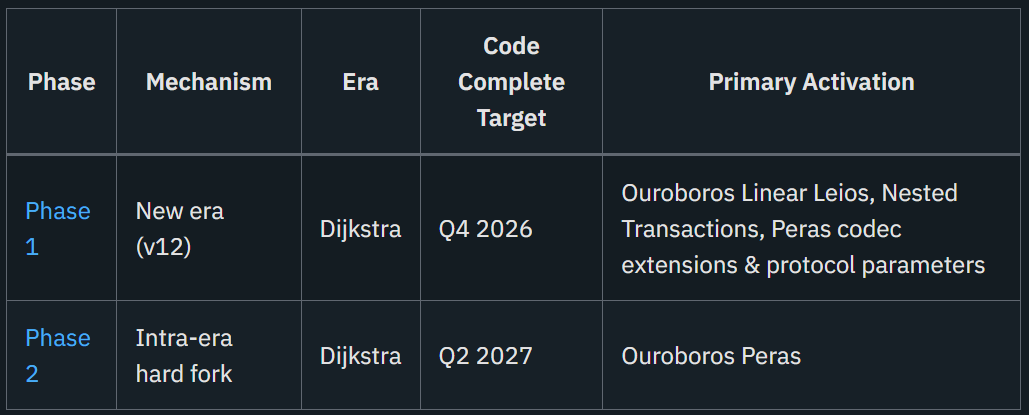
As of August 2026, Dijkstra isn't alive. It's a planned two-phase rollout, with Phase 1 targeting code completion in Q4 2026 and Phase 2 targeting Q2 2027. Here's what the upgrade changes, how the two phases differ, and what still has to happen before either one goes live.
What Is the Cardano Dijkstra Upgrade?
Dijkstra is Cardano's next ledger era, following Conway. Cardano names its eras after mathematicians and computer scientists in alphabetical order. According to Cardano's documentation, the upgrade centers on Plutus v4, consensus and ledger integration, and Conway-era refactoring.
Intersect, which coordinates Cardano's open-source development, publishes the official rollout plan. Phase 1 introduces the Dijkstra ledger era and activates Ouroboros Linear Leios, targeting Q4 2026. Phase 2 activates Ouroboros Peras through a lighter intra-era hard fork that skips a new era package.
How the Two Dijkstra Phases Work
The split isn't arbitrary. A new ledger era can introduce new block structures and protocol parameters, while an intra-era hard fork only changes what's gated behind a protocol version check.
Since Peras needs groundwork only a new era can lay down, which ships in Phase 1, even though Peras doesn't switch on until Phase 2.
Phase 1: Dijkstra Era and Linear Leios
Phase 1 bumps Cardano to Protocol Version 12 and opens the Dijkstra era, activating Ouroboros Linear Leios without changing Praos's security guarantees.
Linear Leios adds a second block type. Ranking Blocks are the existing Praos blocks, extended to announce and certify Endorser Blocks — larger blocks that reference additional transactions instead of carrying them directly. A stake-based committee certifies each Endorser Block before its transactions apply to the ledger. Cardano calls this a partial version of the broader Leio's design, with a fuller rollout pushed to a later era.
Phase 2: Ouroboros Peras and Faster Settlement
Phase 2 doesn't touch block production. Peras adds a voting overlay to the Praos chain-selection rule. Stake pool committees vote on recent chain tips, and once a tip gathers enough votes, it's treated as settled well before standard Praos depth would allow — changing how fast a transaction is final, not how blocks get made.
What Other Features Are Coming With Dijkstra?
Phase 1 carries several smaller upgrades, mostly tracked as formal CIPs:
Change | CIP | What It Does |
Linear Leios | CIP-164 | Adds Endorser Blocks to raise throughput |
Nested Transactions | CIP-118 | Lets a transaction contain child transactions with their own witnesses |
Guard Scripts | CIP-112 | Adds a script type that observes transaction validity without executing |
Account Address Enhancement (Phase 1) | CIP-159 | Lays ledger-level groundwork for account-style addresses |
Remove isValid field | CIP-167 | Simplifies transaction structure |
Non-segregated block body serialization | CIP-176 | Reworks block body format to support Leios and future features |
Remove DRep requirement for reward withdrawals | CIP-181 | Lets ADA holders withdraw staking rewards without a DRep delegation |
Pledge leverage-based rewards | CIP-50 | Introduces a leverage parameter that can later tie pool rewards to pledge ratio |
These aren't equally weighted. Nested Transactions is a major feature, giving developers more expressive on-chain logic. Guard Scripts mostly exist as a dependency for other features. A few proposed CIPs, including Time-Bound Delegation with Dynamic Rewards, were left out after a community poll saw 54.1% vote against it — a sign Cardano's governance filters out unpopular proposals rather than bundling everything in.
What Is the Rollout Timeline?
Every phase moves through the same sequence: Preview, then Pre-production, then mainnet, with a governance vote at each stage.
Stage | What Happens |
Node release | Dijkstra-compatible node ships for testnet operators |
Preview hard fork | Governance action enacted on Preview; ~2-week SPO testing window |
Pre-production hard fork | Governance action enacted; ~1-2 week final testing |
Mainnet governance vote | DReps, SPOs, and the Constitutional Committee vote |
Mainnet hard fork | Date to be determined, following ratification |
Intersect is explicit that these are estimated targets for code completion, not mainnet dates, and they exclude governance and community testing time.
Cardano is also preparing a constitutional amendment to register the new Dijkstra parameters in its governance guardrails.
What Does the Data Say About the Dijkstra Upgrade?
The clearest signal is discipline. Intersect's Aug. 14 update shows planning shifting toward ecosystem readiness and testnet reporting, not a change in scope or dates, and outlets covering it this week describe the timeline as unchanged.
The bigger unknown is what "Q4 2026" and "Q2 2027" mean in practice — these are code-completion targets, not mainnet dates, and governance votes have stretched timelines on past hard forks. The more useful thing to track isn't the calendar — it's the testnet reporting Intersect has promised, since that will show whether Linear Leios and Peras hold up under real conditions.
What Are the Risks and Uncertainties?
Timelines are estimates, excluding governance and testing time.
Governance can still delay a phase, since DReps, SPOs, and the Constitutional Committee must ratify each fork.
Linear Leios is partial, with a fuller version shelved over unresolved complexity.
Fee dynamics could shift, as fees take over from Cardano's shrinking Reserve.
Mainnet dates remain unset, listed as "TBD" even after code completion.
Conclusion
The Cardano Dijkstra upgrade is a two-phase plan to raise throughput through Linear Leios and speed up settlement through Ouroboros Peras, alongside smaller CIPs covering nested transactions and reward mechanics.
Phase 1 targets code completion in Q4 2026, and Phase 2 targets Q2 2027, but both are development milestones, not confirmed mainnet dates. Readers tracking real progress should watch Intersect's testnet reporting and the governance votes at each stage.
Disclaimer
This article is for informational purposes only and does not constitute financial or investment advice. Cardano's Dijkstra upgrade timeline is subject to change based on testing and governance outcomes. Always verify current details through Cardano's official channels before making decisions.
Also read:







.webp)