Coinbase Exchange Review: Features Fees and Security


Coinbase Exchange Review 2026: Fees, Security and Listing Process
Picking a regulated (CEX) centralized exchange to trade crypto is not simple anymore. This Coinbase Exchange review looks at how the platform works, what it charges, and how safe it really is. We will also break down how tokens get listed on it and how they get removed.
By the end of this review, you should know what the platform offers institutions and serious traders and where it stands on transparency.
What Is Coinbase Exchange
This platform is the institutional side of the wider Coinbase business, built for spot trading at scale.
According to official materials, it connects users to one of the deepest liquidity pools among regulated crypto spot venues. It mainly serves high-frequency traders through direct APIs rather than a simple retail app.
According to Coinbase Global's 2024 Annual Report (Form 10-K), the parent company was founded in 2012 and has grown into one of the largest publicly traded crypto firms in the U.S.
This trading venue is licensed to engage in virtual currency business activity by the New York State Department of Financial Services, according to the company's official disclosures.
Unlike a typical retail app, this venue centers on a professional order book. Market makers, funds, and other institutional participants use it to execute large orders without moving prices too much.
How Coinbase Exchange Works
Trading happens through FIX and REST APIs, along with WebSocket feeds for real-time market data. This setup gives firms direct access to order placement without relying on a browser.
The company describes this as a way to plug straight into order books and live pricing data.
The platform also connects to a dedicated derivatives arm, following an acquisition of LMX Labs, a CFTC-regulated futures venue. This lets institutional clients access futures markets alongside spot trading, under one regulatory setup.
Key Features
A few things stand out about this platform:
Deep liquidity – official materials describe it as one of the most liquid regulated crypto spot venues available today.
Dynamic fee structure – trading costs scale down as volume goes up, which helps high-frequency traders.
Easy-to-use APIs – FIX, REST, and WebSocket options give developers flexibility in how they connect.
Futures access – through the derivatives arm, users get regulated exposure to futures markets.
Liquidity Program – a dedicated program that rewards market makers for adding depth to order books.
Coinbase Fees
Trading costs here follow a maker-taker model, meaning price depends on whether an order adds or removes liquidity from the book.
A maker order sits on the book and waits to get filled, while a taker order matches an existing order right away. Larger monthly trading volume unlocks lower fee tiers, a standard practice across regulated venues.
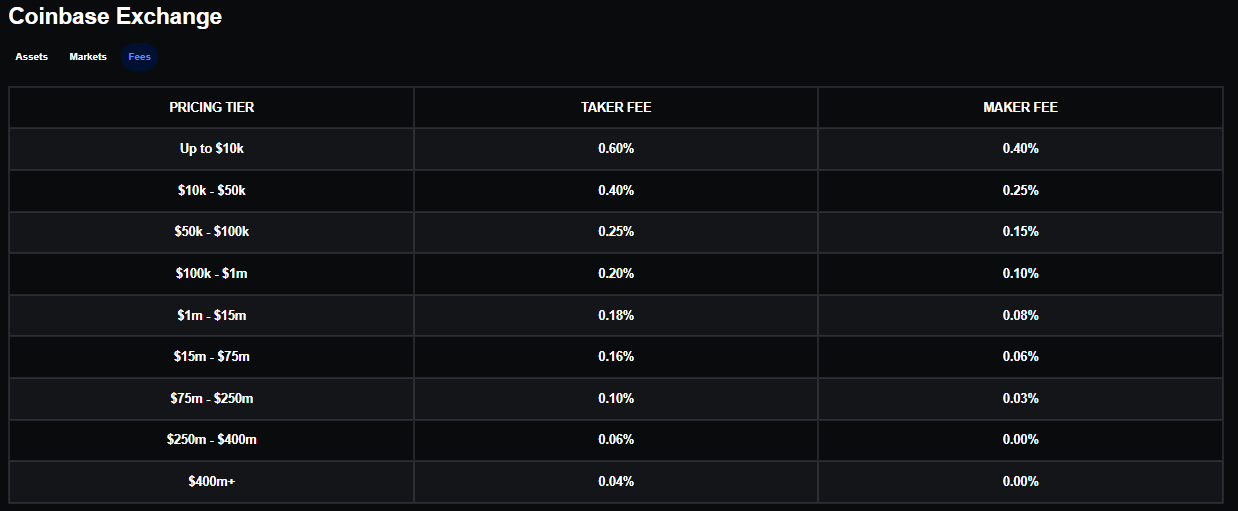
The table below summarizes Coinbase Exchange's maker-taker fee structure based on 30-day trading volume. Fee tiers are subject to change, so always verify the latest rates on the official fee schedule.
Pricing Tier | Taker Fee | Maker Fee |
Up to $10k | 0.60% | 0.40% |
$10k – $50k | 0.40% | 0.25% |
$50k – $100k | 0.25% | 0.15% |
$100k – $1m | 0.20% | 0.10% |
$1m – $15m | 0.18% | 0.08% |
$15m – $75m | 0.16% | 0.06% |
$75m – $250m | 0.10% | 0.03% |
$250m – $400m | 0.06% | 0.00% |
$400m+ | 0.04% | 0.00% |
This tiered setup rewards firms that trade often and in size, which fits the platform's institutional focus.
Exact rates sit on the official fee schedule page and update from time to time, so checking that page directly stays the most reliable way to confirm current numbers before making any decision.
Coinbase Security and Custody
he platform's custody service plays a major role in the platform's institutional offering. These security practices align with the broader principles of how to verify a crypto exchange, including checking custody standards, audits, licensing, and operational transparency before trusting any platform.
Security sits at the center of any honest exchange assessment. Per the company's own blog post on its custody setup, digital assets are secured using multi-party computation, meaning private keys are never fully reconstructed in one place.
Security Measure | What The Company States |
Custody model | Offline, air-gapped cold storage |
Key management | MPC-based signing, no single point of failure |
Regulated entity | A NY state-chartered fiduciary and Qualified Custodian |
Independent audits | SOC 1 Type II and SOC 2 Type II, audited by Deloitte and Touche |
Insurance | Crime insurance policy covering a portion of digital assets against theft |
Its custody service is designed for institutional investors , with the company stating that its in-house custody technology secures a meaningful share of the total crypto market value.
Coinbase Listing Process
The Coinbase listing process follows a defined path based on the company's official Asset Hub and crypto listing guidelines. Project teams must meet legal, compliance, and technical requirements before an asset becomes eligible for trading.
Coinbase also maintains an official Listings page where users and project teams can explore supported assets, review listing information, and learn how new cryptocurrencies become available on the platform.
Apply. Project teams open an account in the official Asset Hub and submit full details on the asset, including its purpose and technology.
Evaluate. A dedicated internal listing group reviews the submission against legal, compliance, and technical security standards.
Business assessment. The team also studies quantitative and qualitative signals tied to the asset's real-world use.
Approval. Assets that clear every stage become eligible to trade, though timing can vary by region due to local rules.
Technical integration. Trading goes live only once the back-end work connecting the asset to internal systems is done.
Officially, applying is free, and no listing or marketing fees get charged to issuers. If you want to understand how exchange listings work across different platforms, including listing dates and supported exchanges, check out our guide on top crypto token listings, listing dates, platforms, and details.
Coinbase Delisting Process
Crypto delisting works differently on Coinbase.
The official asset listings page notes that everything already trading faces ongoing monitoring to confirm it still meets legal, compliance, and technical standards.
Assets that fail continued review can lose eligibility, even after years on the platform.
Removal announcements typically go out through the official blog, a status page, or a verified account on X.
Trading is usually suspended on a set date, giving holders time to withdraw or convert funds before the deadline.
This ongoing review is what keeps the platform's asset list current, rather than fixed once a token is approved.
Advantages
Deep, regulated liquidity built for institutional volume
Transparent, fee-free listing process open to any project
Strong custody architecture backed by independent audits
Access to spot, futures, and a dedicated liquidity program
Challenges and Risks
The fee structure favors high-volume traders more than casual users
Regulatory status varies by region, which affects which assets trade where
Ongoing asset reviews mean tokens can lose eligibility without much notice
Future Outlook
The business keeps expanding past spot trading, adding derivatives and broader institutional services. Its public listing guide also signals a push toward more transparency, something the industry has asked for repeatedly.
How well this holds up will depend on regulatory clarity across the markets it serves.
More institutions are entering crypto through regulated venues rather than offshore platforms. That shift likely keeps demand steady for exchanges built with compliance and custody as priorities, not afterthoughts.
Final Thoughts
If you're looking for a crypto exchange review, this platform stands out for institutions because of its regulated infrastructure, transparent listing process, and strong custody model.
It offers deep liquidity, transparent listing standards, and a custody setup backed by real audits. Anyone evaluating it should still confirm current fees and licensing directly on the official pages before making decisions.
Disclaimer: This article is for educational and informational purposes only and should not be considered financial or investment advice. Always conduct your own research before making investment decisions.