Crypto Transaction Confirmed: Why Is Your Casino Balance Missing?

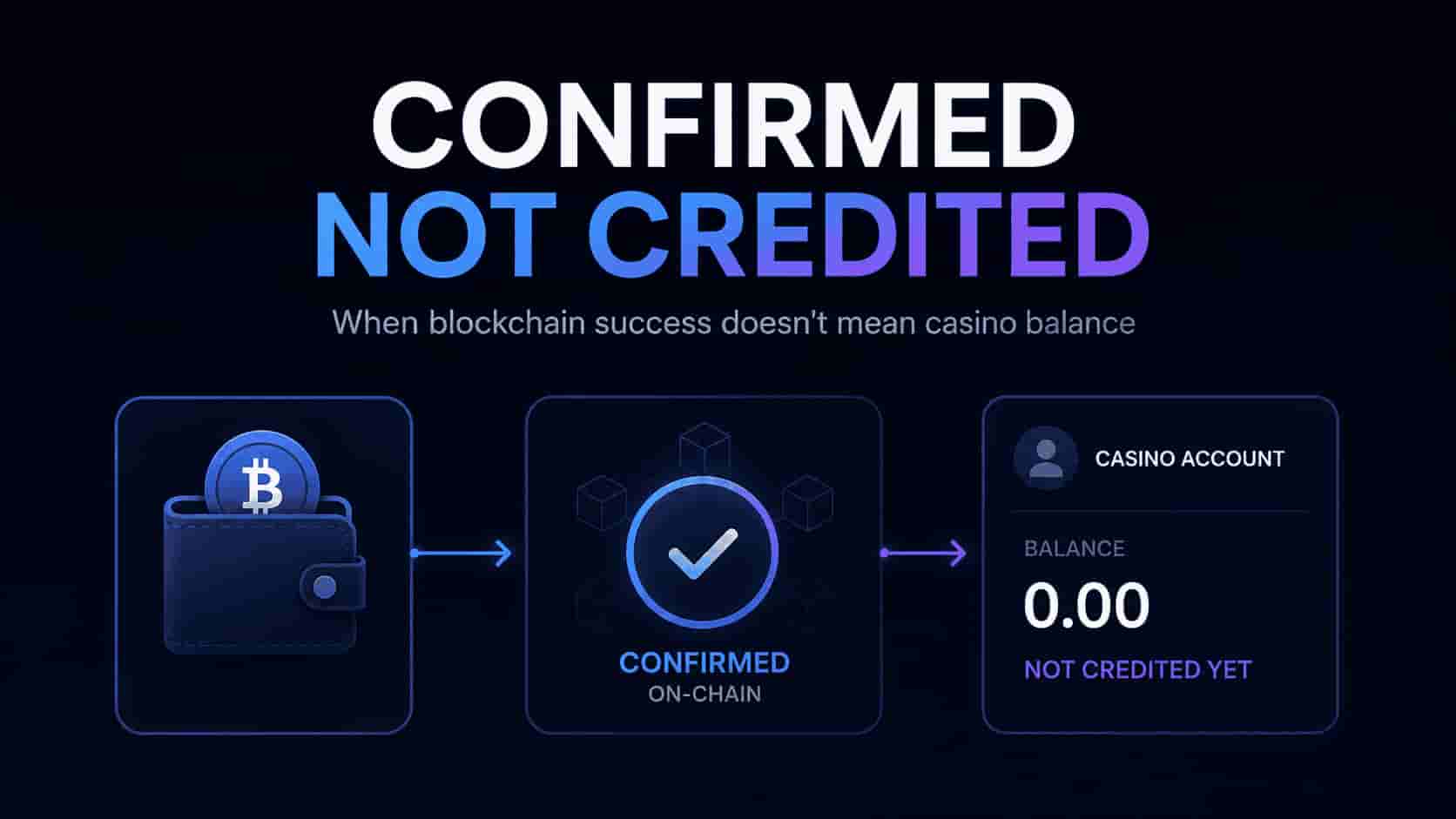
A successful blockchain transaction does not always mean an instant casino balance. Network confirmations, minimum deposit rules, unsupported chains, payment processors and internal crediting systems can all create a gap between “confirmed” and “credited.”
You send 250 USDT to an online casino.
A few minutes later, the transaction appears on the blockchain explorer. The status shows successful. The destination address matches the one copied from the cashier.
But the casino account still shows zero.
A confirmed blockchain transaction and a credited casino deposit are two different events.
It is easy to assume that something has gone wrong with the blockchain. In many cases, the blockchain has already done exactly what it was supposed to do.
The missing step happens somewhere else.
A crypto casino deposit can pass through several systems:
Wallet → blockchain → payment processor → casino account ledger
The blockchain confirms that assets moved between addresses. It does not guarantee that the casino has identified the transfer, matched it to the correct account and credited the internal balance.
That difference explains why “confirmed” and “credited” can sometimes be minutes — or much longer — apart.
Confirmed Does Not Mean Credited
A blockchain and a casino cashier answer two different questions.
The blockchain asks:
Did this transaction successfully reach the destination address?
The casino asks:
Can this transaction be recognised and assigned to this player account?
Those processes overlap, but they are not identical.
A valid on-chain transaction may still require the casino or its payment provider to:
-
wait for additional confirmations
-
detect the incoming payment
-
match it to a user account
-
confirm the amount meets deposit requirements
-
verify the token and blockchain network
-
receive a processor notification
-
update the player’s internal balance
This is why blockchain speed alone does not determine casino deposit speed.
A transaction can already appear successful in a block explorer while the casino’s crediting process remains unfinished.
The Casino May Be Waiting for More Confirmations
Seeing a successful transaction in a blockchain explorer is a good sign.
It is not necessarily the casino’s final crediting threshold.
Payment systems can wait for additional confirmations before considering incoming crypto sufficiently settled.
The sequence may look like:
Sent → included → confirmations → processor detects payment → casino credits account
For players, this means the first step should not be repeatedly refreshing the casino lobby.
Check the transaction hash.
If the transaction is still pending or has only recently been confirmed, the platform may simply be waiting.
If it has remained confirmed for a meaningful period and the balance still has not updated, then it is time to check the payment details themselves.
The Token Can Be Correct While the Network Is Wrong
This is one of the most important crypto payment mistakes.
USDT exists on multiple blockchain networks.
That means:
USDT ERC20 is not the same payment route as USDT TRC20.
The token name may look identical in a wallet, but the underlying blockchain is different.
Consider this example:
The casino cashier displays:
USDT — TRC20
The player sends:
USDT — ERC20
The ERC20 transaction may complete successfully.
The block explorer can show the correct amount, destination and successful status.
Yet that does not prove the casino supports or automatically credits that payment route.
Crypto users therefore need to check three separate details:
Asset → network → address
Payment problems are one reason research platforms such as CasinoIndex separate blockchain performance from the way gambling platforms handle account balances and payments.
A successful blockchain transfer proves that the transfer occurred.
It does not prove that the casino’s cashier instructions were followed correctly.
The Deposit May Be Below the Minimum
Another easily overlooked problem is the minimum deposit.
Suppose a casino requires a minimum crypto deposit equivalent to $20.
A player sends $8.
The blockchain does not know that the casino has a $20 minimum. It simply processes the transaction.
The result can be:
successful on-chain transfer, no automatic casino credit.
What happens to smaller transfers depends on the operator and its payment infrastructure.
Some systems may flag the payment for manual review. Others may only credit deposits automatically above the required threshold. In some cases, the cashier terms may explain that transfers below the minimum cannot be credited normally.
This is why the minimum should be checked before sending funds.
The blockchain cannot enforce an operator’s internal payment rules for the sender.
An Old Deposit Address May No Longer Match the Current Cashier Instructions
Crypto users often save addresses.
That can create problems with casino payments.
Some operators or payment processors generate account-specific deposit instructions, and those instructions may change.
A previously used address should therefore not automatically be treated as the correct address for a new deposit.
Before sending funds, compare the destination with what the cashier shows at that moment.
Do not rely only on:
-
an old screenshot
-
browser history
-
a saved wallet contact
-
an address used in a previous session
Starting from the current cashier reduces the risk of sending assets using outdated payment instructions.
The Blockchain May Be Finished While the Payment Processor Is Not
Not every casino monitors incoming blockchain transactions directly.
Some use third-party crypto payment infrastructure.
That creates a longer payment path:
Player wallet → blockchain → payment processor → casino system → player balance
The public blockchain can therefore show a finished transaction while one of the later steps is still incomplete.
For example:
-
the processor may not yet have detected the transfer
-
the processor may have detected it but not passed the update to the casino
-
the casino may have received the notification but not updated the internal ledger
-
the transaction may require manual reconciliation
This distinction matters because a blockchain explorer only shows the blockchain layer.
It cannot tell you whether the casino’s internal account system assigned the deposit correctly.
Most of these problems are easier to prevent than recover from. Players should know what to check before sending crypto to a casino, especially the exact asset, blockchain network, destination address and minimum deposit.
Memo, Tag or Reference Data Can Matter
Some crypto payment systems need more than a wallet address.
Depending on the asset and platform, an additional memo, tag or payment reference may help identify which account should receive the deposit.
If that information is missing or incorrect, a transaction can reach a platform-controlled address without being automatically matched to the intended user.
Not every cryptocurrency uses this structure.
The safer general rule is:
Follow every field shown in the cashier, not only the destination address.
If the payment page asks for additional identifying information, treat it as part of the transaction instructions.
Account or Wallet Checks Can Add Another Layer
A correctly formatted payment can occasionally require additional review.
Crypto payment services and gambling operators may apply security, ownership or financial-risk controls to some transactions.
That does not mean every delayed deposit is undergoing an AML investigation.
Most are not.
But unusual activity can introduce another processing step, particularly when transaction details conflict with account information or trigger a payment provider’s risk controls.
The important distinction is:
technical confirmation
versus
platform acceptance.
The blockchain controls the first.
The operator controls the second.
That principle applies to other payment methods too. The blockchain is only one part of the payment stack, which is why understanding how casino payment methods behave after money is sent can be more useful than judging a cashier only by advertised network speed.
How to Diagnose a Missing Crypto Casino Deposit
When a casino balance does not update, sending another transaction immediately is usually the wrong response.
Instead, diagnose the existing payment in order.
1. Find the transaction hash
Open the sending wallet and locate the TXID or transaction hash.
2. Check the blockchain status
Confirm whether the transaction is:
-
pending
-
failed
-
successful
-
sufficiently confirmed
3. Verify the receiving address
Compare the on-chain destination with the address used from the casino cashier.
Check the entire address rather than only a few characters.
4. Verify the network
Confirm which blockchain carried the transaction.
With stablecoins in particular, the token name alone is not enough.
5. Check the amount
Confirm that the payment met the casino’s minimum deposit requirement.
6. Check memo, tag or reference information
If additional identifying data was required, make sure it was included correctly.
7. Compare the current cashier instructions
Open a fresh deposit screen and compare the details.
Do not send another payment yet.
8. Contact support with evidence
A useful support request should include:
-
transaction hash
-
cryptocurrency
-
blockchain network
-
amount
-
approximate timestamp
-
receiving address
-
cashier screenshot where available
A message saying only “my deposit is missing” gives support little to investigate.
A TXID gives them a transaction they can trace.
What Not to Do
A missing deposit creates pressure because the assets have already left the wallet.
That is exactly when additional mistakes tend to happen.
Avoid:
-
sending the same payment again immediately
-
switching networks without checking the original transaction
-
trusting private messages from people claiming they can recover the deposit
-
giving casino support a private key or seed phrase
-
assuming a successful transaction automatically proves the casino is at fault
Legitimate support may need the public transaction hash.
It does not need your wallet seed phrase.
That information should never be shared.
Prevention Is Easier Than Recovery
Crypto payments give users direct control over asset transfers.
That also gives the sender more responsibility.
Before confirming a casino deposit, check the transaction in this order:
Asset → network → address → amount → additional reference
Where practical, a small test deposit can also reduce exposure before sending a much larger balance.
The extra check feels unnecessary when everything works.
It becomes valuable when something does not.
And expectations should remain realistic.
A fast blockchain can remove one source of delay. It cannot remove payment processors, casino ledger systems, minimum deposit rules or account-level controls.
Final Thoughts
A confirmed crypto transaction and a credited casino deposit describe two different events.
The blockchain confirms that assets moved.
The casino must still recognise the payment and assign it to the correct account.
If a deposit is missing, start with the transaction hash. Then verify the asset, network, destination address, minimum amount and any additional payment reference before contacting support.
Do not send more money to solve a transaction you have not yet diagnosed.
The simplest way to remember the difference is:
“Confirmed” tells you what happened on-chain.
“Credited” tells you what happened inside the casino.
Understanding the gap between the two can stop a small payment problem from becoming a much larger one.
18+ only. Gambling involves financial risk. Never deposit money needed for essential expenses, and always verify crypto payment instructions before sending irreversible transactions.
Description: A clean crypto payment featured image showing funds moving from a wallet to a confirmed blockchain transaction while the casino account still displays a zero balance. The visual explains the difference between an on-chain confirmation and an internal casino credit.