Ozak AI vs Pepeto Comparison: Which Presale Has Stronger Fundamentals?

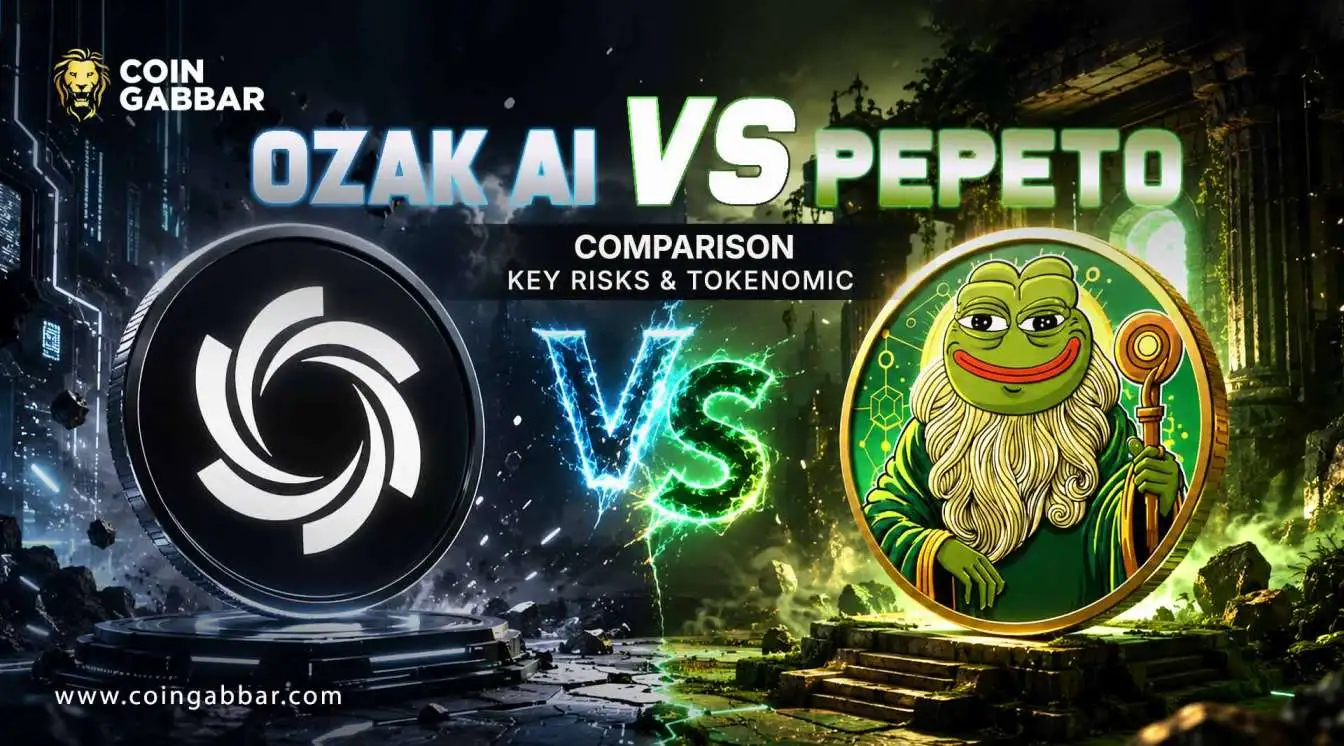
Ozak AI vs Pepeto: Two Presales, Two Different Crypto Strategies
An ozak ai vs pepeto comparison is really a comparison between two different kinds of crypto bets. One is an AI-focused analytics token still holding at a fixed presale price while it waits on a listing date. The other is a meme-branded token trying to fund a working exchange, a cross-chain bridge, and an AI screening tool, all before it trades anywhere.
Both projects are still in presale as of this update. Neither has a confirmed listing date. That alone makes them worth placing side by side.
This article walks through what each project's own site and tokenomics pages say about supply, allocation, presale progress, audits, and product status. It also flags what remains unconfirmed. Readers should treat presale claims as claims, not settled facts, and check the official project dashboards before acting on anything here.
Key Takeaways
Ozak AI ($OZ) is a predictive AI platform built on Ethereum, with a fixed presale price of $0.014 and a stated (unconfirmed) listing target of $1.00.
Pepeto ($PEPETO) is a memecoin-branded token funding a zero-fee exchange, a cross-chain bridge, and an AI contract-screening tool, priced near $0.0000001892 in its current tier.
Both presales report ongoing progress toward their current funding targets, and neither project has published a confirmed exchange listing date at the time of writing.
What Is Ozak AI?
Ozak AI describes itself as an agentic AI platform built for financial intelligence. According to the project's own site, it applies predictive AI models to crypto, equities, and forex data, then delivers signals and analytics through a product called EON.
The $OZ token pays for access to these tools. The project's stated utility list includes prediction-agent access, real-time data feeds from what it calls the Ozak Streaming Network, staking, and gated features tied to token holdings.
Ozak AI runs on Ethereum. The project says its smart contracts have been audited by both CertiK and Sherlock, and the presale contract address is published on its site for anyone who wants to verify it directly on a block explorer.
What Is Pepeto?
Pepeto brands itself around a "god of frogs" mascot, but the pitch underneath the meme theme is a utility stack. According to the project's own pages, Pepeto is building three things: PepetoSwap, described as a zero-fee decentralized exchange; a cross-chain bridge connecting Ethereum, BNB Chain, and Solana using a lock-and-mint model; and an AI screening engine meant to flag rug-pull code and hidden mint functions before a trade executes.
The $PEPETO token is also an Ethereum-based asset. Buyers can stake tokens during the presale itself through the project's own staking dashboard, ahead of any exchange listing. A single security audit from SolidProof covers the token contract, the staking mechanism, and the distribution setup, according to the audit document linked on Pepeto's own site.
Ozak AI vs Pepeto: Tokenomics and Supply
Ozak AI has a fixed total supply of 10 billion $OZ. Pepeto's published allocation does not disclose a single fixed total supply figure on its main tokenomics page in the same format, but the percentage split gives a clear read on where the tokens are meant to go.
Allocation Category | Ozak AI ($OZ) | Pepeto ($PEPETO) |
Presale | 30% | 30% |
Staking / Ecosystem & Community | 30% (Ecosystem & Community) | 30% (Staking) |
Liquidity | 10% (Liquidity & Listings) | 12.5% |
Marketing | Not separately listed | 20% |
Team | 10% | Not separately listed on the tokenomics page |
Future Reserve / Project Development | 20% (Future Reserve) | 7.5% (Project Development) |
The overlap is worth noting. Both projects put 30% of supply into the presale itself, and both reserve another 30% for community-facing incentives, staking in Pepeto's case and ecosystem rewards in Ozak AI's case. The difference shows up lower down: Ozak AI carves out a clear 10% team allocation, while Pepeto's public breakdown does not list a separate founder or team line.
Token vesting is the schedule that controls when purchased tokens actually become available to sell. Ozak AI has published a specific one: 10% of purchased $OZ unlocks at listing, followed by a one-month cliff, then six months of linear vesting on the rest. Pepeto's presale terms, by contrast, describe tokens as claimable once the presale-ends and staked tokens as claimable at the same time, with no multi-month vesting structure disclosed on the main site as of this update.
Presale Price and Funding Progress Compared
Presale price and funding progress move constantly, so treat the numbers below as a snapshot rather than a live figure.
Metric | Ozak AI ($OZ) | Pepeto ($PEPETO) |
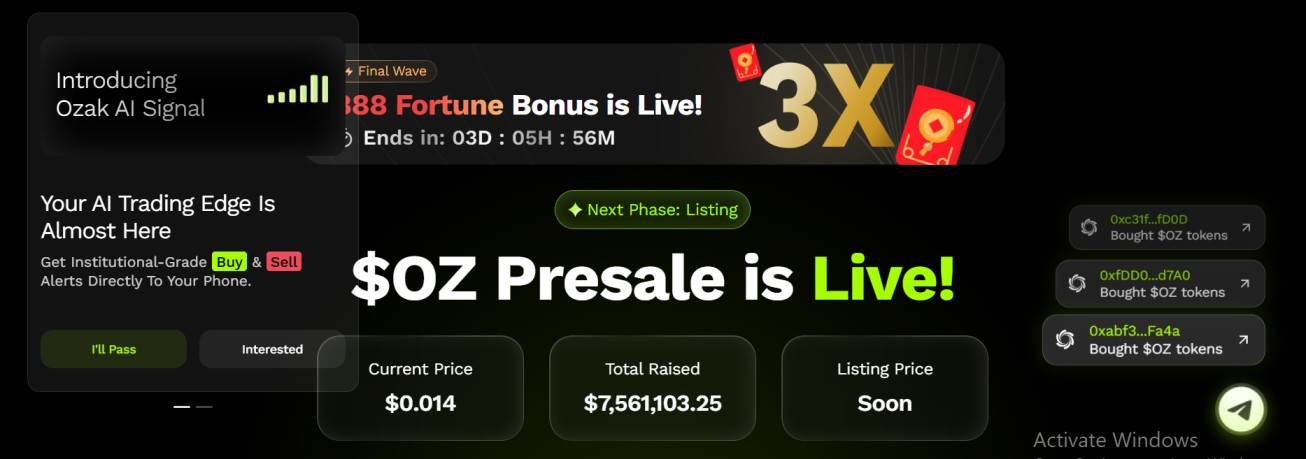
Current presale price | $0.014 | $0.0000001892 |
Total funds raised (project-reported) | Over $7.5 million | |
Sale progress | Reported near full, in a final wave | Reported near its current-stage target |
Stated listing price target | $1.00 (project claim, unconfirmed) | Not publicly stated |
Confirmed listing date | None published | None published |
The gap between the current presale price and a project's own stated listing target is not a promise. Ozak AI's $1.00 figure is the team's own communicated goal, not a number set by any exchange or market. Projected listing price and confirmed listing price are two different things, and conflating them is one of the more common mistakes in presale coverage.
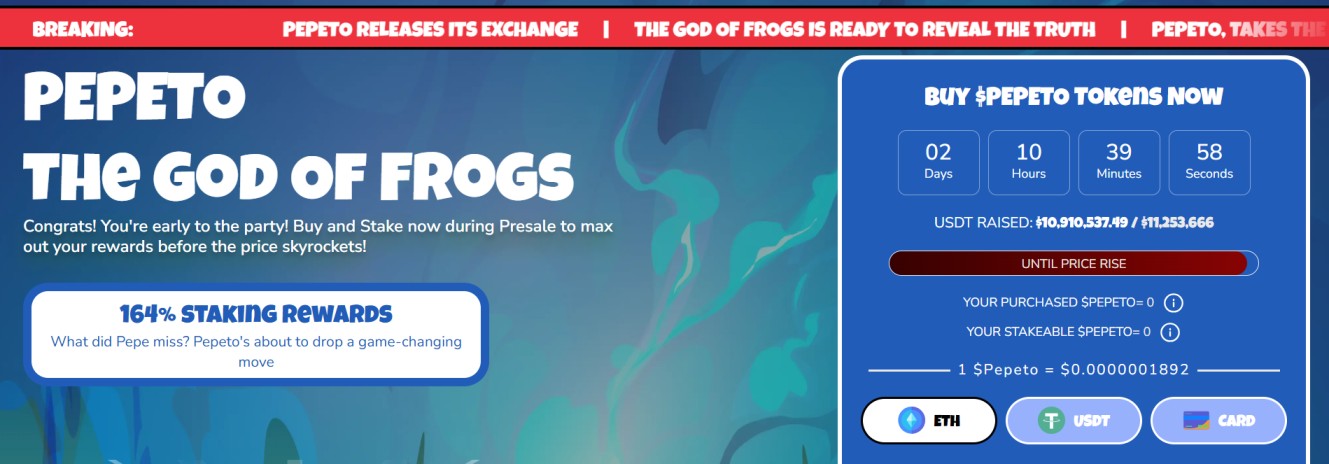
Pepeto has not published an equivalent target price on its main site. Its presale instead runs on a tiered structure, where the token price rises automatically once a funding threshold or countdown closes, a mechanic that has repeated across multiple stages already.
Which Project Has More Developed Products?
This is where the two projects diverge the most in framing.
Ozak AI points to a live platform called EON, which the project says opened to its full waitlist with features including AI-driven analytics, portfolio dashboards, and a "Whale Tracker" for monitoring large wallet activity. The team has also reported user and wallet counts in the hundreds of thousands, though these are self-reported figures from the project's own updates rather than independently audited numbers.
Pepeto's core claim centers on its exchange, bridge, and screening engine. The project's own communications describe the exchange as having completed testing ahead of a public release, alongside a staking dashboard that is already live during the presale itself. As with Ozak AI's user numbers, these product-status claims come from the project's own announcements and have not been independently verified by a third party.
For both projects, the safest approach is to treat "the platform is live" and "the platform has been independently reviewed" as two separate claims until proven otherwise.
Ozak AI vs Pepeto Roadmaps: What Comes Next?
Ozak AI's published roadmap runs through four broad phases: an initial Launch phase covering research and smart contract work, a Development phase building the machine learning engine and node network, a second Development phase adding a business platform and a streaming-network testnet, and a final Growth phase targeting mainnet launch for that streaming network alongside its AI agent products.
Pepeto's roadmap, based on the project's public updates, centers less on staged phases and more on shipping the three core products, the bridge, the exchange, and the screening tool, before moving to a public listing. The project's roadmap page does not lay out the same kind of dated phase structure that Ozak AI publishes.
Potential Risks to Consider
Neither project should be treated as a safe or guaranteed outcome. Some shared and specific risks worth weighing:
No confirmed listing date for either token: Presale near-completion is not the same as a scheduled market debut, and delays are common across the sector.
Self-reported metrics: User counts, staking totals, and product-status claims for both projects come from each team's own updates, not independent audits of usage data.
Vesting and unlocking pressure: Ozak AI's published cliff-and-vesting schedule limits day-one selling, while Pepeto's simpler claim structure means more supply could reach the market sooner after listing.
Team transparency gaps: Ozak AI lists a team allocation in its tokenomics; Pepeto's public tokenomics page does not clearly break out a comparable line, and independent identity verification for either team is limited.
Audit scope: Audits confirm code was reviewed for the issues each firm tests for. An audit is not a guarantee against price loss, exchange risk, or a project failing to deliver its roadmap.
Ozak AI or Pepeto: Which Approach Stands Out?
There's no evidence-based way to declare a flat winner here, because the two tokens are answering different questions. Ozak AI is a bet on whether a live AI analytics platform can convert its reported user base into token demand once trading opens, backed by a published vesting schedule and two completed audits. Pepeto is a bet on whether a meme-branded exchange, bridge, and screening tool can find real trading volume in a crowded field of similar utility-memecoin pitches, backed by a single audit and a faster, less structured claim process.
Ozak AI's case rests on a documented product, a published vesting schedule, and two completed audits. Pepeto's case rests on a broader utility stack, presale staking, and a memecoin-driven audience. Neither structure removes the core uncertainty both tokens share: the presale price is not the main variable to weigh. The absence of a confirmed listing date, for both tokens, is.
Conclusion
Ozak AI and Pepeto are both Ethereum-based presale tokens with ongoing fundraising progress and no confirmed exchange listing date. Ozak AI leans on a predictive AI platform, a published vesting schedule, and two completed security audits.
Pepeto leans on a three-part utility stack, a memecoin identity, and presale staking, backed by a single audit. Readers should verify current presale pricing, funding progress, and audit reports directly on each project's own site before making any decision, since these figures change frequently and neither project has published a confirmed listing date as of this update.
Disclaimer
This article is for informational purposes only and does not constitute financial advice. Crypto presales carry high risk, including the possibility of total loss. Always verify project claims independently before investing.
Also read: