Remittix Explained: PayFi Model and RTX Utility


Cross-border payments still cost too much and move too slowly for most people.
The $Remittix PayFi model was built to close that gap by connecting crypto directly to everyday bank transfers.
This guide walks through what $Remittix is, how its PayFi model works, RTX tokenomics, token utility, roadmap progress, and current presale details, all sourced from the project's own channels.
What Is Remittix?
$Remittix is a crypto-to-fiat payment protocol designed to let users send digital assets and have the recipient receive ordinary local currency in their bank account.
There is no requirement for the receiving party to own a wallet, hold crypto, or understand blockchain at all.
The sender picks a supported cryptocurrency, enters the recipient's bank details, and the platform manages the conversion and settlement.
The project targets the global remittance and cross-border payments industry, a market historically dominated by slow bank wires and providers charging high transfer fees.
$Remittix positions itself as a faster, cheaper alternative built directly on blockchain rails, according to the project's official documentation on remittix.io.
Alongside the core PayFi payment flow, the ecosystem has expanded to include $Remittix Markets, a separate perpetual futures trading layer, and a self-custody Remittix Wallet already live on the Apple App Store with Android support in progress.
The combination of a payments product, a trading product, and a wallet under one token is a deliberate attempt to give RTX more than one use case before it ever reaches an exchange, based on updates published through the project's official channels.
Understanding the Remittix PayFi Model
The $Remittix PayFi model refers to the fusion of decentralized payment infrastructure with fiat off-ramping.
Instead of asking users to trade one token for another on an exchange, PayFi is designed to move value from a crypto wallet straight into a traditional bank account in the recipient's local currency.
This model matters because it removes the biggest barrier to crypto adoption in remittances: the receiving end.
A worker sending money home does not need their family to open an exchange account.
The Remittix PayFi model handles the entire crypto-to-fiat bridge internally, with the platform's own dashboard tracking each transfer from submission to bank credit, as described in the Remittix product documentation.
By combining payments and finance in a single flow, PayFi as a category tries to make blockchain settlement invisible to the end user, which is the same principle behind the Remittix PayFi model's design.
RTX Tokenomics Explained
RTX is the native token that powers the $Remittix ecosystem.
Supply is fixed at 1,500,000,000 tokens on the Ethereum ERC-20 standard, and the contract does not allow additional minting.
This fixed-cap structure is confirmed on the project's own tokenomics page.
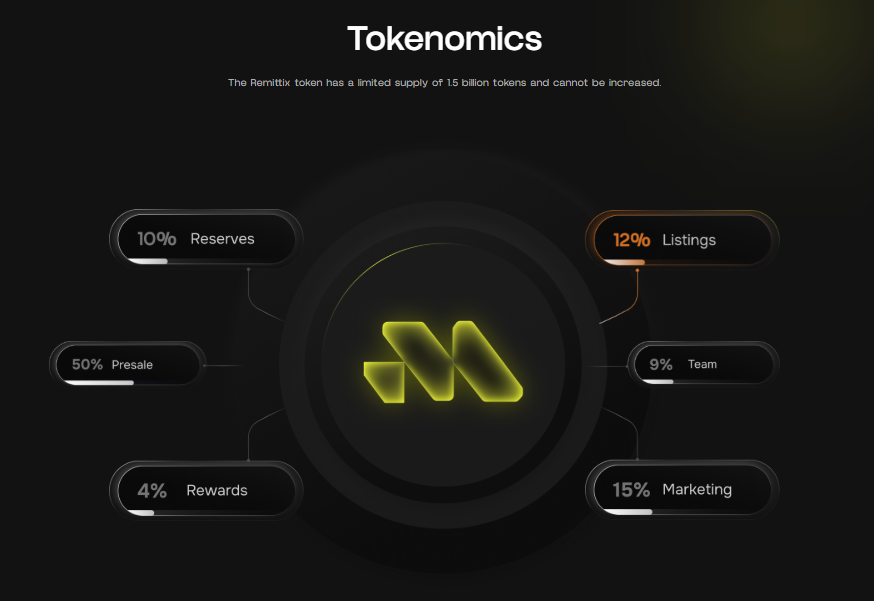
The allocation breakdown is as follows:
| Allocation | Share | Tokens |
| Presale | 50% | 750,000,000 |
| Marketing | 15% | 225,000,000 |
| Exchange Listings | 12% | 180,000,000 |
| Ecosystem Reserves | 10% | 150,000,000 |
| Team | 9% | 135,000,000 |
| Rewards | 4% | 60,000,000 |
RTX token allocation breakdown, Source: Remittix official tokenomics documentation.
Presale buyers face no vesting period and can claim tokens five days after the token generation event.
Team tokens remain locked for three years, a structure meant to reduce insider sell pressure while the Remittix PayFi model moves from presale into open trading.
RTX Token Utility
RTX is not designed as a passive holding asset.
The token is meant to function across the payment layer, the trading layer, and the reward layer of the ecosystem:
-
Settlement currency inside the Remittix Wallet for crypto-to-fiat and bank payout transactions
-
Trading and margin assets within Remittix Markets, the project's newer perpetual futures layer
-
Fee discounts and platform access tied to holding or using RTX across ecosystem products
-
Deflationary pressure through a transaction-fee burn mechanism, where a portion of network fees is permanently removed from circulating supply
-
Community governance input as the ecosystem matures beyond the initial launch phase
This multi-product design is a deliberate shift from a single payments app toward a broader RTX powered ecosystem, according to the project's official product pages.
Remittix Roadmap Progress in 2026
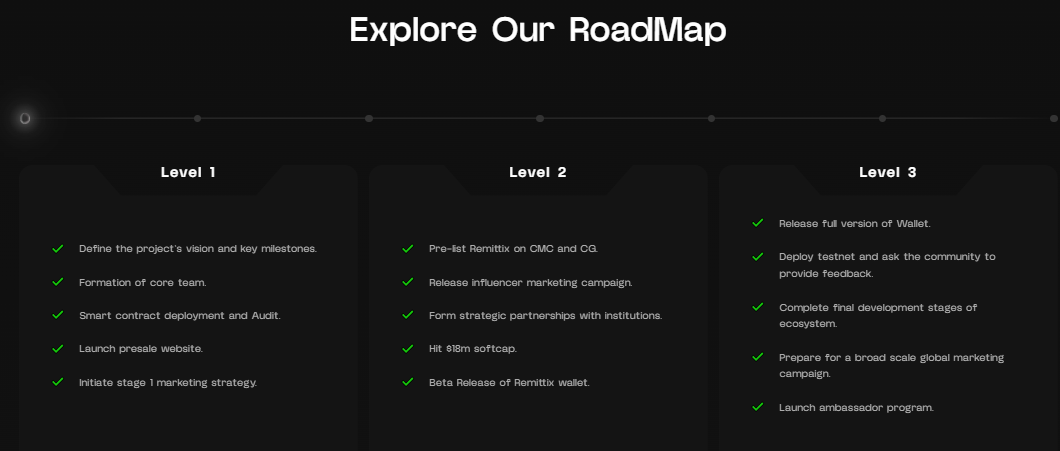
Remittix organizes its development into structured levels rather than a single fixed date.
-
The early levels covered team formation, smart contract deployment, the CertiK audit, and the original presale launch.
-
The middle levels added CoinMarketCap and CoinGecko pre-listings, a soft cap milestone, and the release of the iOS wallet beta.
-
The current level covers the final stretch before the token generation event: full completion of the PayFi platform, community testing with real crypto-to-fiat transfers, the launch of Remittix Markets as a perpetual trading layer, and airdrop registration for eligible holders.
According to the project's public updates, PayFi beta users have already completed live transfers, with fiat delivered directly into recipient bank accounts across more than 30 countries.
Two funding thresholds now shape what happens next.
Reaching $32 million raised triggers the official announcement of the RTX launch date, while the $36 million hardcap is tied to the final token generation event and exchange listings, based on the presale dashboard at remittix.io.
RTX Presale Details
The RTX presale began in December 2024 at a starting price of $0.015 per token and has moved through a series of price steps since.
As of the most recent public dashboard update, the presale has raised more than $32 million from over 40,000 holders, placing it close to the final funding stages before listing.
Key presale facts, drawn from the official Remittix dashboard and documentation:
-
Total supply: 1,500,000,000 RTX, fixed and non-inflationary
-
Presale allocation: 750,000,000 RTX, or 50% of total supply
-
No vesting for presale buyers; tokens are claimable five days after launch
-
Confirmed pre-listing exchange partners include Uniswap, with additional centralized exchange listings planned around the token generation event
-
Smart contract audited by CertiK with no critical, major, or medium-severity findings, according to the CertiK Skynet audit report
Presale participation happens directly through the official Remittix website, and buyers are advised to verify any link against the project's own domain before sending funds.
Security and Compliance
Security has been a recurring theme in how Remittix presents itself to buyers.
The RTX smart contract has been audited by CertiK, and the project has also completed CertiK's KYC verification process for its core team, which independently confirms team identities without making them public by default.
The liquidity pool planned for the token's Uniswap debut is intended to be locked, meaning neither the team nor early insiders can withdraw it immediately after listing.
Combined with the fixed supply and the three-year team token lock, these measures are aimed at addressing the most common red flags associated with early-stage token launches.
Expert Opinion
Analysts covering the PayFi sector note that Remittix stands out among 2026 presale projects because it has shipped a working product before its token began trading on any exchange.
A live wallet, a functioning crypto-to-fiat pipeline, and a completed third-party audit are unusual milestones to reach during a presale phase rather than after listing.
Industry observers generally view a fixed, non-inflationary supply combined with a transaction-fee burn as a more sustainable tokenomics structure than models that rely purely on speculative demand.
At the same time, analysts caution that the absence of a vesting lockup for the 50% presale allocation means significant sell pressure is possible immediately after the token generation event, and that real transaction volume after launch, not presale totals, will ultimately determine whether the Remittix PayFi model achieves lasting adoption.
Disclaimer
This article is for informational purposes only and does not constitute financial, investment, or trading advice. Cryptocurrency presales carry significant risk, including the potential loss of the entire invested amount. Figures such as presale totals, funding thresholds, and roadmap timelines are based on information published by the project as of the time of writing and may change. Always verify current details through the official Remittix website and conduct independent research before making any financial decision.