Arthur Hayes FLOP Tokenomics Revealed With No VC or Presale


Arthur Hayes FLOP Tokenomics: A Fresh Model for Crypto Distribution
Arthur Hayes FLOP tokenomics have finally surfaced, giving the crypto community its first real look at how the BitMEX co-founder plans to distribute his new AI-focused token.
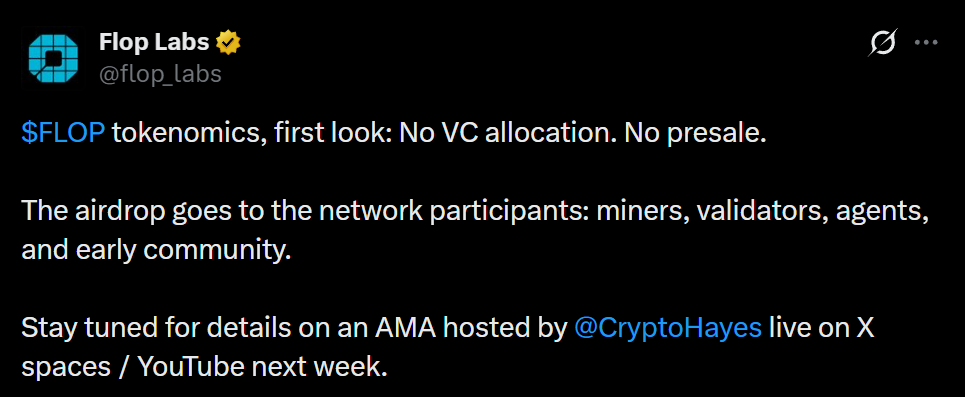
The headline takeaway is simple: there is no venture capital allocation and no presale, with the entire genesis supply instead flowing to the people and machines that actually build and use the network.
Source: Flop Labs' announcement on X
What The First Look Actually Confirms
The initial reveal states plainly that FLOP carries no VC allocation and no presale, with the airdrop going to network participants, including miners, validators, agents, and the early community.
This marks a deliberate break from how most infrastructure tokens have launched in recent years, where insider and investor allocations often make up a large share of genesis supply.
Instead, every token is earned through participation rather than handed out through private funding rounds.
How The Wider Tokenomics Framework Is Structured
The project's teaser document lays out a much fuller picture beyond the initial announcement.
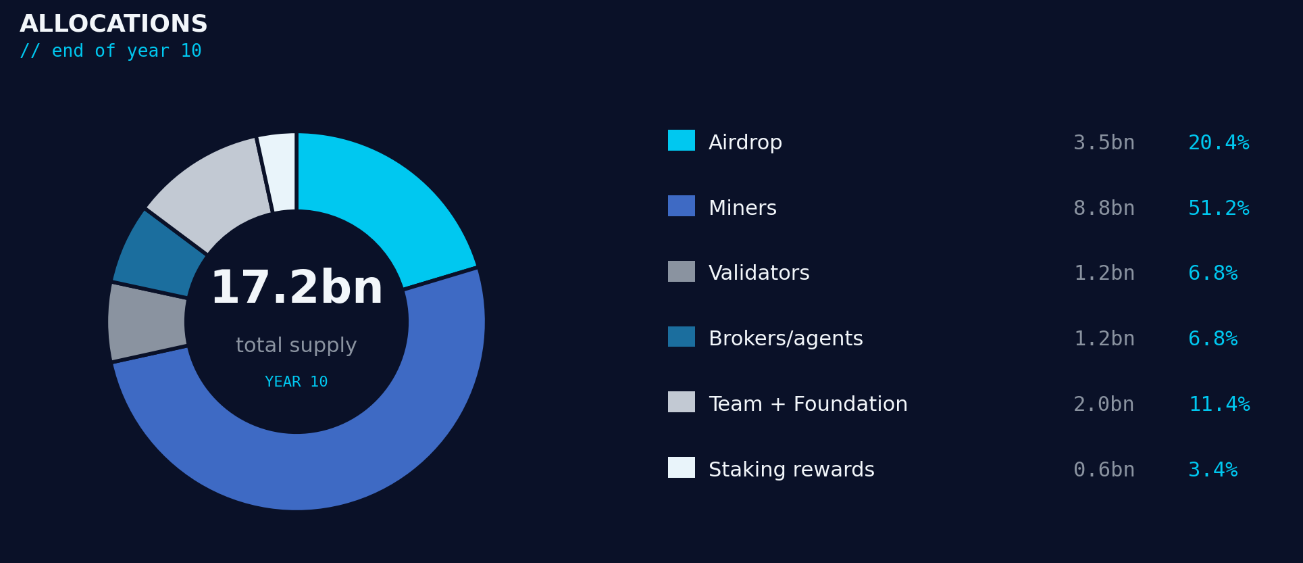
Total supply is projected to reach around 17.2 billion tokens by year ten, with allocations split across several participant groups rather than a single treasury or founder pool.
Under this Arthur Hayes FLOP tokenomics structure, miners are set to receive the largest share by far, reflecting their role in supplying the actual compute the network depends on.
Key allocation figures at year ten include the following:
-
Miners: about 51% of total year-ten supply
-
Airdrop: about 20% of total year-ten supply
-
Team and foundation combined: about 11%
-
Validators and brokers/agents: each about 7%
-
Staking rewards: about 3%
Breaking Down The Genesis Airdrop
The genesis airdrop itself totals 3.5 billion tokens and is further split across four groups rather than distributed evenly.
Miners and agents are each eligible for up to 1.2 billion tokens tied directly to compute provided or compute consumed during the network's testnet phase.
Validators are allocated around 305 million tokens, representing the aggregate stake needed to secure the network at launch, while a smaller reserve of around 794 million tokens is set aside for broader ecosystem incentives.
This structure means the size of an individual's airdrop depends heavily on actual participation rather than simply holding a wallet or completing basic tasks.
Testnet Timeline And How Participation Will Be Measured
The plan, as laid out in the teaser document, calls for a testnet running about ninety days starting in the fourth quarter of 2026, with the mainnet targeted for the first quarter of 2027.
During this window, miners earn their share by connecting hardware and completing verified inference work, while validators are selected based on uptime, block production, accuracy, and latency performance.
Agents, meanwhile, earn their portion primarily through actual spending on inference, with a notable mechanic tying every three tokens spent to one additional token unlocked from their allocation.
This effectively means agents must use the network to unlock their own rewards rather than receiving them upfront.
Quick Snapshot Of The Numbers
| Category | Detail |
| VC allocation | None |
| Presale | None |
| Total projected supply at year 10 | Around 17.2 billion tokens |
| Genesis airdrop size | 3.5 billion tokens |
| Miner share of year 10 supply | About 51% |
| Testnet window | About 90 days, starting Q4 2026 |
| Target mainnet launch | Q1 2027 |
Why This Structure Matters For The Broader Market
This approach to Arthur Hayes FLOP tokenomics arrives at a moment when fair-launch models have become a major talking point across crypto, largely because so many recent token launches have drawn criticism over heavy insider allocations.
By tying the vast majority of supply to measurable participation — such as compute delivered, stake posted, or inference consumed — the design attempts to align token distribution directly with network usage rather than early access or capital contribution.
Whether this translates into sustained real-world demand for AI-driven compute remains an open question the market will only be able to answer once testnet activity actually begins.
Conclusion
The first detailed look at Arthur Hayes FLOP Tokenomics shows a project built around participation over capital, with miners, validators, and agents positioned to earn the overwhelming majority of supply rather than early investors.
With testnet set to begin later this year, the coming months should offer the clearest signal yet on whether this fair-launch structure can translate into a functioning network for AI-driven compute.
Disclaimer
This content is for informational purposes only and is not financial, investment, legal, or tax advice. Cryptocurrency markets are volatile and risky; conduct your own research and consult a qualified professional before making decisions









