Bitcoin News Today: Is The 40% Rebound A New Bull Run Right Now?


Bitcoin News Today: What Could Confirm a New Bull Market in 2026?
Bitcoin News Today centers on one striking figure: a roughly 40% rebound off BTC's late-June low. BTC price today sits near $77.7K, slightly behind the broader crypto market's gain.
That kind of bounce naturally raises a question worth asking directly. Is this the start of a new bull market, or just a stronger stretch inside an ongoing bear cycle?
Bitcoin News Today: What Didier And Griffin Ardern Say About The Rally
The debate played out on a recent episode of the Wu Blockchain podcast focused on blockchain markets, featuring frontier-tech investor Didier alongside macro hedge fund portfolio manager Griffin Ardern. Their views split cleanly.
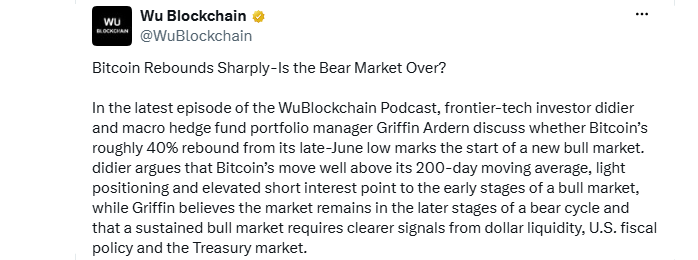
Source: Official X Post
Didier points to $BTC trading well above its 200-day moving average, along with light positioning and high short interest, as early signs of a bull market
Griffin Ardern argues the marketplace still looks like the later stage of a bear cycle, not the start of a new one
Both agree the rally leaned heavily on under-positioning and short covering rather than fresh, sustained buying
Griffin ties any real bull case to clearer signals from dollar liquidity, U.S. fiscal policy, and Treasury marketplace behavior
The conversation also touched on Strategy's balance sheet and whether capital could shift out of crowded AI trades into crypto
Neither side dismissed the rally. The disagreement is about what it means next.
BTC Price Today: After the 40% Rebound From June Lows
Some quick numbers as per CoinMarketCap give the $BTC 40% rebound proper context:
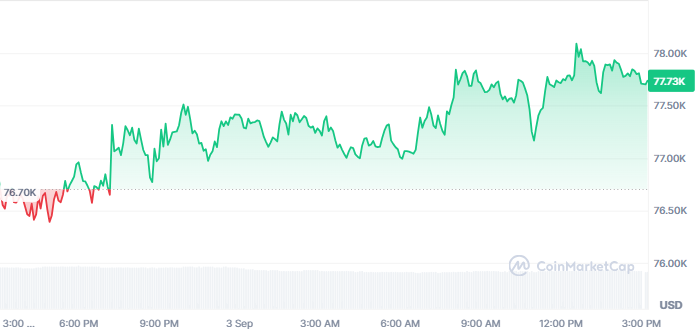
BTC price today: $77,730, up 1.12% in 24 hours
Market cap: $1.56 trillion, up 1.12%
24-hour trading volume: $27.27 billion, down 8.11%
Fully diluted valuation: $1.63 trillion
Circulating supply: 20.07 million
A 40% climb off a low is large by any measure, yet BTC still trades well under levels seen earlier in the year. That gap is exactly why Didier and Griffin Ardern read the same chart so differently.
Bitcoin Bull Market Or Bear Market: Two Views From Experts
The BTC bull market case rests on positioning data. Traders were leaning cautious into the rally, and short covering alone can push price up fast once sentiment shifts. Add in the move above the 200-day average, and the setup looks constructive on paper.
The Bitcoin bear market case rests on macro conditions instead of price charts. Griffin's argument is that a real trend change needs support from looser dollar liquidity, clearer U.S. fiscal policy, and calmer Treasury yields. Without those, a strong bounce can still fade back into range.
Bitcoin ETF Inflow Data And What It Signals For BTC Price This Month
BTC ETF inflow September 2026 activity adds another layer to the picture. August was the strongest month of the year for U.S. spot BTC ETFs, pulling in about $3.52 billion in net inflows as BTC gained roughly 25% for the month. The total ETF assets also grew about 31% to nearly $99.61 billion.
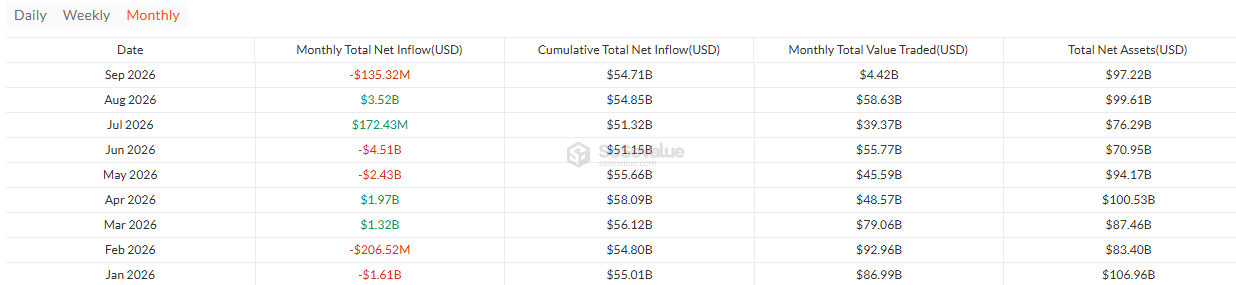
September opened choppy. Data as per SoSoValue:
Sept 1: all spot $BTC ETFs saw $236 million in outflows, IBIT alone lost $201 million
Sept 2: sentiment flipped, with $101.15 million in total net inflows across all funds
IBIT led the bounce, drawing $115.4 million, about 1,495 BTC near $78,000
Bloomberg noted that the single-day flows mostly reflect short-term choices, but BlackRock's size still moves sentiment.
What's Next For Bitcoin: Key Signals To Track
The next real test in Bitcoin news today will not come from the chart alone. It will come from:
Dollar liquidity and Fed policy tone
Treasury yield direction
Daily IBIT and total ETF flow data
U.S. fiscal policy progress
Any capital rotation out of AI trades into crypto
Bitcoin News Today leaves the bear vs bull market debate open. The rebound is real, but so is the caution. Whether this Bitcoin 2026 rebound turns into a real bull depends less on the chart and more on whether liquidity and Treasury conditions actually loosen from here.
Disclaimer: This article is for informational purposes only and does not constitute financial or investment advice. Crypto markets carry significant risk. Always do your own research before making any investment decisions.






