EdgeX Airdrop Insider Allocation Reveal, Are They Cheated Users?


EdgeX Airdrop Probe Unveils Another Market Centralization Concern?
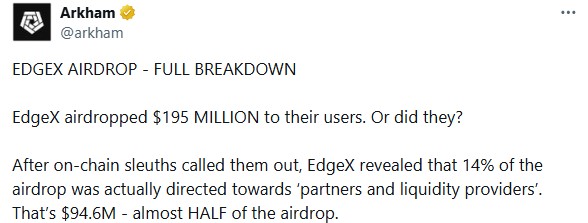
The EdgeX airdrop has come under intense scrutiny after new on-chain data from Arkham Intelligence raised questions about how the $195 million airdrop distribution was handled. What initially appeared to be a large-scale community reward is now being questioned about insider allocations, claiming that not all tokens reached regular users as expected.
The platform launched its native token, $EDGE, on March 31, 2026, with strong early attention across the crypto market. But soon after the token launch, the conversation changed. Instead of discussing listings, price action, and adoption, many traders began focusing on whether the EdgeX airdrop was truly fair.
Is the EdgeX Airdrop a Scam? On-Chain Data Reveals the Truth
The platform allotted 25% (250 million tokens) of the total 1 billion supply as giveaways for loyal and early users. However, data from Arkham reveals a different story.
According to the findings, around 14% of the total EdgeX airdrop allocation, valued at nearly $94.6 million, was actually sent to "partners and liquidity providers" rather than the actual community. While 7% is still sitting in the airdrops wallet, yet to be distributed. This states that the genuine users or traders received only around 4%, much smaller than initially perceived.
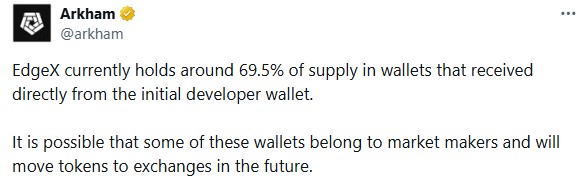
Further analysis reveals that 69.5% (695M tokens) of the total supply is held in 52 wallets linked to the developer/insiders. In reality, only about 9.5% of the total $EDGE supply is actually circulating in the market or in the hands of regular traders.
This has raised concerns about centralization and potential future sell pressure if these holdings move to exchanges.
The situation quickly led to backlash within the crypto community, with many users questioning whether the incentivising program favored insiders over genuine participants who had been farming rewards for months.
EdgeX Responds With Token Lock Initiative
Following the criticism, the team took action by locking that controversial 14% allocation for one year. This move aims to restore confidence and reduce immediate selling pressure from large holders.
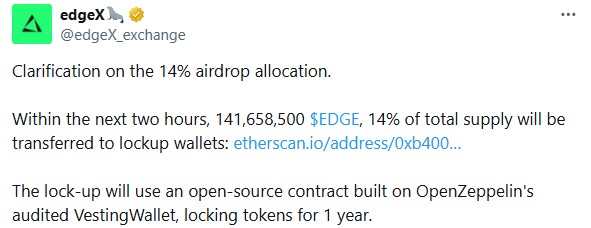
However, the response has done little to fully calm concerns. Many users still feel that the initial distribution lacked transparency, especially when compared to expectations set before the launch.
Similar Airdrop Scam Controversies Across Perp DEX Market
The EdgeX airdrop controversy is not an isolated case. In late 2025 and early 2026, several perpetual DEX projects have faced similar issues:
Lighter (LIT) saw backlash over unfair allocations and withdrawal issues
Aster (ASTER) faced accusations of wash trading and reward manipulation
Backpack (BP) dealt with insider selling rumors and strict anti-Sybil criticism
These incidents highlight a growing pattern in the industry, where high-value airdrops often raise concerns about transparency, fairness, and insider advantages.
What’s Next After the Distribution Fairness Debate
Despite the controversy, the platform continues to position itself as a high-performance decentralized exchange offering super-fast speeds and up to 100x leverage. Its token launch, March 31, 2026, saw strong initial trading activity. $EDGE price opened at $0.73 and later settled into the $0.52–$0.66 range, even as criticism grew around the EdgeX airdrop structure.
In the bottom line, from "shadow wallets" to locked tokens, the launch of the $EDGE token has been a rollercoaster for early supporters.
Looking ahead, the project plans to expand its ecosystem with upgrades, governance features, and broader trading options. However, rebuilding trust will likely remain a key challenge.
Note: This article is for informational purposes.
Also read:






