EU MiCA News: Poland’s Crypto Firms Hit a Regulatory Deadlock

EU MiCA News: Poland’s Licensing Gap Widens After MiCA Deadline
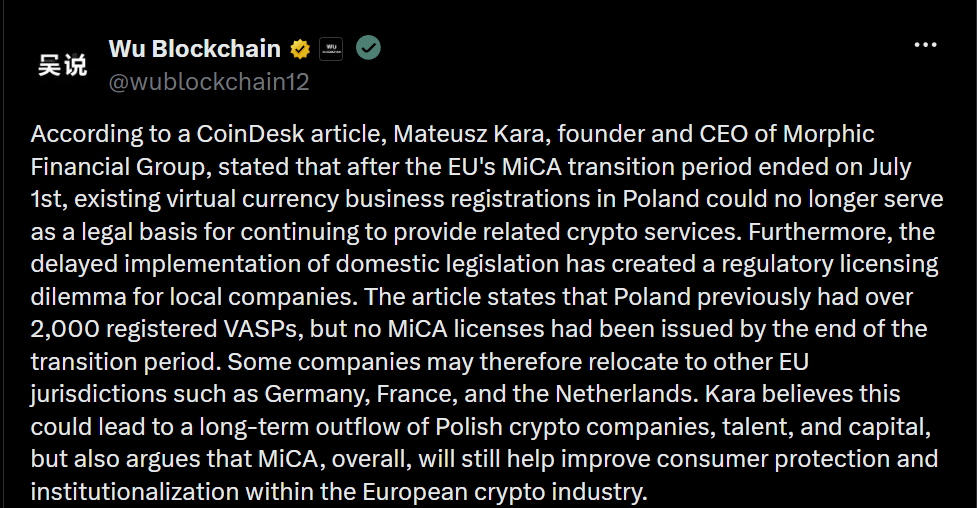
Fresh EU MiCA News out of Poland reveals a serious regulatory gap: with the MiCA transitional period ending on July 1, 2026, Polish crypto businesses that previously operated under national virtual currency registrations can no longer rely on that status to keep offering services, yet Poland still has not designated a competent authority to issue MiCA licences.
Mateusz Kara, founder and CEO of Morphic Financial Group, flagged the situation publicly, warning it has left local firms stuck in what he called a regulatory authorisation dilemma.
Source: wublockchain on X
What the Polish Regulator Itself Confirms
This isn't just industry commentary; it's backed directly by Poland's own financial regulator.
In an official statement, the Polish Financial Supervision Authority (UKNF/KNF) confirmed that no national public administration body has been designated in Poland as the competent authority under Article 3(1)(35)(a) of the MiCA Regulation, covering offerors, ART issuers, and crypto-asset service providers.
The KNF is only the competent authority for e-money token (EMT) issuers, a narrow slice of the broader crypto-asset services market.

Source: Official source of knf gov
The UKNF's statement lays out the timeline clearly:
-
Before July 1, 2026: Entities registered in Poland's virtual currency register, kept by the Tax Administration Chamber in Katowice, could keep operating under national law via MiCA's Article 143(3) transitional provision.
-
After July 1, 2026: If no competent authority has been designated, domestic entities lose the ability to provide crypto-asset services under that transitional provision until they obtain a proper MiCA authorisation, and that deadline "cannot be extended on the basis of a law or a decision of the KNF."
-
Cross-border activity: Even without a Polish authority in place, crypto firms authorized in other EU member states can still legally offer services in Poland, since MiCA passporting doesn't require a host-country authority to be designated.
A Polish-language version of the same statement is also available directly from the regulator.
ESMA's EU-Wide Warning Adds to the Pressure
This piece of EU MiCA News isn't isolated to Poland either.
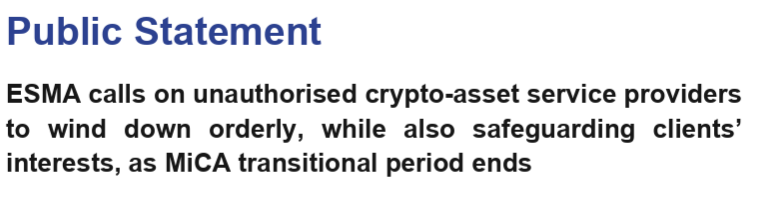
The European Securities and Markets Authority (ESMA) issued its own public statement on June 23, 2026, addressing what happens EU-wide once the MiCA transitional period ends.
ESMA acknowledged that while many crypto-asset service providers (CASPs) will have secured authorization by July 1, 2026, others, including significant providers still servicing EU clients under national regimes, may not be authorized in time.
Source: ESMA Public Statement
ESMA's statement sets out specific requirements for any unauthorized CASP after the deadline:
| Requirement | What It Means |
| Stop onboarding. | Immediately halt new EU client relationships, accounts, and marketing. |
| Limit services. | Only actions needed to sell, transfer, reallocate, or close positions |
| Custody limits | Client asset custody continues only as long as needed for an orderly exit. |
| Client communication | Clear, repeated updates on wind-down timelines and asset protection |
| AML/CFT compliance | Full anti-money-laundering controls maintained throughout the wind-down |
ESMA also warned that non-EU CASPs cannot solicit or serve EU clients at all under MiCA and reminded consumers to verify their provider's authorization status directly through the ESMA Register, moving assets to an authorized CASP or a self-hosted wallet if their current provider isn't listed.
Poland's Numbers Make the Gap More Serious
According to Kara's assessment, Poland previously had more than 2,000 registered virtual asset service providers, yet as of the end of the transition period, zero licences had been issued domestically.
That combination, thousands of previously operating firms and no functioning national licensing path, is what's driving concern about a broader business migration.
Kara's specific concerns include:
-
Polish crypto firms shifting operations to jurisdictions with functioning licensing regimes, such as Germany, France, and the Netherlands
-
A resulting long-term outflow of crypto businesses, technical talent, and capital away from Poland
-
Continued uncertainty for the thousands of previously registered firms until domestic implementation legislation passes
Despite these concerns, Kara said he still views overall as beneficial for the European crypto industry, pointing to its role in strengthening consumer protection and driving institutionalisation across the sector.
Why This EU MiCA News Matters Beyond Poland
Poland's situation illustrates a structural risk built into MiCA's rollout: the regulation sets a hard EU-wide deadline, but implementation still depends on each member state passing its own national legislation to designate a competent authority.
When that domestic step lags, as it has in Poland, businesses are caught between a national registration that no longer counts and a licence; they have no legal path to obtain locally.
The UKNF's own statement confirms this isn't a matter of national discretion; the July 1 deadline is fixed by the Regulation itself and cannot be pushed back by Polish law or a KNF decision.
Conclusion
This latest EU MiCA News confirms a genuine regulatory gap in Poland, one that regulators, both the UKNF and ESMA, have acknowledged directly.
With no domestic competent authority designated and MiCA's transitional protections now expired, Polish crypto firms face a real choice between an uncertain wait for national legislation or relocating to another EU jurisdiction with an operating licensing framework already in place.
How quickly Poland moves to close this gap will likely determine whether the predicted outflow of businesses, talent, and capital actually materialises.
Disclaimer
This article is for educational and informational purposes only and should not be considered financial or investment advice. Always conduct your own research before making investment decisions.
Also read:









