Gram Wallet Telegram Launch: Durov Confirms Rollout Has Begun

Gram Wallet Telegram Launch: Durov Confirms Rollout Has Begun
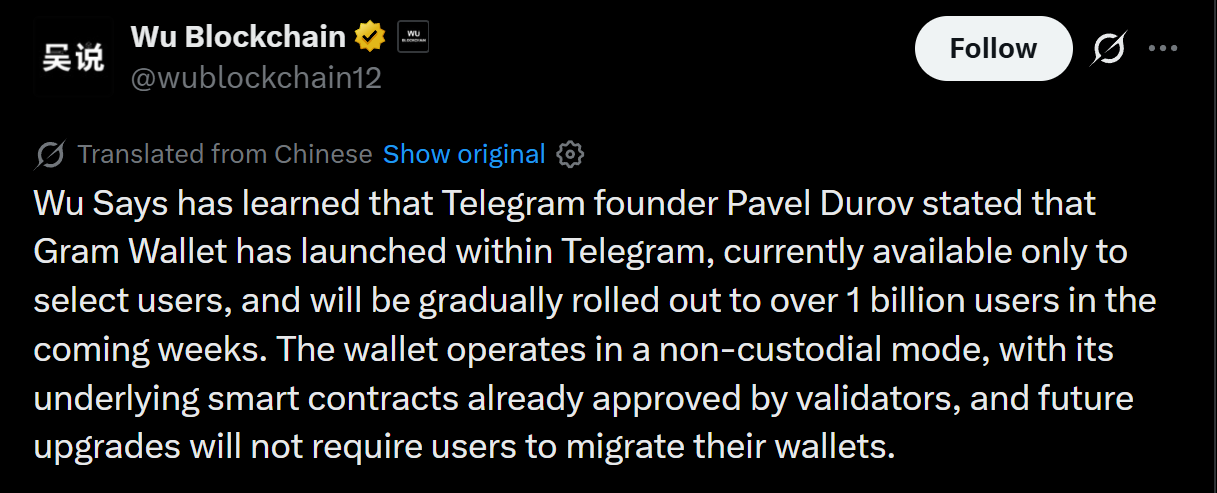
The Gram Wallet Telegram launch is no longer a promise; it's happening. Pavel Durov confirmed on his official channel that the non-custodial feature is now live for a select group of users, with a gradual expansion planned across the app's billion-plus user base over the coming weeks.
Source: WuBlockchain on X
What Durov Announced
Durov first floated the idea back in July, calling it what would become the largest rollout of a non-custodial crypto wallet in human history.
This week's post marks the actual start of that rollout rather than another preview.
Per the announcement, three things are now confirmed:
The feature is live and accessible to an initial group of users
Telegram plans a gradual expansion to its entire billion-plus user base over the next few weeks
The underlying smart contract has already cleared validator approval, which Durov says removes the need for painful migrations in future upgrades
How The New Feature Actually Works
Unlike the existing custodial Wallet bot, which holds user funds through a third-party operator and requires identity checks, the Gram Wallet Telegram launch introduces something structurally different: a non-custodial option.
Each person holds their own private keys directly, and no company, including Telegram itself, can access or recover funds if a recovery phrase gets lost.
It runs on TON, the blockchain whose native token was renamed from Toncoin to Gram earlier this year.
Because it's built directly into the messaging app rather than existing as a separate bot or download, setup requires no external download and no identity verification, a sharp contrast from how the custodial option works today.
Feature | Native Non-Custodial Option | Existing @wallet Bot |
Custody | The user holds keys directly | Third-party operator |
Identity Checks | None required | Required, exchange-style |
Access Point | Built into the main app | Separate bot/mini-app |
Fund Recovery | Not possible if keys are lost | Handled by the operator |
Source: Pavel Durov's Official Channel
Why Validator Approval Matters
This is the part most coverage skips over, but it's worth understanding. TON secures its network through a set of governance smart contracts, including one called Config, which controls how core network parameters get changed.
Per TON's own developer documentation, anyone can propose a change, but that proposal only takes effect once enough active validators sign off by approving it with their own keys.
That process is exactly what Durov means when he thanks the validators who approved the contract powering this launch.
Because the underlying code can be upgraded in place through that validator-approved process, Telegram won't need to deploy a brand-new contract address every time it ships an improvement, which normally forces users into a manual migration, moving funds from an old address to a new one.
Source: TON Governance Contracts Documentation
What This Means For TON
The scale here is genuinely unusual. Telegram counts more than a billion monthly active users, while TON has historically counted its own active addresses in the low millions.
Rolling a self-custody feature out at even a fraction of that reach would rank among the largest single distribution events any blockchain has ever seen.
That gap between potential reach and current network activity is also the open question hanging over this rollout.
Whether people who get access actually start moving value through it, rather than leaving it untouched inside a messaging app they already use daily, will decide whether the Gram Wallet Telegram launch becomes a genuine adoption story or just a very large number of dormant addresses.
For now, the Gram Wallet Telegram launch has cleared its first real hurdle: live, backed by validator sign-off, and expanding on a set schedule. What happens over these coming weeks, as access moves from a small test group toward the full user base, is the next thing worth watching closely.
Disclaimer
This article is for educational and informational purposes only and should not be considered financial or investment advice. Always conduct your own research before making investment decisions.
Also read:






