India Crypto Hearing Cancelled Just Days Before the DEA Session


India Crypto Hearing Cancel August 2026: What’s Behind and Ahead
The Standing Committee on Finance had scheduled a hearing with the Department of Economic Affairs for August 27, 2026. That hearing has now been cancelled. A notice issued by the Lok Sabha Secretariat, dated August 20, confirms that the India Crypto Hearing on virtual digital assets will not take place as planned, seven days before it was due.
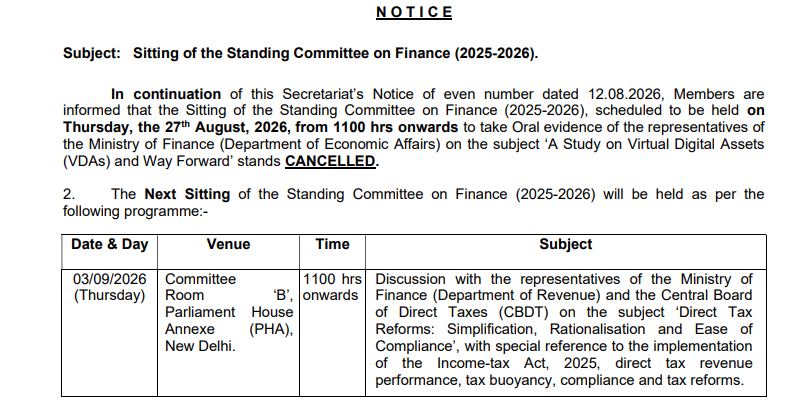
This marks the second delay to this particular session. It was originally scheduled for mid-July, postponed once, and then rescheduled to August 27 before being cancelled altogether. No new date has been announced.
The cancellation is significant for those following the cryptocurrency regulation. The Department of Economic Affairs was expected to be one of the final witnesses in an extended study titled A Study on Virtual Digital Assets and Way Forward.
Exchanges, tax officials, and the RBI had already presented their views to the panel earlier in the process.
What the India Crypto Hearing on August 27 Was Meant to Cover
The session was part of a longer parliamentary study titled A Study on Virtual Digital Assets and Way Forward, which dates back to 2024-25.
The committee has already heard from several stakeholders during this study:
Cryptocurrency exchanges
Tax officials from the Ministry of Finance
The Ministry of Corporate Affairs
The Reserve Bank of India
Other regulatory and industry bodies
The Department of Economic Affairs was expected to be one of the final witnesses. Its VDA testimony was meant to close a gap left by earlier sessions.
What if this India crypto hearing went ahead? It could have delivered:
Clarity on the government's overall position on digital assets
An update on the long-pending discussion paper
Direction on interim measures, such as the self-regulatory organisation model proposed in July
Input to help the committee finalise its recommendations sooner
It would not have created binding law on its own, since Standing Committee reports are recommendatory. But it was expected to be a meaningful step toward reducing regulatory uncertainty.
Why the India Crypto Hearing With the Finance Ministry Was Called Off
The notice offers no explanation beyond stating that the sitting stands cancelled.
Some of the likely pressures behind the delay include the Reserve Bank of India's reported internal position favouring restrictions on private cryptocurrencies, on the grounds that formal regulation could grant the sector added legitimacy.
There is also a gap between that stance and the committee's own July recommendation. This proposed an interim framework built around self-regulatory organisations operating under a designated regulator such as the Securities and Exchange Board of India or the RBI. Repeated delays to the Department of Economic Affairs discussion paper have added to this uncertainty.
Note: The notice gives no reason for the crypto hearing cancel decision and names no replacement date.
What Happens Next After the India Crypto Hearing Gets Cancelled Now
A cancelled sitting does not close the underlying study. Several paths remain open:
The committee can reschedule the meeting at a later date
Its July report already proposed examining a formal statutory framework, with recognised self-regulatory organisations as an interim step
The finance ministry can still issue a discussion paper or draft legislation independent of the committee's calendar
Enforcement and compliance work, including Financial Intelligence Unit registration, continues regardless
The committee's next sitting, on September 3, will focus on direct tax reforms with the Department of Revenue instead. The digital asset study is left without a confirmed date for now.
Why Does India Crypto Market Need This Hearing?
India Crypto Regulation 2026 Position
None of this changes what is legal today. Buying, holding, and trading cryptocurrencies remains allowed for residents. There is still no ban, and still no single law for this sector, only a patchwork of rules:
A flat 30 percent tax applies to gains, with losses generally not offset against other income
A 1 percent tax is deducted at source on qualifying transfers
Platforms must register with the Financial Intelligence Unit and follow anti-money laundering checks
The Reserve Bank of India favors a cautious approach while supporting the Digital Rupee framework
This mix keeps activity legal but commercially uneasy for exchanges building products without a finished rulebook.
What Indian Exchanges and Investors Should Expect in the Coming Weeks
Traders should not expect an overnight shift from this India Crypto Hearing cancellation. The tax structure stays exactly as it is, and daily buying or selling continues without interruption. What changes is the pace of any fresh VDA update coming from Parliament.
Exchanges hoping for clarity may need a rescheduled panel or a standalone move from the finance ministry, such as the long-delayed discussion paper. This looks like a pause in paperwork, not a shift in policy.
Disclaimer: This article is for informational purposes only and does not constitute financial or investment advice. Crypto markets carry significant risk. Always do your own research before making any investment decisions.









