Kraken Wallet Manifesto Reveals A New Vision For Crypto Self Custody

Kraken Wallet Manifesto Redefines Self Custody For Crypto Users
Kraken has published its Kraken Wallet Manifesto, a lengthy statement of intent explaining who the new wallet is built for and why the exchange believes self-custody needs rethinking right now.
Rather than chasing mass retail adoption, the document positions this product squarely at experienced crypto holders who want more control over how their assets are stored, spent, and put to work onchain.
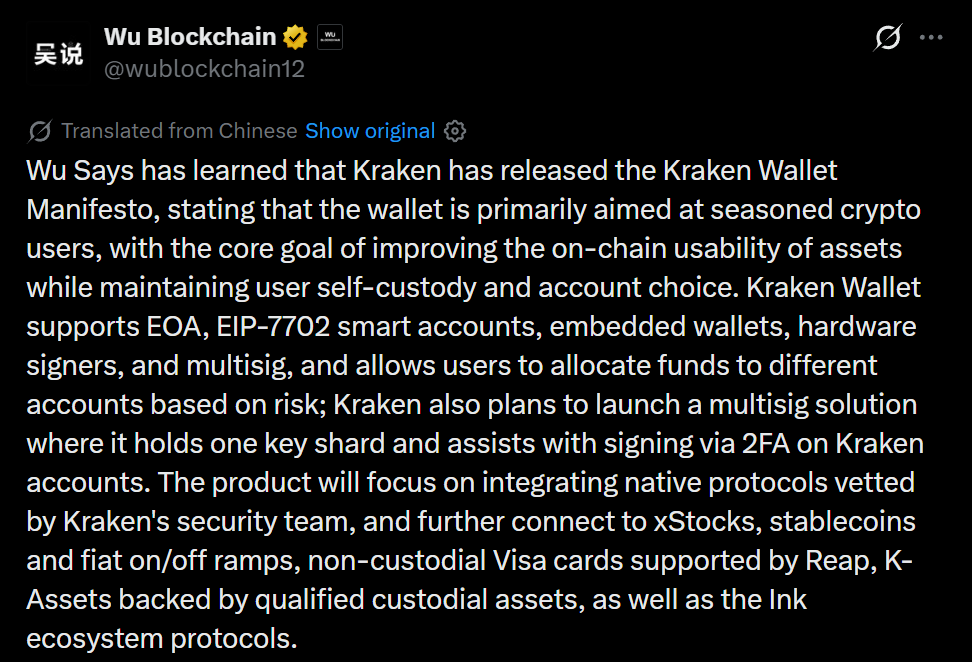
Source: WuBlockchain on X
Why The Timing Matters Now
The Kraken Wallet Manifesto opens by arguing that two recent shifts changed the calculus around self-custody.
First, a firmware flaw in a widely trusted hardware wallet quietly weakened how securely new seed phrases were generated, starting back in 2021.
Blockchain analytics firm Galaxy Research later estimated that losses tied to the resulting exploit climbed past $100 million across thousands of affected addresses.
Second, the manifesto points to the growing cost of staying on the sidelines, citing how early participants in decentralized platforms like Hyperliquid captured billions in value through token distributions that latecomers missed entirely.
Together, Kraken frames these two trends as the reason cold storage alone no longer feels sufficient for active onchain users.
How The Account System Is Actually Structured
Rather than forcing a single account type on every user, the Kraken Wallet Manifesto describes a design built around choice.
Supported account types include standard externally owned accounts, newer smart accounts under the EIP-7702 standard, embedded accounts, hardware signer connections, and multisignature setups.
The idea is that a person can split holdings across several account types at once—keeping the bulk of funds in a higher-security multisig while running a smaller, more active account for daily on-chain activity.
The company has also confirmed plans for its own co-signer multisig option, where it holds one key fragment and helps authorize transactions through two-factor login on a person's existing account.
What The Product Plans To Connect To
Beyond account structure, the announcement also lays out a roadmap for what the product will plug into.
Rather than supporting every protocol available, the firm says it will only natively integrate services that its own security team has reviewed and approved, starting with lending and borrowing tools on the Ink network.
Planned connections named in the announcement include:
Tokenized stock products known as xStocks for exposure to traditional equities on-chain
Stablecoin support alongside fiat on-ramps and off-ramps
Non-custodial Visa card functionality built through payments partner Reap
K-Assets, a receipt-token system backed by holdings kept in Kraken's qualified custody
Native support for the Ink ecosystem, including its early points programs
Quick Feature Snapshot
Detail | Information |
Target audience | Experienced crypto users rather than mass retail |
Supported account types | EOA, EIP-7702 smart accounts, embedded wallets, hardware signers, multisig |
Planned co-signer multisig | The firm holds one key shard and assists via 2FA |
Core integrations vetted by internal security team | Ink network protocols, including lending and borrowing |
Planned connections | xStocks, stablecoins, fiat ramps, Reap cards, K-Assets |
Current availability | iOS live now, Android coming the following week |
Source: 0xsubugatai's Manifesto Thread on X
What This Signals For The Company's Broader Strategy
This positioning ties the new product directly back to the parent company's fifteen-year operating history, stating that the licensing, banking relationships, and security track record built over that time now underpin the wallet itself.
The document repeatedly emphasizes that Kraken has never lost client funds to a hack and frames that record as the basis for trusting it with a partial key in the upcoming co-signer option.
The broader pitch is that sophisticated users should not have to choose between airtight security and the ability to actually use their holdings on-chain.
Conclusion
With this Kraken Wallet Manifesto now public, the exchange has set clear expectations for a product aimed squarely at experienced holders rather than newcomers, combining flexible account options with a tightly curated set of on-chain integrations.
Whether that balance between security and usability resonates with its intended audience should become clearer as adoption data comes in following the iOS launch and the upcoming Android rollout.
Disclaimer
This content is for informational purposes only and is not financial, investment, cybersecurity, or legal advice. Always verify information, do your own research, and use caution. We are not responsible for any losses or damages.
Also read:









