Quantum-Resistant Crypto Pilot Hits NEAR Testnet

Quantum-Resistant Crypto Pilot with Banks on NEAR
In major Crypto news, a new quantum-resistant crypto pilot has gone live, and this time it is not developers alone testing the waters.
Regulated banks and financial regulators from three continents are now part of the experiment. The Responsible Fintech Institute (RFI) and digital asset custody firm Safeheron announced the initiative on August 23, 2026, as confirmed in the official press release.
The programme evaluates post-quantum cryptography for wallet generation and on-chain transfers, running entirely on a quantum-resistant NEAR testnet.
News of the launch spread quickly on crypto social media too, with the crypto_banter post on X summarising the pilot as the first major quantum-resistant crypto pilot to bring banks and regulators together on the same infrastructure.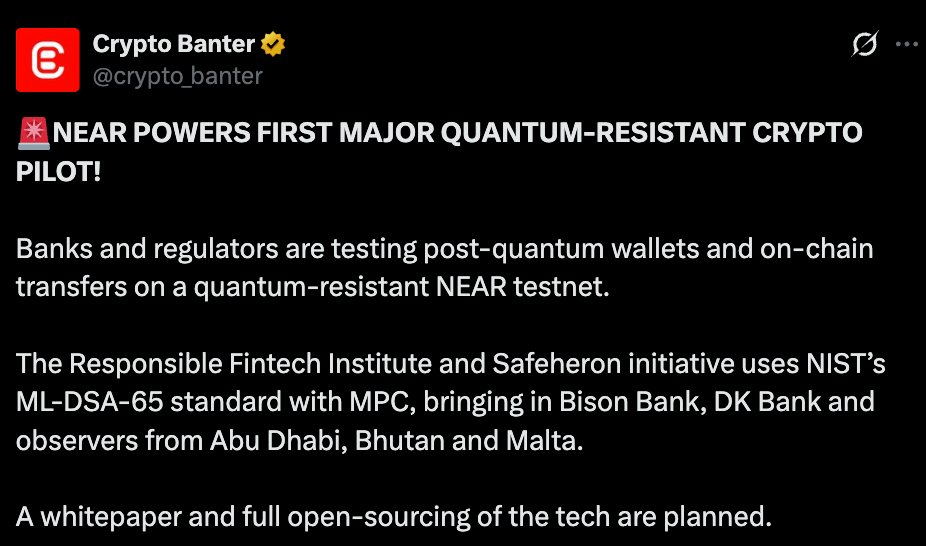
What The Quantum-Resistant Crypto Pilot Actually Tests
At its core, this quantum-resistant crypto pilot is built around a multi-party computation protocol, commonly shortened to MPC quantum cryptography.
That supports ML-DSA-65, the digital signature standard formalized by the US National Institute of Standards and Technology under FIPS 204. Instead of theorizing about quantum risk, participants are running live tests:
Wallet generation using post-quantum signature schemes.
On-chain transfers inside a shared application environment.
Non-custodial 2-of-2 MPC key control designed to limit operational burden.
Cross-border interoperability checks between different regulatory regimes.
Safeheron is handling the engineering side, contributing what amounts to a Safeheron quantum wallet framework for the pilot, while Responsible Fintech Institute leads governance and coordination across jurisdictions.
Who Is Involved
Role | Participant |
Technology partner | Safeheron |
Convening body | Responsible Fintech Institute |
Banks | Bison Bank, DK Bank |
Regulators (observer role) | Abu Dhabi Global Market, Gelephu Financial Services Office (Bhutan), Malta Financial Services Authority |
The involvement of Bison Bank DK Bank testing alongside three separate regulators is notable.
Banks are handling the technical side, generating post-quantum wallets for banks and moving test transfers, while regulators currently observe the first phase before contributing to a governance workstream later.
Why ML-DSA-65 And NEAR Protocol Quantum Security Matter
Public-key cryptography underpinning most blockchains today is not built to withstand a sufficiently powerful quantum computer.
NEAR was chosen partly because its account model already supports key rotation, making the shift to NEAR protocol quantum security more practical than on chains where addresses are permanently tied to a single keypair.
RFI Chairman Chia Hock Lai said no single bank, vendor, or regulator can solve this alone, and that testing the same post-quantum architecture across jurisdictions builds a compliance and security reference the industry can stand on.
Safeheron's Chief Security and Policy Officer Jag Foo said AI is accelerating the pace of change and bringing the quantum threat closer to reality, adding that Safeheron intends to open-source its PQC code so cryptography securing institutional assets stands up to independent scrutiny rather than asking for trust.
This pilot is not happening in isolation. Momentum toward a quantum safe blockchain 2026 standard has been building all year.
For instance, the Bank for International Settlements published a paper on quantum-readiness for the financial system, calling for phased migration rather than a simple algorithm swap.
At the same time, the Monetary Authority of Singapore and ABS formed a joint taskforce on AI and quantum cyber risk.
Additionally, the Hong Kong Monetary Authority has embedded quantum readiness into its Fintech 2030 roadmap.
What Comes Next
Organizers plan to publish a whitepaper detailing the research, protocol design, and testing outcomes, and Safeheron has committed to open-sourcing the underlying PQC code once development matures.
Regulators including Malta's MFSA and Bhutan's GFSO have indicated the exercise gives them an early supervisory view into how quantum-safe rails might operate before any binding mandate exists.
Conclusion
As a standout headline in Crypto news today, this quantum-resistant crypto pilot marks one of the clearest signals yet that post-quantum readiness is moving from whitepapers into live testing environments with regulated financial institutions in the room.
With Bison Bank and DK Bank running actual wallet and transfer tests on NEAR, and three regulators observing the process firsthand, the initiative gives the market a real-world reference point rather than another theoretical roadmap.
The planned whitepaper and eventual open-sourcing of Safeheron's PQC code will likely determine how quickly other banks and jurisdictions follow this early lead into quantum-safe infrastructure.
Expert View
Industry analysts note that this quantum-resistant crypto pilot marks an unusually early convergence of regulators and regulated banks around post-quantum cryptography, rather than the technology-only trials seen on chains like Solana or Bitcoin forks.
The presence of three separate regulatory bodies at the observer stage suggests supervisory frameworks for quantum-safe digital asset transfers could develop faster than markets currently expect, though actual mainnet adoption timelines remain unconfirmed.
Disclaimer: This pilot is a testnet research exercise and does not represent a live financial product. Nothing in this article constitutes investment advice; outcomes of post-quantum migration efforts may vary and should not be taken as guaranteed.









