Pi Network News: OpenClaw And Atlassian MCP Server Arrive On SoloHost

Pi Network News Shows SoloHost Expanding Beyond Nodes
Pi Network News today centers on two new additions to SoloHost, the self-hosted app platform built into the desktop client.
A local AI agent called OpenClaw and a developer-focused Atlassian MCP Server have both joined the lineup, giving desktop app users more ways to run software directly on their own machines rather than relying on outside servers.
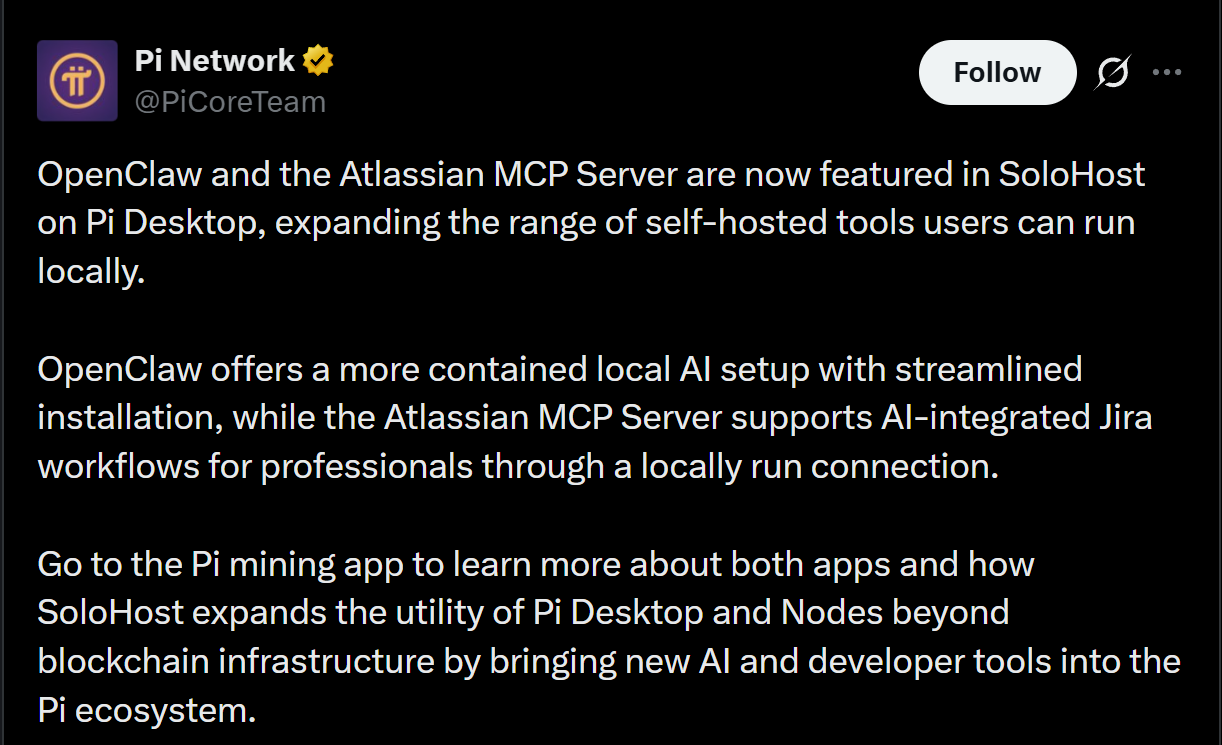
Source: @PI On X
What SoloHost Actually Does For Pioneers
SoloHost lets desktop app users discover, install, and run self-hosted applications without manually setting up the underlying server, Docker environment, or other backend pieces themselves.
This latest Pi Network News update arrives alongside the recent Node 0.6.2 release and shows how the platform is expanding beyond pure blockchain infrastructure into general-purpose local computing tools.
How OpenClaw Works And Why It Runs In A Container
OpenClaw is a personal AI agent that can operate using either a locally installed model or an external one such as ChatGPT or Claude, depending on what a user's hardware can support.
When it runs through SoloHost, the agent is placed inside a restricted container that limits its default access to the wider computer, rather than granting broad file-system reach the way a standalone install typically would.
This setup does not block every action a user actively authorizes, but it does cut down on unnecessary background access to unrelated files and system resources.
Its memory in either configuration stays stored locally on the user's own device rather than on a remote server.
Key details about this addition include:
Runs on either a local AI model or a connected external model
Operates inside a contained environment with restricted default access
Stores agent memory locally rather than remotely
Joins the existing Hermes agent as a second local AI option on the platform
Focuses more on cross-tool and messaging connectivity than persistent memory
Why The Atlassian MCP Server Matters For Developers
The second addition targets a more specialized audience, namely developers and product teams who want AI tools working directly inside their Jira workflows.
Atlassian already offers its own hosted version of this connection, but teams sometimes run into quota limits or reliability issues when depending on that shared hosted option.
This new self-hosted version instead lets a user run the connecting server locally on their own machine, removing those shared usage constraints entirely.
Because the setup relies on the open Model Context Protocol rather than being tied to one specific AI platform, it can work with several compatible tools, including Cursor, Claude Desktop, Claude Code, and Codex.
Quick Feature Snapshot
Detail | Information |
New apps added | OpenClaw and Atlassian MCP Server |
Released alongside | Pi Node version 0.6.2 |
OpenClaw model options | Local model or external models like ChatGPT and Claude |
Atlassian MCP server-compatible tools | Cursor, Claude Desktop, Claude Code, Codex |
SoloHost development stage | Beta, with open permissionless publisher flow |
Reported Pi Node runner base | 420,000+ |
Source: Pi Network Official
What This Signals For The Wider Ecosystem
This round of Pi Network News points to a broader shift in how the platform positions its desktop app and node software, not just as blockchain infrastructure but as general-purpose computing tools that pioneers can put to everyday use.
The company frames this expansion as a way for users to benefit from AI capabilities while keeping more of their data and processing on devices they personally control, rather than sending everything to third-party servers.
Since SoloHost remains in beta with an open publisher flow, the platform is asking users to evaluate individual apps and install them at their own discretion rather than treating every listed package as fully vetted.
Conclusion
With OpenClaw and the Atlassian MCP Server now live inside SoloHost, this latest Pi Network News update shows the ecosystem continuing to broaden what the desktop app can actually be used for beyond mining and node operation.
As more developers bring self-hosted tools into the platform, SoloHost looks positioned to keep expanding the practical value pioneers can get from hardware they already run.
Disclaimer
This content is for informational purposes only and is not financial, investment, cybersecurity, or legal advice. Always verify information, do your own research, and use caution. We are not responsible for any losses or damages.









