Pi Network News: OpenPay Mainnet Shift And Pi Coin Price Update


Pi Network News: Ecosystem Apps Update, Price Today, and Updates Next
Pi Network News today centers on a major shift for OpenPay, one of the busiest third-party apps built on $Pi. Effective immediately, OpenPay's testnet listing inside Pi-Apps has ended. Anyone opening the app is now redirected straight to OpenPay's live mainnet site at openpy.space. $Pi coin itself trades near $0.0898, down close to 1% over the past 24 hours, with a market cap sitting around $996.6 million.
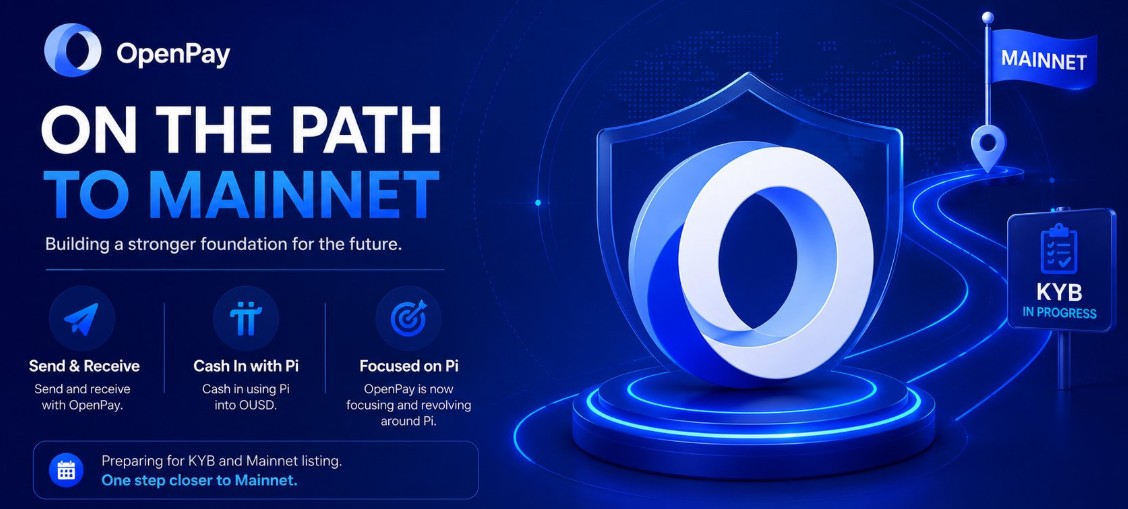
Source: Official Announcement
This single change carries weight for the wider Pi Network ecosystem. It shows one of $PI's largest external wallets moving past experimentation and stepping toward permanent mainnet status.
It also raises a fair question many Pioneers are asking right now: did the P$I Network officially list OpenPay, or did OpenPay simply launch its own mainnet on its own terms?
OpenPay Exits Pi Apps Testnet And Moves Fully To Its Mainnet Platform
OpenPay is a Web3 digital wallet $Pi payment app built around send and receive tools, QR scanning, and cash-in options tied to $Pi. The team behind it, linked to the broader MRWAIN and wainfoundation network, confirmed the testnet chapter is closed. Every user landing on the old link now moves to the mainnet build.
There's a catch worth noting. OpenPay does not currently appear on the official Pi Network KYB list published at minepi.com, which mostly features exchanges such as Kraken and OKX. $Pi's own guidance urges caution around apps claiming mainnet readiness without formal approval.
Scam-tracking sites, including official ScamAdviser, also flag the domain's short history and limited trust score, mainly because it is young and tied to crypto services that carry higher risk by nature.
OpenPay also runs its own separate KYC step, even for people who already cleared $Pi's official verification. The team says this is because it lacks access to Pi's private KYC records and needs its own data for compliance reasons tied to financial features like loans and cash-in.
OpenPay Says Its Mainnet Launch Is Separate From Pi Network's Listing
OpenPay pushed back directly on criticism in a follow-up statement titled "We've Completed Our Part." The team said its KYB application has already been submitted. According to the post, $Pi Authentication and Payments are already built into the app, and its own OUSD token system is live and running.
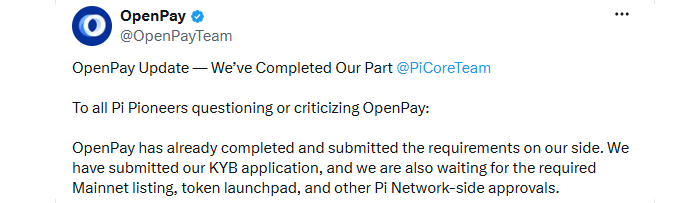
The core message: OpenPay considers its own development finished. What remains, the team says, sits entirely on Pi Network's side — a formal Mainnet listing, token launchpad approval, and internal review that OpenPay cannot speed up or control.
Pi Network News Update: KYB Progress And OpenPay Wallet Features Today
OpenPay shared a fuller picture of where it stands on $PI Network KYB requirements. Key milestones include:
-
$Pi authentication built into the wallet login
-
Cash-in support that converts $Pi into OUSD
-
Send and receive tools between $Pi wallets
-
QR code scanning for quick payments
-
Wallet-to-Pi-Wallet transfers
-
A refreshed interface with OpenLedger transaction receipts
KYB approval itself is still listed as in progress rather than finished. Some transfer features also remain testnet-limited until the Core Team grants a formal $PI Mainnet listing. The company points to a full changelog on its site for anyone tracking each build.
$PI Coin Price Today: Small Moves Amid Wider Market Caution Signs
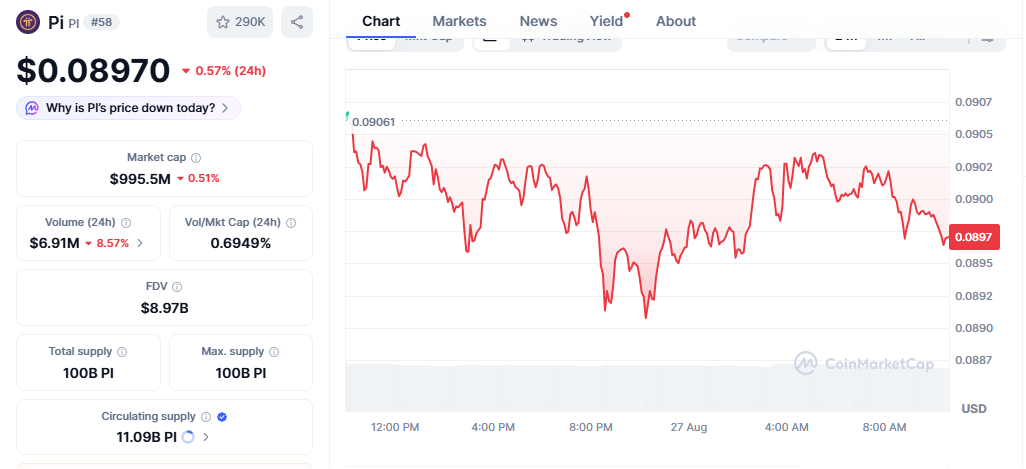
$PI coin price today reflects a quiet, slightly negative session rather than sharp swings. Current figures as per CoinMarketCap show:
-
Price: $0.08970, down 0.57% in 24 hours
-
Market cap: $995.5 million
-
24-hour volume: $6.91 million, down 8.57%
-
Fully diluted valuation: $8.98 billion
-
Total and Max supply: 100 billion $PI
-
Circulating supply: 11.09 billion $PI
Trading volume falling faster than price suggests fewer active trades rather than heavy selling pressure.
Pi Network Ecosystem 2026: Protocol Upgrades
On the protocol side of Pi Network News, ecosystem development is moving on its own separate track. Pi Core Team confirmed Protocol 26 is now complete, closing out a build cycle focused on core network stability.
Right after that, Protocol 27 entered testnet, marking the newest upgrade in the lineup.
This latest round centers on tighter authentication for smart contracts. That focus matters because stronger authentication is described as a required building block before high-authority protocol functions can be safely enabled on mainnet.
Every protocols release have generally added one more layer of infrastructure, and Protocol 27 continues that same step-by-step pattern rather than introducing an unrelated feature set.
What Comes Next For Pi Network After The Protocol 27 Testnet Phase
With Protocol 27 now in testnet, the next stage involves testing, feedback, and eventual movement toward a mainnet release, following the same path Protocol 26 already completed. Beyond protocol work, supply data adds another angle worth tracking separately.
Unlock schedules for 2029 point to a sharp drop in monthly $Pi releases, with several months falling below 4,000 $PI after one larger spike near 15,700 $PI in August that year.
Between OpenPay's independent mainnet launch, its ongoing wait for official Pi Network approval, and Protocol 27's move into testnet, the ecosystem is clearly shifting from testing mode into something closer to production.
The months ahead, especially any formal KYB decision on OpenPay and Protocol 27's testnet results, look set to shape whether this momentum turns into lasting utility for $Pi coin holders.
Disclaimer: This article is for informational purposes only and does not constitute financial or investment advice. Crypto markets carry significant risk. Always do your own research before making any investment decisions.









