Pi Network News: What New AI Tools on Desktop and Nodes Can Do?


Pi Network News Today: SoloHost Brings Local AI Tools to Desktop Nodes
$PI coin climbed 1.78% to $0.0931 over the past 24 hours, moving against a broader market dip. The biggest piece of Pi Network news this week, and one of the more notable SoloHost updates so far, explains why: a fresh SoloHost rollout is turning ordinary Pi-Nodes into local AI machines.

Source: Official Announcement
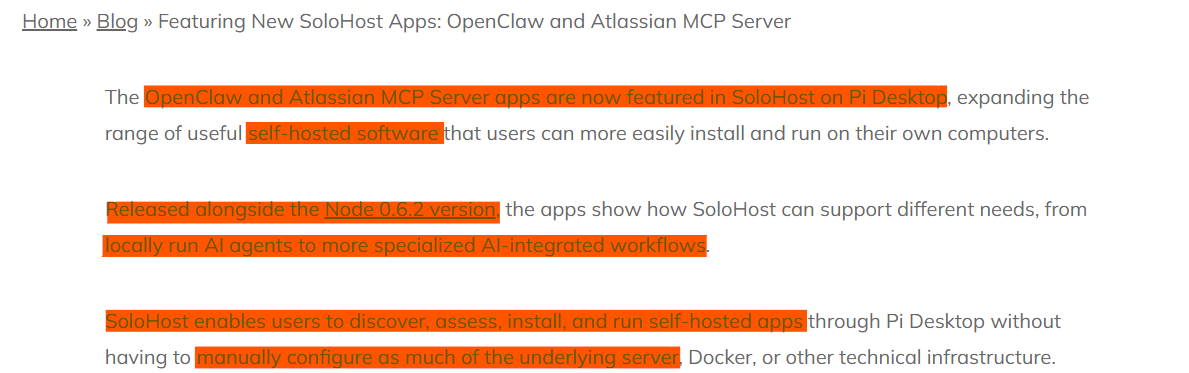
The update landed with Pi-Desktop Node version 0.6.2. It adds two new self-hosted apps, OpenClaw for local AI assistance and an Atlassian MCP Server for connecting AI tools to Jira. Both apps install automatically, without any manual server setup.
Trading volume backs up the excitement. Volume jumped 83% in 24 hours, a signal that buyers stepped in rather than sat on the sidelines.
Pi Network News: What SoloHost and OpenClaw Actually Bring to Users
SoloHost is a beta framework built directly into Pi Desktop, the same software that runs Pi-Nodes. It lets Pioneers discover, install, and run self-hosted applications on their own machines.
Docker containers, servers, and other technical steps happen behind the scenes. That level of automation is what makes this Pi Network news different from a typical software patch note.
The Pi OpenClaw AI agent stands out as the flagship app. It runs local AI models or connects to external ones like ChatGPT or Claude, storing memory on-device inside a restricted container. That setup keeps personal data off third-party servers.
Key details worth noting:
-
SoloHost first launched in beta on Pi2Day 2026, June 28, as an open system for developers
-
Apps can be managed remotely through the Pi-Browser on mobile
-
The Atlassian MCP Server links AI assistants to Jira for automated project workflows
-
Node operators gain extra use for hardware already running around the clock
Pi Network News: Why the OpenClaw AI Agent Matters for Pioneers
This push fits a bigger pattern. The network upgrades 2026 have steadily shifted the network's Desktop and Node software away from pure blockchain duties. SoloHost turns that same hardware into a platform for everyday computing tasks.
Source: Official Upgrades Blog
For everyday Pioneers, the change means simple access to local AI tools without technical setup. For developers, it opens a distribution channel to reach a base of more than 420,000 active nodes. That scale matters for anyone building $PI Network AI tools or other self-hosted software, and it gives this round of crypto news real staying power beyond a single announcement.
Alongside the SoloHost rollout, the $PI coding agent crossed 100,000 stars on GitHub. That milestone points to real developer engagement, not just casual interest, and adds weight to the broader Pi network ecosystem story.
Pi Network roadmap 2026 also points toward distributed computing. An early test already succeeded, with volunteer nodes processing tasks and returning results automatically. Longer term, node operators may earn $PI for contributing spare computing capacity to outside clients, turning the $PI's decentralized infrastructure into something closer to a working compute network.
Pi Network News: $Pi Coin Price Today Reacted to Fresh Upgrades
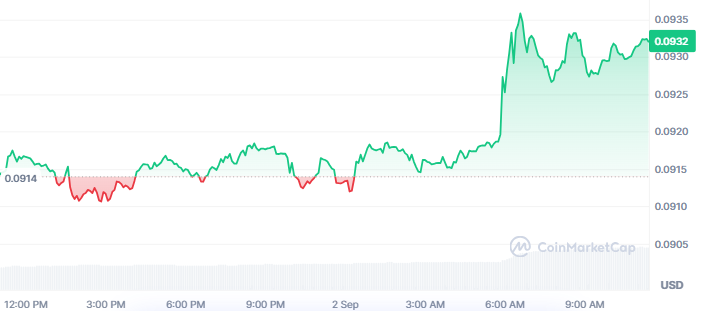
$PI coin price today sits at $0.09325, up 1.89% over 24 hours even as much of the wider market pulled back. CoinMarketCap data shows steady interest building around the coin.
-
Market cap: $1.03 billion, up 1.93%
-
24-hour volume: $5.05 million, up 83.18%
-
Fully diluted valuation: $9.31 billion
-
Circulating supply: 11.14 billion $PI, against a 100 billion max supply
Two factors appear to be driving the move. Progress on Protocol 27, alongside expanded utility through OpenPay and SoloHost, has fed accumulation among long-term holders.
The sharp rise in trading volume also breaks a recent stretch of flat activity, suggesting fresh capital entered rather than existing holders simply shuffling positions.
Pi Network News: KYC Delays Still Testing Pioneer Patience in 2026
Not every part of the network is moving smoothly, and any complete $PI coin news roundup has to account for that. Millions of Pioneers remain stuck in Tentative KYC status, some for a year or longer. Tentative does not mean rejected. It signals extra checks for fraud prevention, duplicate accounts, or regional compliance rules.
Roughly 18 million users hold verified KYC status, yet only about 16 to 17 million have completed full migration to Open Mainnet. That gap comes down to a few recurring issues:
-
Long backlogs, though batch processing cleared millions of cases in late 2025
-
Regional compliance blocks that trigger extra security review
-
Document or liveness check failures from blurry photos or unsupported formats
-
Migration steps, like wallet setup and two-factor authentication, that still take time after KYC clears
The Core Team has described Tentative status as a deliberate safeguard meant to keep the network limited to real, unique humans. Officials advise Pioneers to complete available liveness checks, submit clear documents, and keep mining active while waiting for status updates.
The Network's Open Mainnet went live on February 20, 2025, removing the firewall that once blocked outside wallet transfers and exchange trading. More than a year later, individual migrations still move in queues rather than on one fixed schedule for everyone.
What’s Ahead of the Pi Network News Today?
The mix of technical progress and lingering friction sums up where the network stands heading into the rest of 2026. This latest 2026 update shows real product momentum, and the price reaction suggests holders are taking notice.
Any lasting $PI coin recovery 2026 will likely depend on how fast the remaining KYC backlog clears and how many developers actually build on the new self-hosted platform.
Disclaimer: This article is for informational purposes only and does not constitute financial or investment advice. Crypto markets carry significant risk. Always do your own research before making any investment decisions.






