Polymarket News: Fed Rate Cut Vs Clarity Act, What Coming in September

What Does Polymarket News Say About Fed Rate Cut and Clarity Act?
Crypto traders are watching two events at once this September, and neither one looks like a sure thing. Will the Federal Reserve cut rates? Will Congress finally pass the crypto rulebook the industry has waited years for? Polymarket News is where you find the answer, and right now the answer is: probably not, on both counts. The wider market backs that view too, sitting in a quiet consolidation phase rather than making a big directional bet ahead of either event.
Key Takeaways
-
68% of Polymarket traders expect no change to the Fed's target rate at the September 2026 meeting, with only 31% pricing in a 25 basis point hike.
-
Clarity Act odds fell from 28% to 15% in a single week, showing traders growing less confident the bill becomes law by the end of 2026.
-
The global crypto market cap sits at $2.75 trillion, up just 0.2% in 24 hours, a sign of a market waiting rather than moving.
What Does Polymarket News Say About The Fed's Next Move?
The Fed meets next on September 16, 2026, and the target range currently sits between 3.50% and 3.75%, according to the CME FedWatch Tool. That backdrop matters, because Polymarket's "Fed Decision in September" shows traders leaning firmly toward no change.
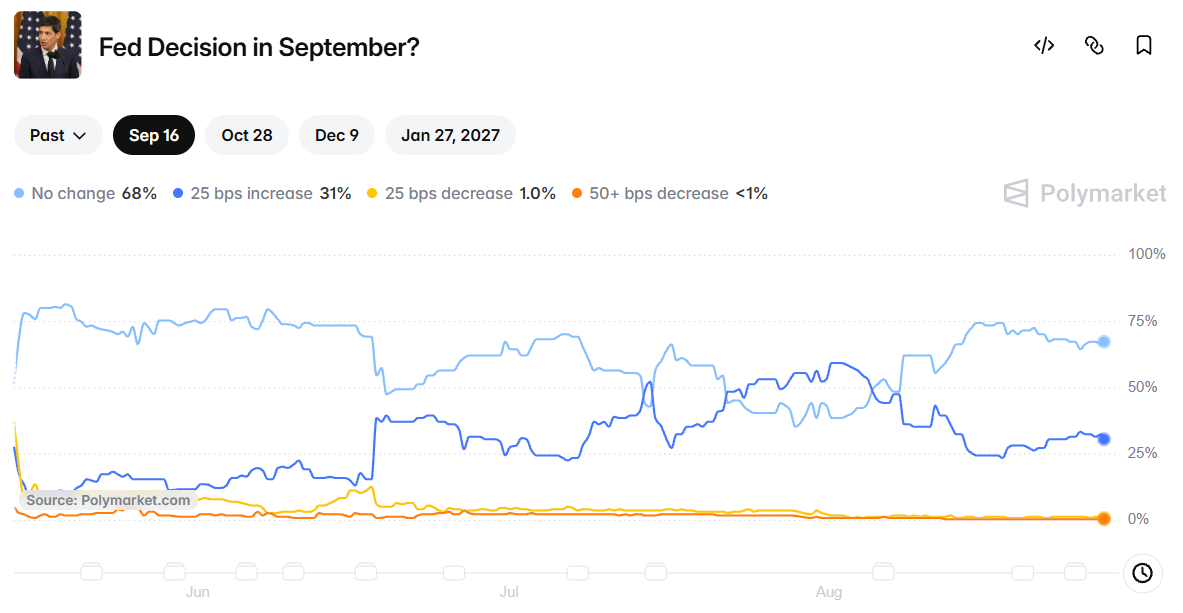
Source: Polymarket Data
Here's how the odds break down right now:
| Outcome | Polymarket Odds |
|---|---|
| No change | 68% |
| 25 bps increase | 31% |
| 25 bps decrease | 1.0% |
| 50+ bps decrease | Under 1% |
A rate cut barely registers as a possibility. Traders are pricing this as a hold, not a pivot, and that reading lines up with a crypto market that isn't running hot either. Bitcoin dominance sits at 57.6%, Ethereum dominance at 11%, and daily trading volume across all crypto is $80.4 billion.
None of those numbers scream risk-on. They read like a space parked in neutral, waiting for the Fed to actually speak before it moves again.
Why Is The Clarity Act Losing Ground On Polymarket?
The Digital Asset Market Clarity Act of 2025, known in Congress as H.R.3633, is the bill the crypto industry has pushed hardest for. It would hand the Commodity Futures Trading Commission the job of regulating digital commodity exchanges, brokers, and dealers.
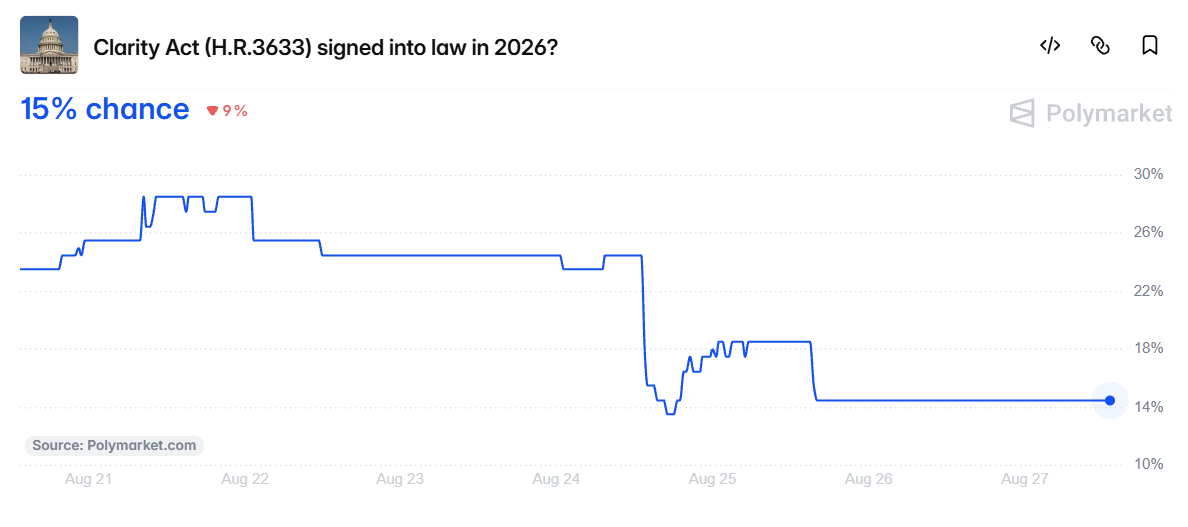
Source: Polymarket Site
To trade on an exchange under the bill, a token's blockchain would need to be mature or run under decentralized control, or its issuer would need to file regular reports. The bill also sets rules for trade monitoring, recordkeeping, and how customer funds get kept separate from a firm's own money.
The House already passed it. The Senate hasn't. Polymarket's market on whether the Clarity Act gets signed into law by December 31, 2026 now sits at just 15%, sliding from 28% inside a week. That's a sharp drop for a bill industry groups treat as their top legislative priority.
The politics around it are heating up regardless. Reuters reported that Stand With Crypto, the Coinbase-backed advocacy group, endorsed 32 sitting House members ahead of the November midterms. Every one of them voted for the Clarity Act when it passed the House, including Tom Emmer, Bill Huizenga, Ritchie Torres, and Josh Gottheimer.
The strategy is straightforward: if the Senate won't move the bill now, keep the House majority that already backed it, and keep pressure on for the next session.
A Senate vote is expected around September 15, one day before the Fed decision. If it stalls again, some analysts think the SEC and CFTC could start writing their own rules rather than wait on Congress.
What Should Traders Expect Heading Into September?
Line up both markets and a pattern shows: no Fed rate cut, and a Clarity Act that likely passes procedural steps or gets debated without full adoption by year-end. That combination points to a market that keeps consolidating rather than breaking out sharply in either direction through September. Neither event removes uncertainty on its own, and traders on Polymarket seem to be pricing that in already.
YMYL Disclaimer: This article covers prediction market odds and legislative and monetary policy developments. It is for informational purposes only and does not constitute financial, investment, legal, or trading advice. Prediction market prices reflect trader sentiment, not guaranteed outcomes, and can change quickly. Federal Reserve decisions and congressional votes are subject to change without notice. Always do your own research and speak with a licensed financial or legal advisor before making decisions based on this information.









