Russia Crypto Law 2026 Takes Effect: What Traders Need to Know


Russia Crypto Law 2026: Retail, Crypto Payments and Licensing Changes
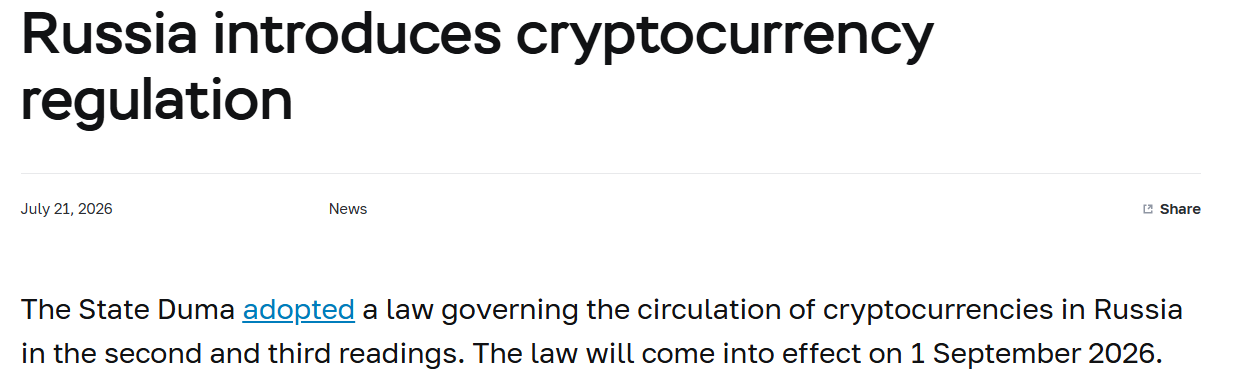
Russia crypto law 2026 finally goes live today as of September 1, 2026. A new law, Federal Law No. 282-FZ, moved trading out of the shadows into licensed hands. The Russia crypto law 2026 sets fresh limits on who can trade, how much, and which coins qualify.
The rules apply to exchanges, brokers, and custodians. Anyone offering cryptocurrency services inside Russia now needs a license from the Central Bank.
Here is what changed under this Russia Crypto Law 2026:
-
Retail buyers face a yearly cap of ₽300,000 (about $3,700) per intermediary
-
A test is required before non-qualified investors can open an account
-
Qualified investors trade without that cap
-
Bitcoin, Ethereum, and USDT are the first assets open to retail buyers
-
Paying for goods and services with cryptocurrency inside Russia stays banned
-
Cross-border trade settlements are allowed under the new rules
Licensing will not happen overnight. Existing platforms get a transition window into 2027, and some issuance rules only start on September 1, 2027.
Sberbank projects the newly regulated market could handle ₽3.5 to 4 trillion, roughly $40 to $46 billion, in first-year trading volume, climbing toward ₽7.5 trillion, near $87 billion, by 2029.
Why Russia Crypto Adoption Grew After Sanctions Cut Off Bank Access
The Russian Government’s stance on digital assets has shifted sharply since 2022. Early that year, the Central Bank pushed for a near-total ban on digital asset trading, citing risks to financial stability.
Exclusion from SWIFT changed that thinking fast as per the Chainalysis report. Banks needed new ways to move money across borders, and cryptocurrencies became part of the answer.
Mining got legal status in 2024 through Federal Law No. 221-FZ, with registries and energy caps attached. A trial program the same year let cryptocurrency settle limited foreign trade deals. The Russia crypto law 2026 builds on both moves, formalizing a domestic market while keeping cross-border settlement open without volume limits for exporters and importers.
MiCA vs Russia Crypto Regulation and the CLARITY Act Side by Side
The European Union's MiCA framework has applied fully since late 2024. It grants one license valid across the bloc and generally allows cryptocurrency payments, making it the most open of the three systems.
In the United States, the CLARITY Act remains stuck in the legislative process as of early September 2026. The House passed its version in 2025, and a Senate committee advanced a related bill, but a final vote timeline stays unclear. Its main goal is splitting oversight between the SEC and CFTC, not building a new licensing regime.
Russia's approach sits apart from both. State control comes first, with a strict ban on domestic digital asset payments, tight retail caps, and central bank oversight over every licensed player.
Digital Ruble Rollout Adds a Second Layer to Russia Crypto News Today
A broader rollout of the digital ruble, the Central Bank's own digital currency, also began on September 1. Moscow now has two parallel tools: a state-backed digital currency for domestic use and a supervised private digital asset market aimed largely at trade.
Officials expect the framework to pull informal peer-to-peer and offshore cryptocurrency activity into channels the Central Bank can track. Holders also gain legal protection through the courts, something informal trading never offered.
What's Next
The real test comes as 2027 gets closer. Watch three things: how much trading volume shows up, how many small investors sign up and pass the test, and how strictly banks enforce that ₽300,000 cap. Those answers will show if Russia's locked-down model can hold its own next to the more open cryptocurrency cross-border settlement rules used in Europe and the slower path still being built in the U.S.
Disclaimer: This article is for informational purposes only and does not constitute financial or investment advice. Cryptocurrency markets carry significant risk. Always do your own research before making any investment decisions.
Also read:






