Russia Digital ruble launch Goes Mainstream today

Russia's digital ruble launch officially began on September 1, 2026, when the Bank of Russia's mandate for the country's 12 systemically important banks and largest retailers to support the state-issued currency took effect.
Sberbank, VTB, Alfa-Bank, Gazprombank, and the other listed lenders must now let customers open Virtual $ruble wallets inside their existing mobile banking apps, according to the Bank of Russia.
Retailers that bank with these institutions and posted over ₽120 million in revenue last year must accept Virtual $ruble payments from the same date.
Bank of Russia Governor Elvira Nabiullina told TASS ahead of the rollout that "technologically, everything is ready." As of September 1, 2026, the mandate is officially in force.
What Changes for Banks and Retailers in the Digital Ruble Launch?
From September 1, 2026, Russia's Virtual $ruble launch requires 12 systemically important banks and Sellers earning over ₽120 million a year to support Virtual ruble payments and wallets, per the Financial Institution of Russia.
Customers access wallets through their normal banking app, individual transactions are fee-free, and payments run through a universal QR code.
Smaller banks and retailers follow later.
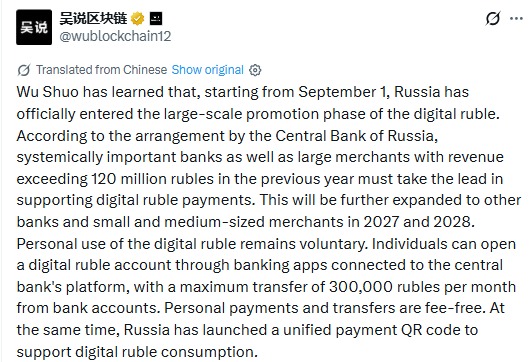
Source: Wublockchain official tweet
Banks with a universal license and retailers earning over ₽30 million must comply by September 1, 2027, and remaining banks and retailers under that threshold have until September 1, 2028.
Individuals can transfer up to 300,000 $rubles (about $3,500) per month from ordinary accounts into Virtual $ruble wallets; businesses face no such cap.
Why Is Russia Pushing the Digital Ruble Launch Amid Sanctions?
Russia has been cut off from SWIFT, Visa, and Mastercard since 2022, and the Virtual $ruble launch sits at the center of Moscow's push to build payment infrastructure independent of Western networks.
This mirrors an earlier postponement: the rollout was originally due in July 2025 before the central bank pushed it back to give banks more preparation time, per Reuters reporting.
The European Union's 20th sanctions package, adopted April 23, 2026, bars EU entities from processing Virtual $ruble transactions and ruble-linked tokens such as RUBx, leaving the currency largely walled off from cross-border use with European counterparties even as it expands domestically.
How Are Russians Responding to the Digital Ruble Launch?
Public appetite remains mixed.
A survey by pollsters Vyberu.ru and Evrokredit.
Ru found 46% of Russians are ready to use the digital ruble immediately, rising to 62% among 18-to-24-year-olds.
Separate national polling has found many Russians see little advantage over cash or existing bank cards and are reluctant to receive wages in the new currency.
Expert Opinion
Market analysts note that the digital ruble launch marks a legal and technical milestone rather than an immediate consumer shift, since individual usage remains voluntary and public adoption has so far trailed the government's own timeline.
Analysts add that the real test will come as retailers integrate payment rails and banks compete to make wallets convenient enough for the mandate to translate into everyday transaction volume.
Disclaimer
This article is for informational purposes only and does not constitute financial or investment advice. Central bank digital currency rules, including transfer limits and compliance deadlines, remain subject to change by Russian and EU regulators.
Also read:






