Stablecoin News: Tether Africa Expansion Gains Momentum

Stablecoin News: What the Tether-NSE MoU Actually Covers
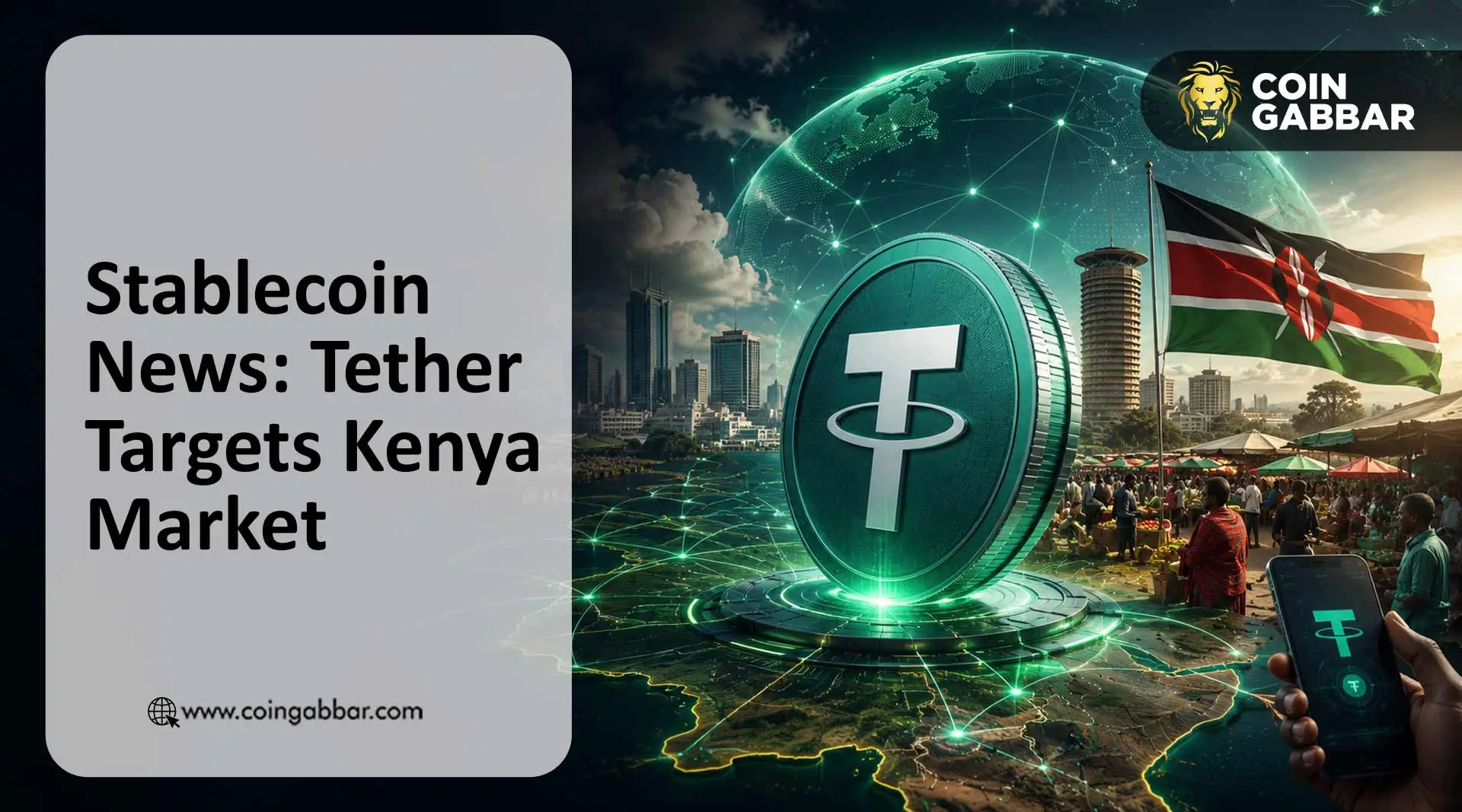
Today's notable stablecoin news comes out of East Africa. Tether has signed a Memorandum of Understanding with the Nairobi Securities Exchange (NSE), Kenya's primary stock exchange, to explore digital asset education, securities tokenization, and blockchain-based market infrastructure. The agreement, announced July 28, 2026, marks Tether's latest step in extending its stablecoin business into regulated capital markets infrastructure.
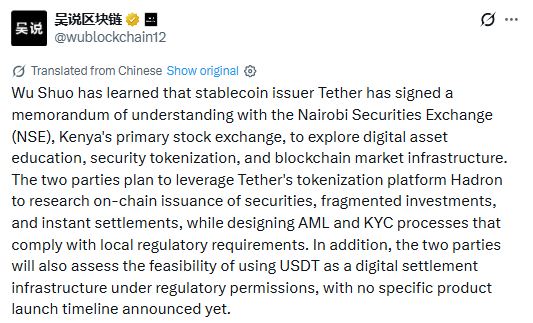 Source: X(formerly Twitter)
What the Tether-NSE Deal Covers
Per the official announcement, the two parties plan to use Tether's Hadron tokenization platform to research on-chain issuance of securities, fractionalized investment access, and instant settlement mechanisms, while designing AML and KYC onboarding processes tailored to Kenyan regulatory requirements. A separate but related workstream focuses on investor education — structured training sessions and workshops aimed at NSE-listed brokers and retail investors, designed to build broader capital markets literacy in a digital asset context.
The MoU also calls for assessing whether USDT could serve as a digital settlement infrastructure layer, where permitted under Kenyan regulation, to help streamline the NSE's current multi-step settlement cycle. Tether CEO Paolo Ardoino framed the collaboration around deepening practical institutional adoption of digital assets while keeping processes transparent, accountable, and privacy-protective. NSE CEO Frank Mwiti said the partnership aligns with the exchange's 2025–2029 Strategic Plan, which centers on modernizing market infrastructure and broadening investor access.
Notably, no specific product launch timeline was included in the announcement — this remains an exploratory partnership rather than a confirmed rollout of any tokenized product or settlement rail.
Why Kenya, and Why Now
The Nairobi Securities Exchange isn't a small or peripheral venue. Established in 1954, NSE is one of Africa's leading exchanges, carrying a market capitalization of roughly $26.4 billion. It's a member of the Association of Futures Markets and a partner exchange in the United Nations-led Sustainable Stock Exchanges initiative, giving the Tether partnership institutional weight beyond a typical crypto-native deal.
The tokenization angle also targets a specific structural opportunity: fractionalized access to securities for both local Kenyan investors and the country's substantial diaspora population, who often face friction accessing home-market investment opportunities from abroad. That's a use case tokenization is generally well suited to address, regardless of which blockchain infrastructure ultimately gets used.
Stablecoin News: Part of Tether's Broader Hadron Push
This deal doesn't stand alone. It follows a similar Memorandum of Understanding Tether signed with the Dubai Multi Commodities Centre in June 2026, also centered on blockchain education and tokenization exploration, and reflects a consistent pattern: Tether using Hadron-branded MoUs to build relationships with regulated market infrastructure operators across multiple regions rather than pursuing tokenization purely through crypto-native partners.
The timing lines up with broader sector momentum. Tokenized real-world assets, excluding stablecoins themselves, have grown to an estimated $36.8 billion in on-chain value, according to tracking from RWA.xyz — a market Tether has been positioning Hadron to compete in directly, alongside earlier agreements with firms like KraneShares and Bitfinex Securities on tokenized exchange-traded products. Tether has also cited its stablecoin infrastructure securing over $125 billion in value as the technical backbone it's extending into this tokenization push.
Conclusion
Today's stablecoin news shows Tether continuing to push beyond USDT issuance into the infrastructure layer of regulated capital markets. The Nairobi Securities Exchange MoU is exploratory, with no confirmed product timeline, but it adds Kenya to a growing list of jurisdictions where Tether is testing tokenization and settlement partnerships through Hadron.
Disclaimer
This article is for informational purposes only and does not constitute financial or investment advice. All details are based on Tether's and the Nairobi Securities Exchange's official announcements as of July 29, 2026, and are subject to change. This partnership is exploratory, with no confirmed product timeline. Always conduct independent research before making any investment decision.
Also read:


2 months ago
I responded to an advertisement involving a Dutch model, and shortly afterward I was contacted by Mark Grams, who claimed to be a professional investment adviser. After six weeks of building trust with me, he convinced me to convert both my investment and my father's portfolio into crypto. In total, I transferred €1.6 million worth of crypto to what I believed was a legitimate investment platform. When I later asked to access my funds, I was told that my account had been blocked and that I needed to transfer more money to unlock it. That was when I realized I had been scammed. After filing a police report with little progress, I hired a legal team, who then contacted Morphohack Cyber Service via email (MORPHOHACK@CYBERSERVICES.COM). They used blockchain analysis to trace the stolen crypto, and the trail led to several crypto exchanges, including HTX. However, Morphohack was able to recover all the crypto that had been funnelled through their network. Recovering my funds also helped uncover a broader network of alleged crypto-related crimes. After I lost my funds, I felt like the ground beneath me was about to explode, Morphohack brought me back to life with their professional help. I highly recommend Morphohack and their incredibly helpful team.








