Tether Sued USDT Freeze: Thai Businessmen Demand $42.4M Return

$42.4 Million USDT Freeze Sparks New York Lawsuit
Two Thai businessmen filed a Tether sued USDT freeze case in the U.S. District Court for the Southern District of New York on August 31, 2026. Nutthawat Rukthammachalern and Natthawat Kasamvilas say the stablecoin issuer blocked $42.4 million worth of their tokens without a court order.
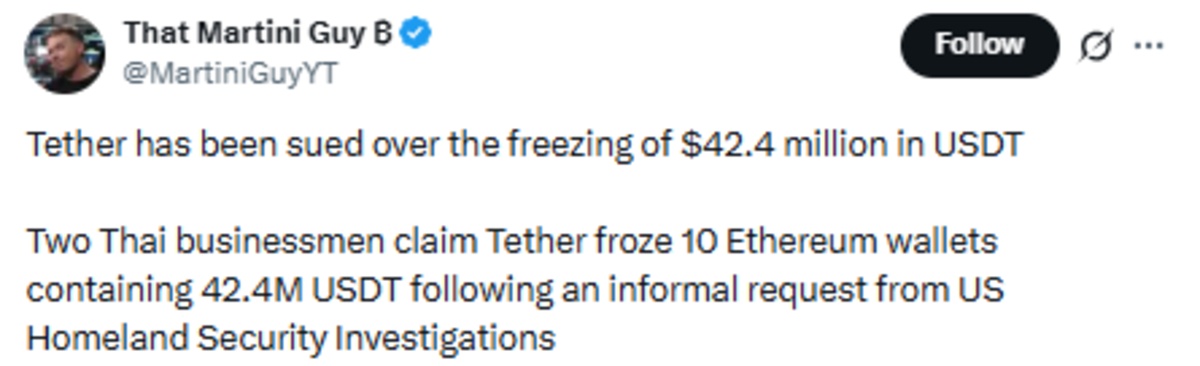
Source: X Post
The complaint names four entities as defendants, all based in El Salvador. It says the firm locked ten Ethereum wallet addresses on October 30, 2025, after an informal request from a Homeland Security Investigations agent.
What The Lawsuit Claims
According to the filing, the company acted before any warrant existed. A federal seizure warrant only arrived on February 19, 2026, more than three months after the addresses were blacklisted.
The plaintiffs argue that a verbal request from a single agent cannot justify a Tether sued USDT freeze action, since it is not a legal process.
The suit also challenges what happens next. The warrant reportedly directs the firm to destroy the tokens and mint replacements for a government-controlled wallet.
The plaintiffs call this a taking of their property, not a lawful seizure, since no forfeiture judgment has been entered.
The table below summarizes the key dates in this Tether sued USDT freeze dispute.
Date | Event |
October 30, 2025 | Ten Ethereum addresses blacklisted |
November 2025 | Plaintiff emails company, gets referred to HSI |
February 19, 2026 | Seizure warrant issued in North Carolina |
August 31, 2026 | Lawsuit filed in New York |
Source: Official Report
Why It Matters For Stablecoin Holders
This Tether sued USDT freeze dispute raises a question that touches every stablecoin holder: can an issuer act on an informal government tip alone. The plaintiffs bought their tokens on the secondary market and never signed any agreement with the firm.
The complaint leans on New York's new Article 12 rules for digital assets, arguing that holding a private key gives full legal control over a token, regardless of any blacklist function built into the smart contract.
Key claims in the case include:
Conversion of property under New York law
Trespass to chattels
Unjust enrichment, since reserves backing the blocked tokens still earn interest
A request for declaratory judgment on the scope of the warrant
The Company Responds
The firm has pushed back publicly, calling the case baseless and describing its blacklist actions as part of ongoing work with global law enforcement.
It has stated that this kind of cooperation has helped restrict billions of dollars tied to suspected illicit activity across many countries.
This Tether sued USDT freeze filing does not dispute that the tokens may relate to an unrelated $61 million fraud probe in North Carolina. Instead, it challenges whether a private company can restrain someone else's property before any court order exists.
What Comes Next
The plaintiffs are asking the court to declare the block unlawful, stop any destruction of the tokens, and award damages plus interest dating back to October 2025.
A separate motion is also pending in North Carolina federal court seeking direct return of the funds. No trial date has been set as of this writing.
Expert Take
Legal observers note that this Tether sued USDT freeze dispute could set an early precedent for how issuer-controlled digital assets interact with U.S. seizure law.
The outcome may shape whether stablecoin issuers need a court order before acting on any government tip or whether informal cooperation remains acceptable practice.
Conclusion
This case is still in its early stage, filed just days ago. It centers on a Tether sued USDT freeze claim that could influence how stablecoin issuers handle law enforcement requests going forward.
YMYL Disclaimer: This article is for informational purposes only and does not constitute legal, financial, or investment advice. It is not a recommendation to buy, sell, or hold any cryptocurrency.
Also read:






