Pi Network News Today: Can No Token Burn System Pressure $PI Price?

Pi Network News: No Burn Mechanism, $PI Price Risk, and Ecosystem 2026
Pi Network News today centers on a question dividing holders: does having zero token burns put $PI coin price at risk, or does it not matter at all? $PI price today sits close to $0.09380, with a $1.04 billion market cap.
No coins have ever been permanently destroyed on this network, and opinions split sharply on whether that gap actually threatens $PI long-term price strength.
How No Burn Works: Pi Network Tokenomics and Risks Explained
The case for risk starts with the supply economy. Pi Network has a hard cap of 100 billion coins, and every one of those tokens was minted at genesis as per the official tokenomics.
Migrated mining rewards currently sit near 11.14 billion $PI, pushing effective total supply toward 17.14 billion $PI once the fixed 65% community allocation is applied.
Without a token burning system, that ceiling never shrinks. Other large-cap tokens use burns to offset new supply entering the market, which supports price during growth phases.
$PI has no such offset. If daily usage grows slower than new tokens unlocking through migration, the extra circulation could weigh on price even as adoption climbs.
This is the core worry behind the Pi Network price impact debate: utility alone has to carry the weight that scarcity usually shares.
How No Token Burn Mechanisms Generally Risk Prices In Crypto Industry
Across crypto, token burns often do heavy lifting for price. New tokens enter the market through mining or unlocks. Burns remove tokens to balance that out. When a project skips this step, a few risks tend to show up:
-
Supply keeps growing while demand may not keep pace
-
No scarcity story to attract short-term buyers
-
Price relies fully on real usage instead of a supply narrative
-
Slower emissions can hide the risk during quiet periods, then show up later
This is the real Pi Network price impact question. Without a burn, $PI has to earn its price through actual use, not through a shrinking token pool chart.
What Saves the $Pi Coin: Why It Never Needed A Burn Feature
The counterargument rests on how supply is actually controlled. $PI coin tokenomics rely on a declining emission model rather than destruction.
The mining rate drops on a set schedule, migration requires identity verification, and unverified balances never reach circulating coins. That filtering does similar work to a burn without permanently erasing coins.
A few structural points support the "no risk" side:
-
Transaction fees, near 0.01 $PI, get redistributed daily to active nodes rather than destroyed
-
Lockups pull tokens out of liquid circulation temporarily, easing sell pressure without a burn
-
Only migrated, KYC-verified balances count toward real circulating coins
-
The 65/20/10/5 allocation split stays proportional regardless of migration speed
These mechanisms slow supply growth even without a formal Pi Network No Burn Mechanism debate ending in an actual burn-mechanism.
Scarcity through discipline, not destruction, is the Pi Network news argument here.
The Core Team has defended this stance publicly against repeated calls from parts of the base to add a burn. Nothing in current whitepaper materials or the 2025 tokenomics blog outlines a plan to change that position.
Any shift would require a formal announcement through an official blog post, whitepaper revision, or protocol upgrade.
Pi Coin Price Today: What The Market Signals Suggest This Week
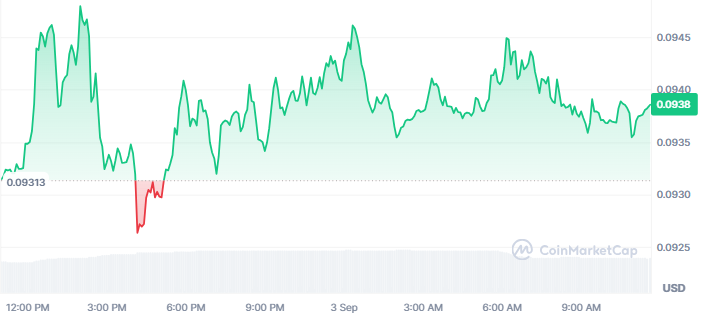
Pi Network update today leans more on upgrade news than burn speculation. Current numbers as per CoinMarketCap:
-
$PI coin price today: $0.09380, up 0.68% in 24 hours
-
Market cap: $1.04 billion, up 0.56%
-
24-hour volume: $5.66 million, up 11.56%
-
Fully diluted valuation: $9.36 billion
-
Circulating supply: 11.14 billion coins of a 100 billion max
The gain tracks closely with anticipation for the Protocol 27 mainnet upgrade and a decentralized exchange launch scheduled for September 15.
The token also climbed OKX's trending list this week. Bitcoin slipped slightly over the same window, suggesting this move ties to the network mainnet migration progress and upgrade news rather than broader market direction.
What’s Ahead of This Pi Network News Today?
So, does the missing burn actually risk price? The honest answer sits in between. It adds a structural headwind that utility has to overcome on its own, but it is not automatically bearish while migration discipline holds supply growth in check.
The real test in Pi Network news arrives after September 15: if usage from the DEX launch and Protocol 27 outpaces the new migrated supply, the no-burn design will look like a non-issue. If usage lags, the supply question comes back louder than before.
Disclaimer: This article is for informational purposes only and does not constitute financial or investment advice. Crypto markets carry significant risk. Always do your own research before making any investment decisions.






