Crypto Liquidations Surge: Inside a $153.82M Cascade


What Are Crypto Liquidations, and Why Do They Shake the Market?
Crypto liquidations happen when an exchange closes a leveraged trade on its own because the trader’s money can’t cover the loss anymore. One closure rarely moves anything.
But $153.82M in forced closures within a short window? That can push prices down fast and drag more traders into the same mess.
This guide covers what liquidations are, how they work, why they happen, what they do to traders and the market, and how traders try to stay clear of them.
How Do Crypto Liquidations Work Step by Step?
Leverage means borrowing money from an exchange to open a trade bigger than the trader’s own funds would allow. The amount the trader invests is called the margin, and is similar to a security deposit that ensures the lender won't lose any money if the trade fails. Each position also has a price of liquidation.
That’s the point where the leftover margin drops below the minimum the exchange demands, known as the maintenance margin.
Once the market hits that price, the exchange’s liquidation engine shuts the trade and keeps whatever margin is left as a fee. Some platforms close just a slice of the position first, which is called partial liquidation.
Others close the whole thing at once. With 10x leverage, a move of roughly 10% against the trade is enough to trigger it. At 50x, there’s room for only about 2%.
Why Do Crypto Liquidations Happen?
Sudden price swings are the main cause. Crypto sees plenty of them because trading never stops and order books can thin out in minutes. Other factors pile on, and they often show up together.
Too much leverage: high multiples leave almost no space for normal price moves.
Thin order books: higher order volumes when there are fewer buyers and sellers.
Bad news: hacks or new rules or exchange trouble can result in fast sales.
Too many players on one side of the trade: When the number of players on either side of the trade is too large, it will be shaky.
Collateral reduction: When the coin used as a collateral value decreases, even without investing in any new coin, the margin decreases.
Long vs Short Crypto Liquidations: Key Differences Explained
A long trader bets the price will rise, so a falling market gets that trader liquidated. A short trader bets on a drop, so a climbing price does the damage. Long liquidations add selling pressure, since the exchange sells the position.
Short liquidations add buying pressure, since the exchange has to buy back the borrowed coins. A sharp rise that wipes out shorts is called a short squeeze. The opposite move is a long squeeze.
Knowing the difference between long vs. short liquidation helps traders see which side of the market is more crowded and where the next wave of forced closures may start.
What Are the Effects of Liquidations on Traders and the Market?
Effects on traders
The biggest blow is the loss of the full margin that was given for the position.
The slippage, or difference between the price a trader expects to receive and the actual execution price, can worsen the exit even if the trader gets the quoted liquidation price.
Effects on the market
Forced selling pushes the price down.
That lower price drags more positions past their liquidation levels, and the loop repeats until buyers step in. Analysts call it a liquidation cascade.
A $153.82M wave of closures shows how a small dip can grow into a wide selloff, meaning a rush of selling across the market.
Bitcoin and Ethereum handle these waves better because their markets are deeper.
Smaller altcoins tend to go down harder, as there are lesser numbers of orders between the price levels.
The helpful aspect of liquidation
It is designed to safeguard lenders from losing more than the posted margin.
Exchanges will typically maintain an insurance pool to fill any shortfall.
In DeFi lending, smart contracts sell collateral automatically when its value drops too low.
How Do Stablecoin and Deposit Token Collateral Change the Risk?
Collateral type matters almost as much as leverage. It held in a volatile coin shrinks when the market falls. A stablecoin is a token built to hold a steady value, usually tied to a currency, so margin held in one is easier to predict.
Still, stablecoins carry risk too. A depeg, meaning a loss of the intended value, can shrink collateral and set off closures in a different way.
A deposit token stands for a claim on money held at a regulated bank. It’s a newer option that some institutions are testing for settlement and collateral.
Retail derivatives trading hasn’t adopted it much yet, so its effect on liquidation risk is still unclear.
Which Warning Signs Come Before Crypto Liquidations?
Rising open interest indicates that there is an increase in the number of borrowed dollars. Payment between holders of long and short positions, known as extreme funding rates, indicates that one side of the market is "overcrowded.
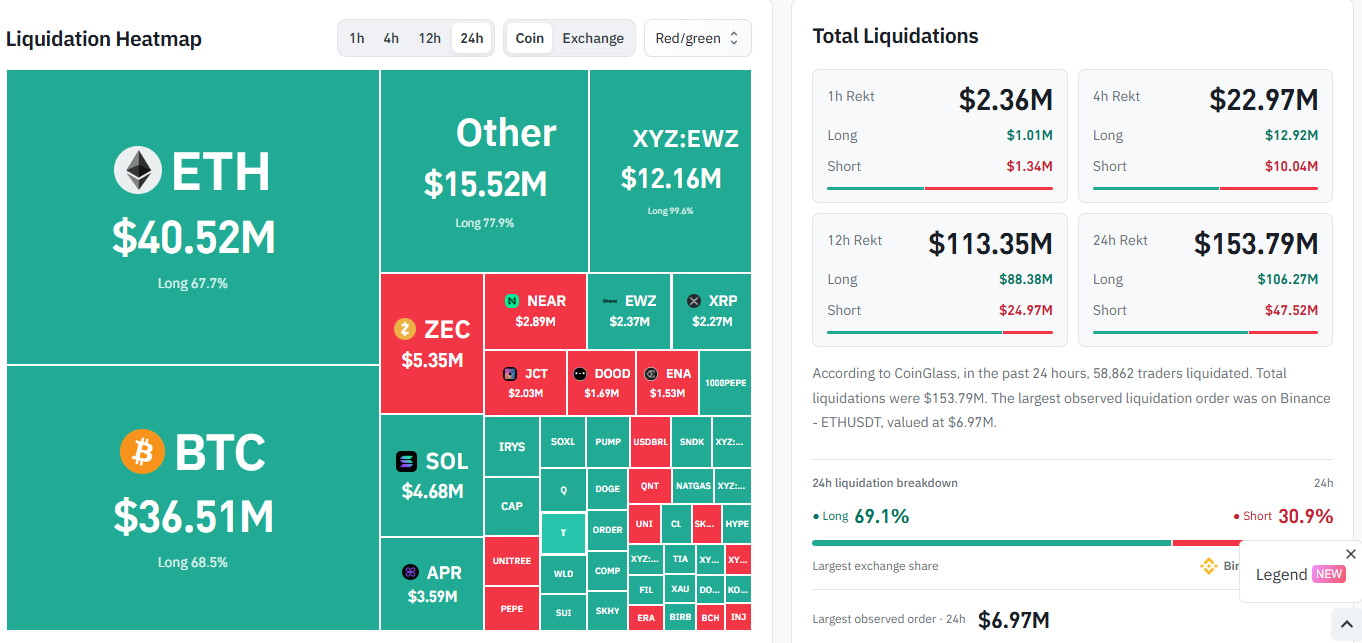
Liquidation heatmaps show where clusters of trades would close. The $153.82M figure should be checked on a live tracker, since totals change by the hour.
What Are the Best Tips to Avoid Liquidation?
A few simple habits keep the market price well away from the liquidation price.
Lower leverage: it gives a wider buffer before liquidation.
Order to buy/sell "stop loss" Orders: These shut a position at the designated price rather than let the exchange do so.
Isolated margin: It restricts risk to one position; cross margin distributes the entire margin among all positions.
Early additional margin: increases the liquidation price away from the market.
Smaller position sizes: they keep any one loss manageable next to total capital.
What Should Traders Remember Before Using Leverage?
Liquidations are automatic safety tools that close leveraged trades once margin runs out. They protect lenders and keep exchanges stable, but they aren’t gentle on traders, because the whole margin can disappear in minutes.
They can also speed up market falls when many trades sit near the same levels, since one wave of forced selling pushes prices into the next cluster of liquidation prices.
Traders who understand margin, liquidation price, and funding rates have a better chance of spotting trouble early. Lower leverage, stop-loss orders, and extra margin also give a position more room to survive normal price swings.
Since crypto never closes, checking open positions often matters just as much as picking the entry price.
Disclaimer
This article is for informational purposes only and isn’t financial advice. Crypto derivatives are high risk, and losses can be bigger than expected, so readers should do their own research and talk to a licensed advisor.