Crypto Payment Resilience Tested? UK Cyberattack Alert Raises Doubts


Crypto Payment Resilience Tested? UK Cyberattack Alert Raises Doubts
As of October 24, 2026, crypto news today comes from an unlikely place: a UK household checklist.
On October 22, 2026, the Cabinet Office published its Be Ready announcement, the first stage of a three-year national resilience campaign on UK emergency preparedness.
One checklist line puts crypto payment resilience in focus. It tells households to keep cash and cards in case electronic payments or ATMs are disrupted.
What Does the UK Cyberattack Warning Mean for Crypto Holders?
The official Be Ready checklist says severe weather and cyber attacks can disrupt everyday services.
Neither the Cabinet Office nor the NCSC mentions digital assets. The UK cyberattack crypto link is therefore a risk question, not a reported incident.
Crypto Banter also covered this news in its tweet on X, pointing to cyberattack risks and the PHP vulnerability.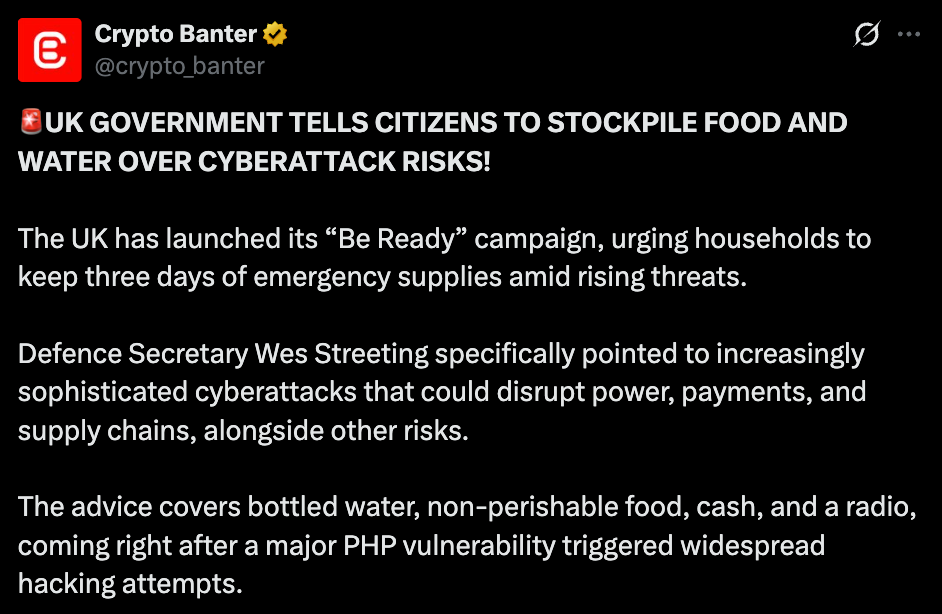
What Does the Be Ready Checklist Say?
Item | Official advice |
Water | 3 litres per person daily |
Food | Non-perishable, 3 days |
Cash and cards | Coins and notes, for payment or ATM failures |
Radio and power bank | Wind-up FM radio, charged bank |
What Is Crypto Payment Resilience?
It describes how well digital asset transactions keep running during a banking outage, internet disruption or payment infrastructure disruption. Exchanges, wallets and fiat on-ramps each rely on different layers.
Operational resilience matters because one failed layer could slow the rest.
Can a Cyberattack Affect Crypto Exchanges?
The NCSC alert on PHP, published on October 21, 2026, covers CVE-2026-109618 and CVE-2026-109619. It says attackers may run commands on any server using PHP, and advises taking unpatched systems offline if needed.
Exchanges are not named. Any cyberattack crypto exchanges risk would depend on each platform’s software, and exchange downtime could follow precautionary shutdowns. Do crypto exchanges go down during cyberattacks? Neither source answers that.
Can You Access a Bitcoin Wallet During an Internet Outage?
Bitcoin self custody keeps private keys with the holder, so a self-custody wallet does not depend on an exchange login.
Sending coins still needs a network connection, so a crypto wallet access outage could pause transfers. Crypto payment resilience therefore covers wallet access too.
What happens to crypto if the internet goes down? Balances stay on the blockchain, while digital asset access may pause for the affected user. Offline access to keys is possible, but broadcasting is not.
Will Crypto Work During a Bank Outage?
Onchain transfers skip banks, yet card spending and fiat deposits use them. A bitcoin payments cyberattack scenario would hit those bank-linked edges first.
How could a payment outage affect digital asset transactions? Mostly there, which makes crypto payment resilience a bank-linked question.
Bitcoin Price Today: CoinGecko Snapshot
Data from CoinGecko, as of October 24, 2026:
Metric | Value |
Price | $80,455 (£60,422) |
24h change | -1.3% |
7d change | -1.0% |
24h volume | £16.854B |
CoinGecko’s daily table shows a 3.3% BTC/GBP drop on October 22, launch day. No source links that move to the campaign or the alert.
Expert View: What Could This Mean for UK Crypto Users?
Analysts following crypto news may read the cash line as a crypto payment resilience reminder: digital payments rest on banks, power and the internet. Payment rails are often treated as critical infrastructure for that reason.
Is bitcoin safe during a cyberattack? The network is not one UK system, but individual access points may be disrupted.
Disclaimer: This article is for information only and is not financial, legal, or investment advice. Digital assets are volatile, and you can lose money. Verify details with official sources before making any decision.









