Console Wallet Tops 200,000 Users, Expands to Browser and Mobile

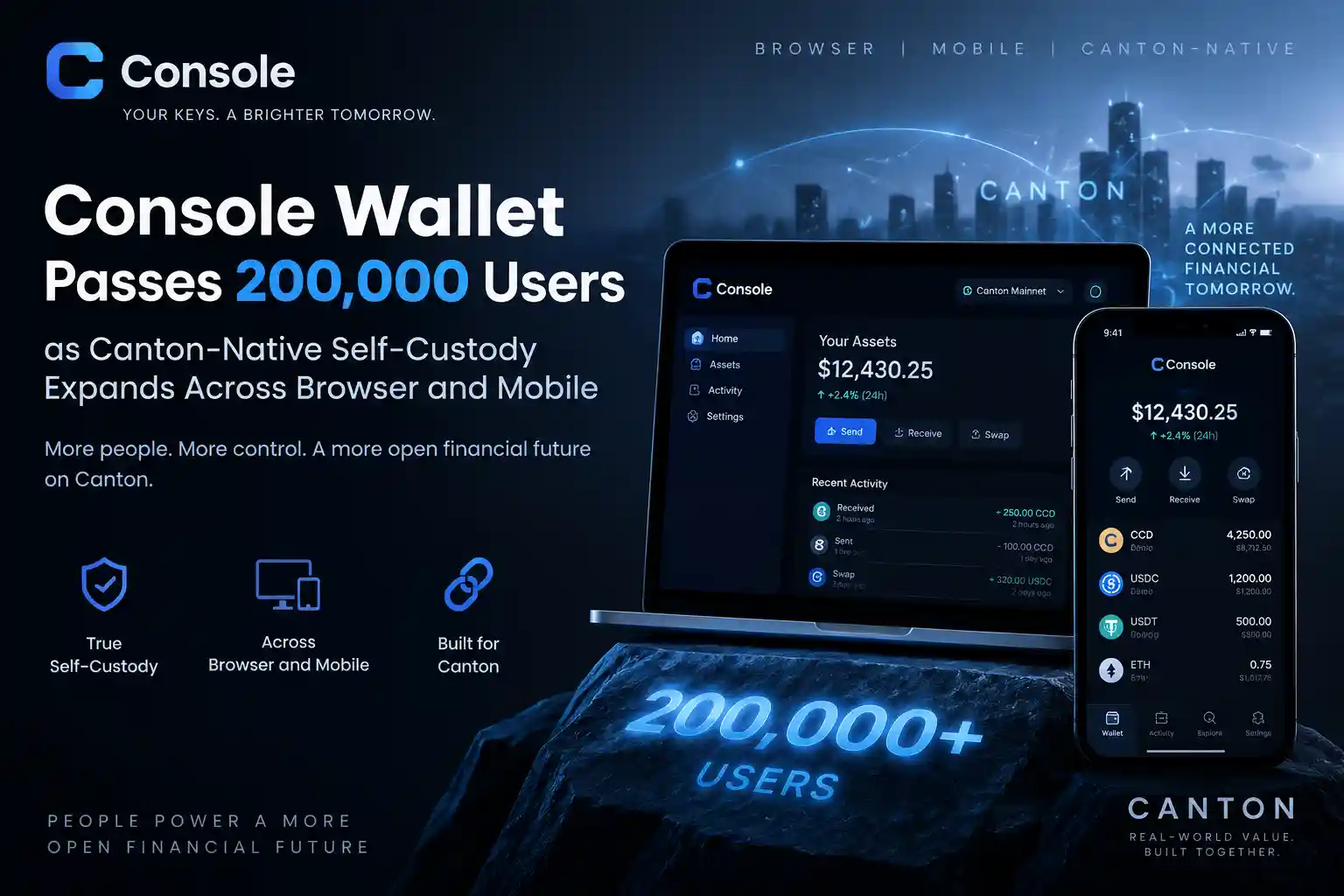
PixelPlex has reported continued growth for Console Wallet, the self-custodial wallet and dApp access layer it built for the Canton Network. According to company-reported product figures, the wallet has grown to 200,000 users and has processed 17 million transactions. The growth reflects demand for an entry point into Canton that does not require handing assets to a third-party service.
Canton Network is a privacy-oriented blockchain used for financial applications, where transaction data is shared only with the parties entitled to see it. That model changes how a wallet has to behave, and the Console wallet was built around Canton's rules from the start rather than adapted from a general-purpose EVM wallet. The practical effect is a lower barrier for anyone entering the ecosystem.
Self-custody and Canton-native transaction flows
Console Wallet keeps private keys on the user's own device, protected by passkeys or the device's secure enclave. Neither Console Wallet nor PixelPlex can access or move user funds, and there is no seed phrase to store or lose. Users who want their own backup can export the key at any time.
Before anything is signed, the wallet shows what is actually being approved. Clear signing presents transaction details, network fees, and Canton-specific approval conditions such as offer-based transfers and time-limited windows, while built-in risk checks flag suspicious requests. Name-based sending lets users select a saved contact instead of pasting a long Party ID, removing a common source of costly errors.
Canton assets are detected automatically, so balances appear without manual token imports. Users can also enable auto-approval for supported incoming Canton tokens, which removes repeated signing for routine transfers. Unknown assets and EVM transactions still require a manual signature. On mobile, QR scanning connects the wallet to desktop applications and push alerts surface incoming transfer requests, so time-sensitive approvals are less likely to be missed.
Multi-network access and a standardized route for developers
The wallet manages accounts on Canton, Ethereum, and Base in one interface, and built-in swap and bridge functionality lets users move liquidity between supported networks without switching to a separate tool. For businesses, that means Canton-based products can reach users who already hold assets in EVM environments.
For builders, Console Wallet works as more than an asset-storage interface. Its alignment with CIP-103, a standard PixelPlex co-authored, together with the Console Wallet dApp SDK, gives development teams a vendor-neutral integration path instead of commissioning isolated, one-off wallet connections. The modular architecture is designed to accommodate additional assets, networks, and user flows over time, and the wallet participates in Canton's native incentive mechanics, under which qualifying activity can translate into app rewards as network usage grows.
Console Wallet is available across Chrome, Firefox, iOS, and Android. Users and development teams can review its current capabilities, supported networks, and integration documentation on the Console Wallet website.
About Console Wallet
Console Wallet is a self-custodial wallet and dApp access layer for the Canton Network, with additional support for Ethereum and Base. Private keys remain on the user's device, and the wallet combines clear signing, fee previews, name-based sending, and built-in risk checks across browser and mobile. It is used by individual holders, Web3 developers, and companies building Canton applications.
About PixelPlex
PixelPlex is a blockchain, fintech, and digital asset development company that designs and builds infrastructure for enterprises and Web3 teams. As a crypto wallet development company, it built Console Wallet in-house and continues to develop it for the Canton ecosystem.