When Machines Trade Against Machines: Crypto Trading Bots


What Are Crypto Trading Bots and How Do They Compete?
Crypto trading bots are programs that place orders without a person clicking. Many now react to each other, not just to prices. One program spots a gap, another quotes around it, a third races to beat both. The price on your screen is the result of that contest.
This guide shows who runs crypto trading bots, what research says about their effect, and what readers can check before using them.
What Are Crypto Trading Bots and Why Do They Matter Now?
A bot is software that follows rules to buy or sell. Crypto trading bots run their rules all day, so the contest never pauses.
-
Market makers post buy and sell quotes and earn the gap, called the spread.
-
Arbitrage programs buy where an asset is cheap and sell where it is dear.
-
Liquidation programs close loans that are too risky.
-
MEV searchers chase profit from how transactions are ordered.
-
Execution algorithms slice big orders into small ones.
Why Do Crypto Markets Never Close for Automated Traders?
Stock exchanges shut each evening. Digital asset venues do not. Prices move at 3 a.m. on a Sunday, and someone must react.
Software never tires. It can watch many venues at once, cancel orders in milliseconds and follow fixed risk limits. Our guide to crypto markets lists the main venues.
No reliable public figure says what share of trades come from crypto trading bots. The studies below avoid that claim, and so does this article.
Which Types of Players Compete for the Same Opportunities?
The five players overlap. One firm may run several strategies at once, so outsiders cannot always tell them apart.
Market makers supply liquidity. That means enough orders that a trade can happen without moving the price much. See our note on market liquidity.
Arbitrage programs close price gaps. Our crypto arbitrage explainer covers the basics.
Liquidation programs watch lending apps and rush to close weak loans, a topic in our DeFi liquidation guide.
MEV searchers read pending transactions. MEV stands for maximal extractable value, the profit available from ordering transactions. Read more on MEV in crypto.

How Does One Bot’s Trade Trigger Another Bot’s Reaction?
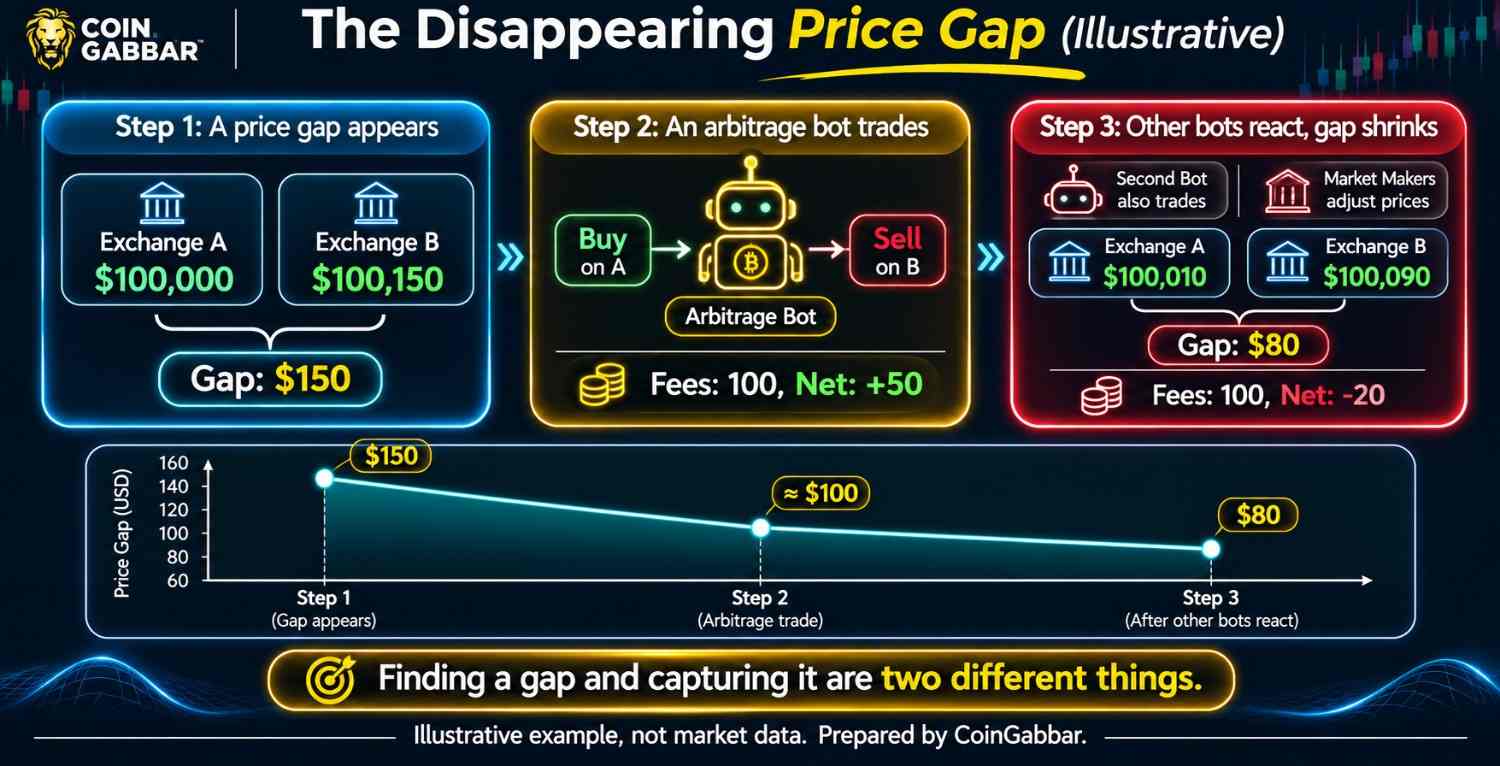
Here is an illustrative case, not real market data. Bitcoin trades at $100,000 on Exchange A and $100,150 on Exchange B.
An arbitrage bot sees the $150 gap. It buys on A and sells on B. Say fees total $100, so the net is $50.
Then the trade itself changes the books. Market makers move their quotes. A second bot spots the shrinking gap and rushes in. If the gap falls to $80 before the first order fills, the same trade loses $20.
Finding an opportunity and capturing it are two separate things. Speed, capital and fees decide who wins.
Does Arbitrage Software Really Make Prices Fairer?
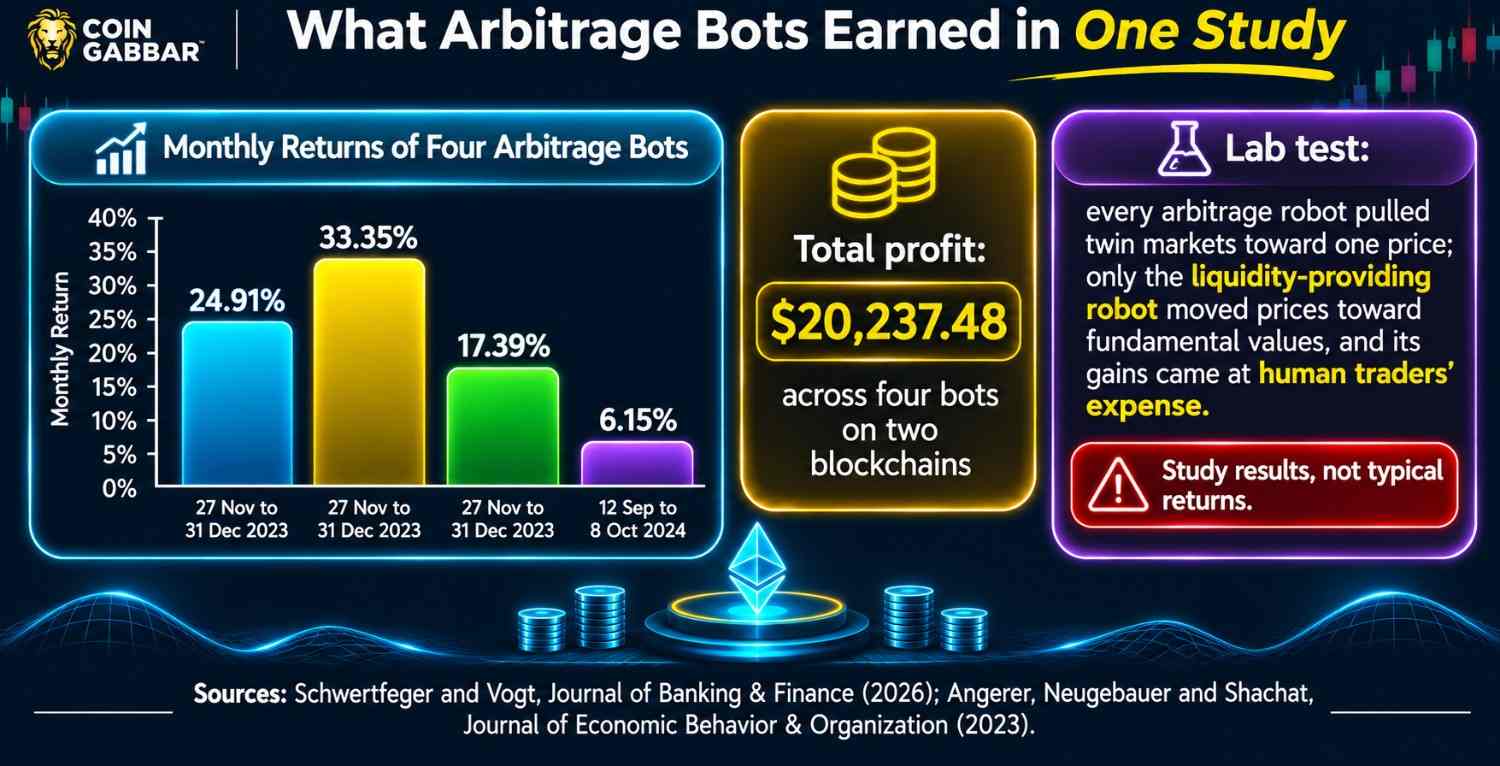
Partly. In a lab test, Angerer, Neugebauer and Shachat (2023) found every arbitrage robot pulled twin markets toward one price. Only the robot that supplied liquidity pushed prices toward fundamental values. Its gains came at the expense of human traders.
Real markets are harder than a lab. Schwertfeger and Vogt, in the Journal of Banking & Finance (2026), studied four bots that actually traded on two blockchains. Monthly returns were 24.91%, 33.35% and 17.39% from 27 November to 31 December 2023. A later run, 12 September to 8 October 2024, returned 6.15%. Total profit was $20,237.48.
Those are study results, not typical returns. The authors also found markets stay fragmented. Costs, thin liquidity and uncertainty about transaction order limit the gains.
How Do Market Makers and MEV Searchers Change Execution?
Public blockchains show pending transactions before they run. That opens a door for fast software.
Barczentewicz, Sarch and Vasan discuss programs that read these pending transactions, simulate them and copy the profitable ones. Their paper, Battle of the Crypto Bots, appeared in 2024 in the University of Pennsylvania Journal of Business Law. It also raises legal questions about copying and front-running.
So a trader may compete with software watching their own order. The effect shows up as slippage, the gap between the expected and the actual price.
Can Automation Raise Volatility and Transaction Costs?
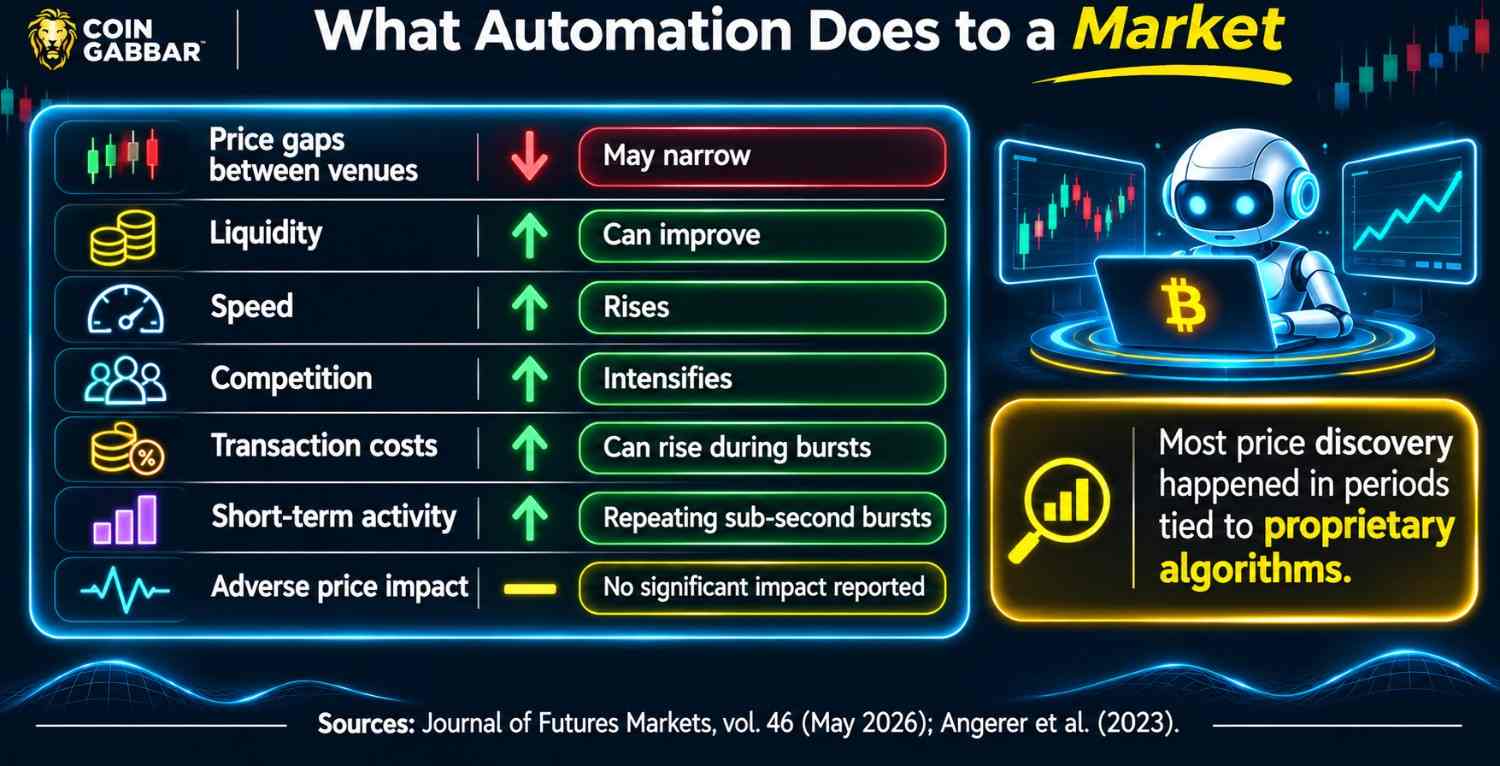
Sometimes. A study in the Journal of Futures Markets found repeating bursts of activity every fraction of a second in Bitcoin and Ethereum.
In spot markets the pattern pointed to agency algorithms taking liquidity. In perpetual futures it pointed to proprietary algorithms. The bursts raised volatility and transaction costs, though the abstract reports no significant adverse price impact.
Most price discovery happened in the periods tied to proprietary algorithms. Our guide to crypto market volatility adds context.
Automation helps some measures and strains others. A fair reading keeps both.
Are Humans on Equal Terms With Crypto Trading Bots?
Machines have clear edges. They watch many markets, never sleep and cancel orders in a blink.
Humans still lead where software is weak: long-term research, reading news, picking strategy and setting risk. The studies above do not show that retail traders always lose, or that bots control every market.
A literature review of 138 papers by Almeida and Gonçalves (Annals of Operations Research, 2024) maps this field. It is a good start for readers who want the wider evidence.
The open question is fair. Does an average trader face the same market as a bot, or one whose rules favor fast execution? The evidence cannot settle it yet.
What Measures Can Traders Take in an Automated Market?
These are general checks for anyone near crypto trading bots, not advice.
-
Set a slippage limit so a trade fails rather than fills at a bad price.
-
Avoid thin pools, where one order moves the price.
-
Compare total costs, including fees and network charges, before trading.
-
Treat bot profit claims with care. The returns above are study results.
-
Start with small sizes when testing any automated tool.
-
Read our crypto trading guide before using any strategy.
What Do Key Algorithmic Market Terms Mean for Readers?
-
Market maker: a trader that posts both buy and sell quotes.
-
Spread: the gap between the best buy and sell price.
-
Arbitrage: buying low in one place and selling high in another.
-
MEV: profit from choosing the order of transactions.
-
Mempool: the waiting room for transactions not yet confirmed.
-
Slippage: the difference between the expected and the actual price.
-
Latency: the delay between a signal and an order.
Expert Opinion: Are Markets Now Machine Ecosystems?
CoinGabbar analysis suggests crypto trading bots and other programs jointly set the visible price. The strongest evidence is mixed: gaps do close, yet costs and bursts of activity can rise, and the gains in the lab went to the liquidity provider, not to human traders. The takeaway is that speed is now part of the price.
A limit: lab results and one exchange sample cannot describe every market. Check the papers before relying on any figure.
Disclaimer: This article is for information only and is not financial, legal or tax advice. Returns are never promised or assured. Automation carries risks of loss, and rules differ by country. Readers should consult a qualified adviser.