Biggest Crypto Liquidations in History and What They Teach Us


Every crypto cycle has one day when leverage snaps. Screens turn red, positions vanish within minutes, and traders ask whether this was the worst ever. The biggest crypto liquidations offer a yardstick for any crash.
What Is the Quick Answer on the Biggest Crypto Liquidations?
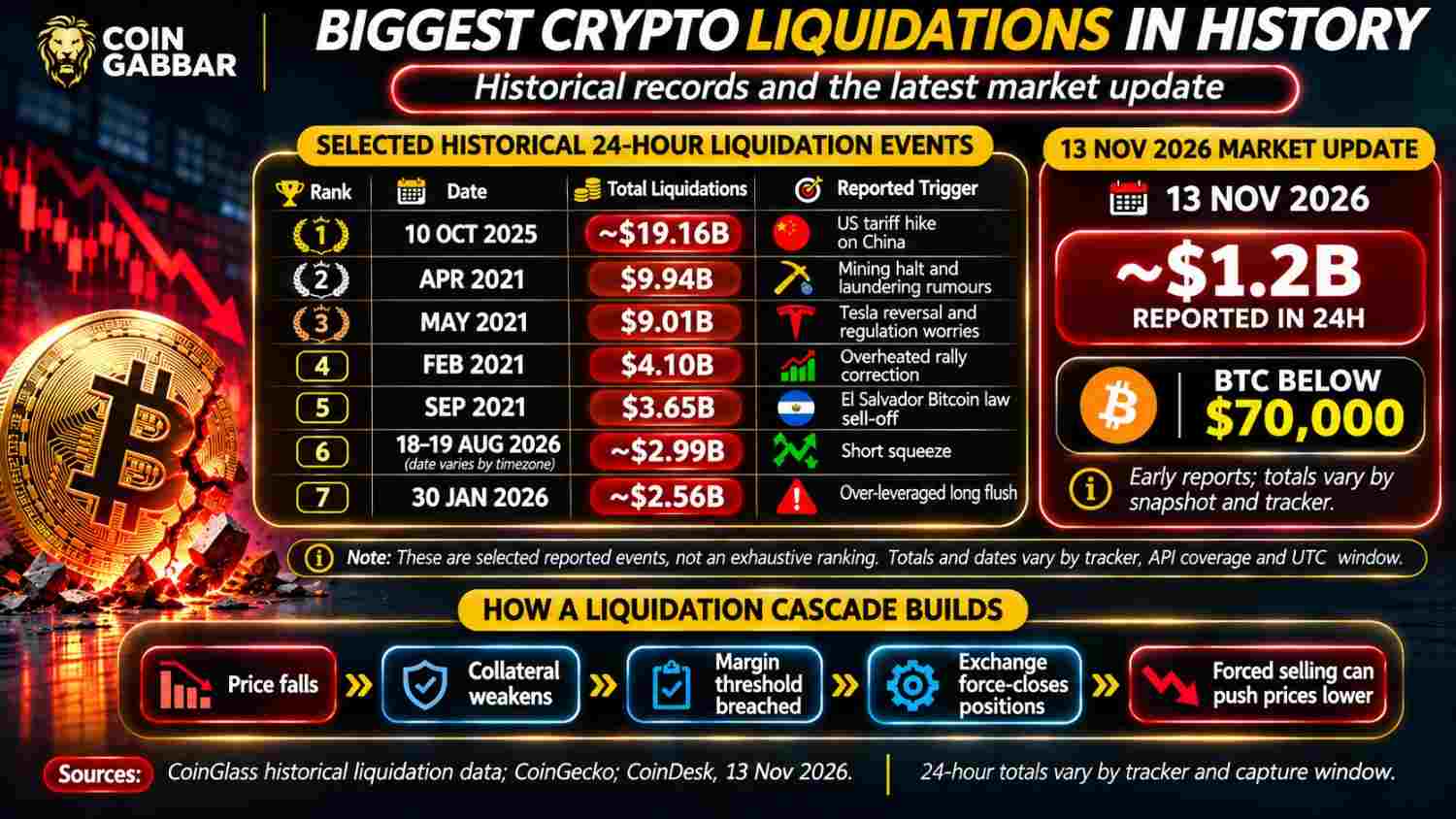
The record among the biggest crypto liquidations belongs to 10 October 2025, with about $19.16B liquidated in 24 hours, according to CoinGlass. The next largest, in April 2021, was about $9.94B.
The biggest 2026 flush so far came on 19 August, at about $2.99B. The 13 November drop sits far below all of them.
Totals differ by tracker, so treat each number as an estimate.
How Is Crypto Liquidation Data Calculated and Ranked?
A liquidation happens when an exchange force-closes a leveraged position because the margin no longer covers the loss. Trackers add up these closures over a 24-hour window and split them into longs and shorts.
Rankings of the biggest crypto liquidations use that 24-hour total. Most of the data comes from CoinGlass, as of 14 November 2026. A date can shift by a day because of the UTC rollover.
Exchanges also don't report every order. Some publish only one liquidation per second, so real totals are often higher than reported figures.
Which Were the Biggest Crypto Liquidations Ever Recorded?
The table below is a selection from the CoinGlass liquidation events list, ordered by size. Not every ranked event is shown, and exact dates vary across sources.
| Date | Total | Reported trigger |
| 10 Oct 2025 | $19.16B | US tariff hike on China |
| Apr 2021 | $9.94B | Mining halt, laundering rumors |
| May 2021 | $9.01B | Tesla reversal, regulation worries |
| Feb 2021 | $4.10B | Overheated rally correction |
| Sep 2021 | $3.65B | El Salvador Bitcoin law sell-off |
| 19 Aug 2026 | $2.99B | Short squeeze |
| 30 Jan 2026 | $2.56B | Over-leveraged long flush |
The October 2025 event was nearly double that of the next one. We could not confirm that every row uses the same 24-hour UTC window.
Our guide to crypto liquidations covers the basics behind these numbers.
What Triggered Each of the Biggest Crypto Liquidation Events?
On 10 October 2025, a 100% tariff announcement on Chinese imports hit a market packed with leveraged longs. Our report on the October tariff crash shows how fast sentiment turned.
Among the biggest crypto liquidations, the 2021 events were policy shocks. Mining crackdowns, a Tesla reversal and tax worries each pushed prices down. Triggers differ by source, so read them as the likely spark, not proof.
The August 2026 event ran the other way. About 91.6% of the total was shorts, which makes it a squeeze. A US Treasury announcement came at the same time, though causation can't be proven.
How Did the October 2025 Crash Spread Across the Market?
This was the largest of the biggest crypto liquidations, and CoinGlass data showed over 1.6 million traders liquidated. Bitcoin slid from about $122,500 to about $104,800, a drop of around 14.5%.
Two mechanisms spread the damage. Cross margin means one balance backs every position, so a loss in one trade drains the rest. Auto-deleveraging means the exchange closes profitable opposing positions when it can't cover losses.

A stablecoin also briefly lost its peg on one major exchange. Whether that drove the cascade is disputed, as our note on the October 10 blame debate explains.
How Do Leverage and Open Interest Set the Size of a Wipeout?
Open interest is the total value of open futures contracts. When it swells, more positions sit near their liquidation price, and a small move trips many stops at once. For example, a trader with 20x leverage is wiped out by a 5% move against them.
Funding rates show who is crowded. High positive funding means longs pay shorts to stay in. Read our leverage risk guide for position sizing.
In August 2026 shorts were crowded, and a sudden rally forced them to buy back.
Where Does the 13 Nov 2026 Drop Rank Among Them?
Bitcoin fell 6.3% to about $69,101 on 13 November. It was the first drop below $70,000 since mid-August. Fading rate-cut hopes after hot inflation data drove the move.
Early reports put liquidations near $1.2B, and totals differ by tracker. That is roughly 6% of the October 2025 total, and well below every event in the table. Our note on leveraged traders below $70K covers the setup.
So it isn't among the biggest crypto liquidations. It is a sharp flush, not a record. Recheck the live total before quoting it.
What Lessons Repeat in Every Crypto Liquidation Cascade?
Crowded positions set up the cascade in every one of the biggest crypto liquidations. When most traders lean one way, a single headline triggers the flush. Our explainer on the liquidation cascade mechanism shows how forced selling feeds itself.
Thin liquidity and cross margin make it worse, and a weak stablecoin peg adds panic. Rising open interest and high funding often warn of this setup early.
The damage lands in minutes, long before most people can react.
How Can Indian Traders Cut Liquidation Risk Today?
The biggest crypto liquidations hit leveraged accounts hardest. Many Indian traders access futures through offshore apps. Availability and registration status with FIU-India, the government unit that tracks money laundering, can change by platform. Check both before you deposit.
Tax adds to the risk. The Income Tax Department says virtual digital asset income is taxed at 30% plus surcharge and cess, and losses can't be set off. Our India crypto handbook covers filing.
Traders who limit position size, use isolated margin, and set a stop loss before entry may lower their liquidation risk.
Expert Opinion: Do Big Flushes Reset the Market?
CoinGabbar analysis suggests that large flushes often clear excess leverage. Our basis is the CoinGlass table above, comparing each event's total with its reported trigger and the side hit.
Some flushes led into longer weak phases, so a record wipeout is not a bottom signal on its own.
Leverage is the common factor behind the biggest crypto liquidations, and open interest is the number to watch.
What Should Traders Take Away From This History?
Leverage drives the size of the biggest crypto liquidations. More open interest means a bigger cascade when a trigger lands.
Watch funding rates, keep leverage low, and treat any single-day total as a snapshot, not a verdict.
Disclaimer: This article is for information only. It isn't financial, legal, or tax advice. The crypto market is volatile, and the rules appear to change overnight. There's no guaranty of returns. Refer to a qualified adviser for current rules.
















