Deposit Tokens vs. Stablecoins: What JPM Coin Actually Is


Deposit Tokens vs. Stablecoins: Why the Gap Matters Now
Banks and crypto firms are now chasing the same goal, which is faster digital money. That is why Deposit Tokens vs. Stablecoins has become a common search.
A deposit token is simply a bank deposit that lives as a token on a blockchain. A stablecoin is a crypto token that aims to stay at one price, usually matching USD, and a private company holds reserves to back it.
They look alike on a screen. Behind the screen, the rights and risks are quite different. JPMorgan’s JPM Coin put the question in front of many readers after it reached a public blockchain in late 2025.
What Is a Deposit Token and How Does It Behave?
Think of a deposit token as the money in a bank account, copied onto a blockchain. The bank still owes that money, so the holder has a claim on the bank itself. Transfers can settle within minutes, and the bank updates its own books each time. Key traits include:
Bank-backed: the token stands for money held at a licensed bank.
Gated access: only verified clients can hold or send it.
Possible insurance: protection may apply, depending on the country and the bank.
Conditional payments: a payment can be set to release only after something happens, such as an asset being delivered.
What Is a Stablecoin and How Does It Behave?
A stablecoin tries to hold a fixed value, most often one unit of a national currency such as USD. A private company issues it and keeps reserves, usually cash and short-term government bonds. If a holder wants out, the issuer is expected to pay back at face value. Key traits include:
Reserve-backed: the value rests on what the issuer actually holds.
Open to anyone: any supported wallet can send or receive it, day or night.
Redemption promise: holders depend on the issuer to honor cash-outs.
Thin protection: bank deposit insurance usually does not cover it.
How Do the Two Work Behind the Scenes?
Both ride on blockchains, so both move faster than older payment rails. The route is different, though. A deposit token never leaves the bank. The bank mints the token, tracks it on a ledger, and updates its records with each transfer.
A stablecoin starts when a user sends cash to an issuer. The issuer mints new tokens and parks the cash in reserve. When a holder cashes out, the process runs in reverse.
What Exactly Is JPM Coin?
JPM Coin, also known as JPMD, is a USD deposit token from JPMorgan’s Kinexys unit. It is built for business clients, not everyday users. Reports say it went live on the base network in November 2025.
The name sounds like a crypto coin, yet it is not a stablecoin. It represents a real deposit at the bank, and that single detail explains most of the difference.
Other large banks are also reported to run similar tokenized deposit services for business clients, so the model is not limited to one name.
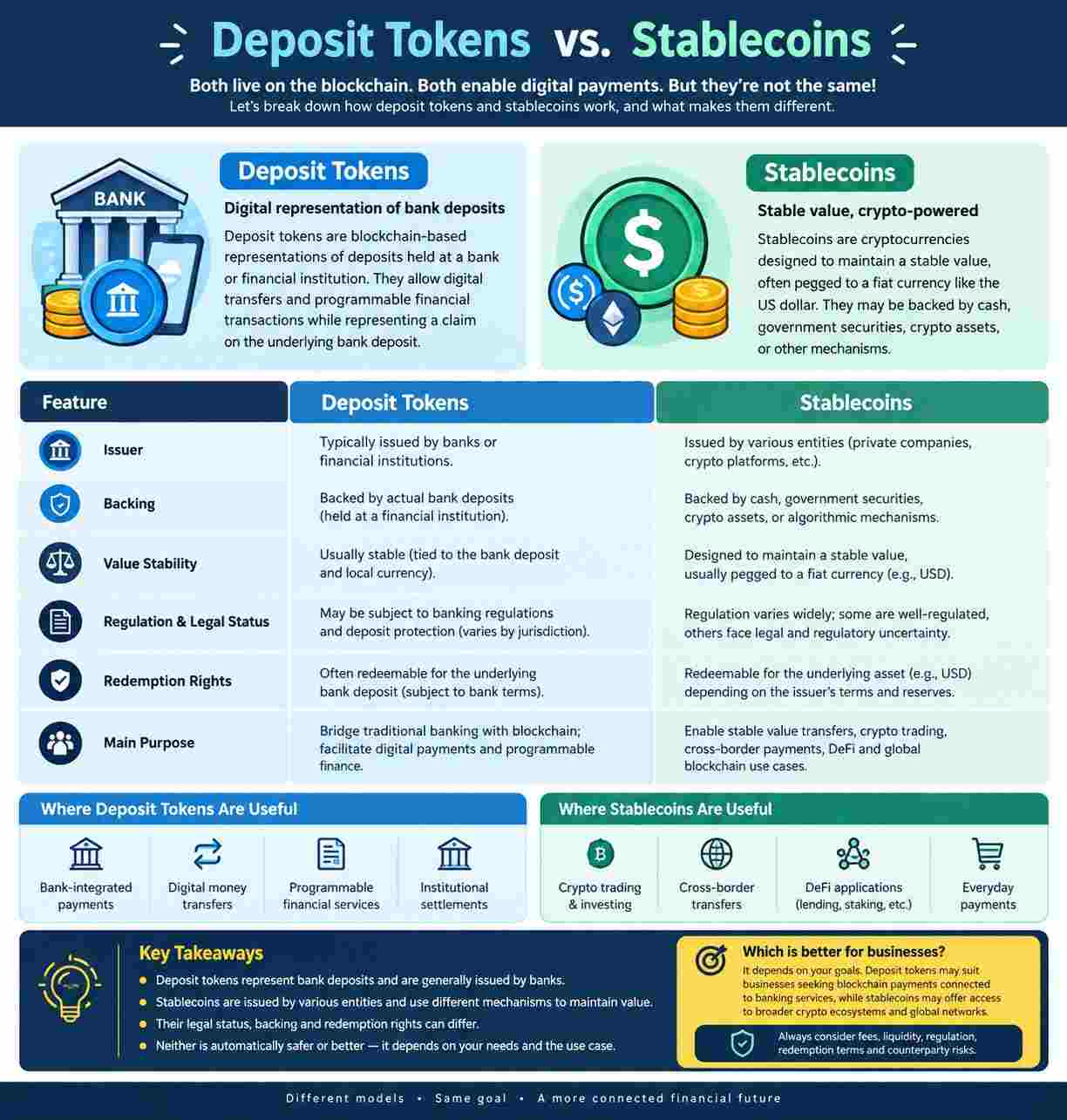
How Do Deposit Tokens vs. Stablecoins Compare in a Table?
Factor | Deposit Token | Stablecoin |
Issuer | Licensed commercial bank | Non-bank company or bank subsidiary |
Legal claim | Money owed by the bank | Right to redeem from the issuer |
Backing | Bank balance sheet | Cash and short-term government bonds |
Access | Approved bank clients | Anyone with a supported wallet |
Insurance | May apply, depending on local rules | Usually none |
Main users | Banks and company treasuries | Traders, DeFi users, and global senders |
A February 2026 central bank research paper looked at the same question. It found that tokenized deposits come out ahead when regulation is costly and banks take little risk. Stablecoins come out ahead when rules are lighter.
Which One Is Better, and for Whom?
In the Deposit Tokens vs. Stablecoins debate, no single winner exists. Each fits a different job. Deposit tokens suit banks and large companies that want clear legal rights and a familiar institution behind the money.
Stablecoins suit open markets, where speed and easy wallet access count for more. Industry reports put stablecoin supply near USD 300 billion, so adoption is already large.
The same reports expect both to exist together, since neither has replaced older payment systems. The right pick depends on who is paying, where the money is headed, and which rules apply.
What Are the Real-World Use Cases?
Deposit tokens: moving cash between a company’s own entities, settling tokenized securities, payments that wait on a condition, and same-day cash needs inside one bank network.
Stablecoins: wallet-to-wallet transfers, collateral for DeFi loans, payments to family or suppliers abroad, and trade settlement on crypto exchanges at any hour.
What Risks and Rules Deserve Attention?
Neither option is risk-free. The main concerns are:
Deposit tokens still carry the credit risk of the issuing bank.
A bank run or a technical failure can still disrupt deposit tokens.
Deposit tokens may stay locked inside closed networks with limited reach.
Stablecoins can slip off their peg if reserves are hard to sell fast.
Holders may face limits or delays when trying to redeem a stablecoin.
Smart contract bugs and wallet theft remain real dangers for stablecoin users.
The US GENIUS Act, signed in July 2025, created a federal framework for payment stablecoins, but reports in July 2026 said agencies missed the deadline for final rules.
The European Union’s MiCA framework treats fiat-backed stablecoins tied to one currency as e-money tokens.
Rules differ by country, so a token allowed in one market may be limited in another.
What Does the Evidence Say About Deposit Tokens vs. Stablecoins?
One clear signal stands out. Large banks are building tokenized deposits instead of staying away from public blockchains. That matters, because it shows banks see stablecoin growth as a very real challenge.
The main concern is that tokenization does not create new income for banks, because the gain comes from keeping deposits and speeding up transfers. The biggest unknown is regulation.
Final US rules and cross-border recognition could decide which model grows faster. Before relying on either token, readers should check issuer reports, reserve details, redemption terms, and insurance status.
Final Takeaway
Deposit tokens vs. stablecoins is not really a fight with one winner. Deposit tokens bring bank-level legal protection to blockchain payments.
Stablecoins bring open access and global reach. Rules, reserve quality, and technical safety are the next things to watch.
Disclaimer
This article is for informational purposes only and does not give financial, investment, or legal advice. Digital assets are volatile and carry a risk of loss, so readers should research on their own and consult a licensed professional before making any financial decision.