Avalanche News: Can AVAX Gain From Dubai Courts’ Blockchain Adoption?

In Avalanche news today, Dubai Courts has started using Avalanche to verify court orders and hearing records. People around the world can check these records within seconds.
This is a real-world use of blockchain outside finance. It shows how courts can use this technology to check if legal documents are genuine.
Key Takeaways
-
DIFC Courts now issue digital credentials for court orders and hearing records. These credentials use Avalanche C-Chain.
-
The blockchain stores a digital fingerprint of each document. It does not store the document itself or private case details.
-
Deca4 Advisory built the system. Ava Labs confirmed the partnership through its official @avax account on X.
From the Official DIFC Courts Press Release
DIFC-Courts announced the new system on October 14, 2026. Court documents now have digital credentials that cannot be transferred to others. People can use these credentials to check records from anywhere in the world.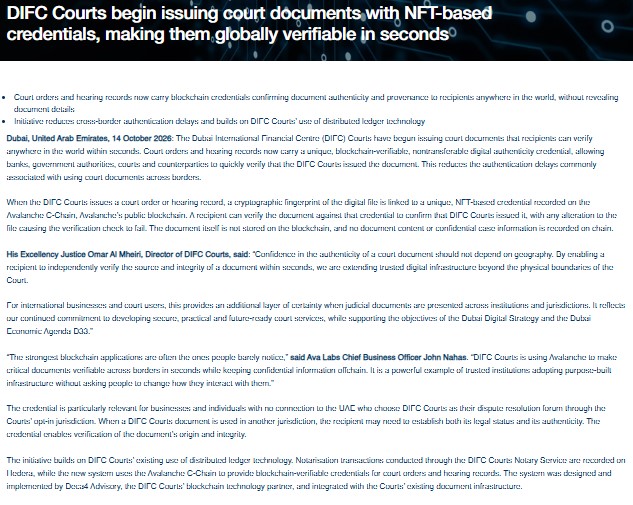
Source: Posted on difccourts.ae, October 15, 2026
Each document gets a digital fingerprint. This links to an NFT-based credential on Avalanche C-Chain. The document itself stays off the blockchain. Private case details also remain off-chain.
Deca4 Advisory built the system. It adds a new service to the courts' existing Notary Service on Hedera.
Justice Omar Al Mheiri said the system can help people trust court documents across borders. John Nahas of Ava Labs said it allows checks across countries without changing how users work.
The project also supports Dubai's Digital Strategy and Economic Agenda D33. It adds a new blockchain tool for court orders and hearing records.
From the Official @avax X Post
The official Avalanche account shared news of the project. It said Dubai's DIFC Courts are using Avalanche to make court orders and hearing records easy to check worldwide.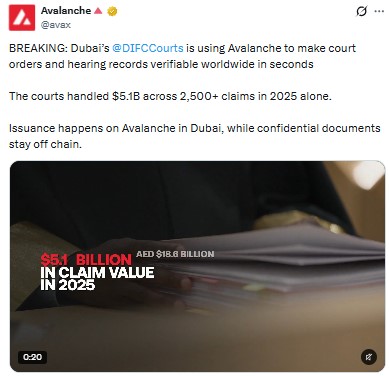
Source: @avax on X, October 15, 2026
The post says DIFC-Courts handled claims worth $5.1 billion in 2025. It also says the courts handled more than 2,500 claims that year.
The $5.1 billion figure shows the scale of the courts' work. It is not money flowing into Avalanche. It also does not represent revenue earned by the network or AVAX holders.
What This Means for Avalanche News
Latest crypto news shows how institutions can use blockchain in daily work.
DIFC-Courts use Avalanche C-Chain to issue digital credentials. Each document may create a blockchain transaction. This gives people a way to check if a court record is genuine.
The courts handled more than 2,500 claims in 2025. Still, the number of transactions from this service may remain small.
The bigger benefit may be trust. A court linked to Dubai's financial sector has chosen Avalanche for part of its legal work.
It is too early to know if this news will affect the AVAX price. The result will depend on how widely the system is used. Other factors, such as market trends, will also matter.
Why Document Authentication Matters
Checking legal documents can be hard when people live in different countries. Blockchain tools may make this process easier.
People can check if a court issued a record. They can also check whether the record has changed since it was issued.
The system keeps document contents off-chain. This helps keep private case details separate from public blockchain records.
However, the wider impact is not yet clear. It will depend on how well the system works and whether more institutions adopt it.
The announcement shows one practical use of Avalanche. It does not prove that the network will earn more revenue. It also does not guarantee AVAX price appreciation.
YMYL Disclaimer
This article is for information only. It is not financial or investment advice. The $5.1 billion figure comes from the official @avax post on X dated October 15, 2026. It refers to claims handled by DIFC Courts in 2025, not Avalanche network revenue. The technical details come from the DIFC Courts-press release dated October 15, 2026. Any effect on AVAX price remains uncertain. Crypto investments carry a risk of loss.






