


A nonprofit that helps banks and asset managers use the Ethereum network has announced a new hub for them. The group said its platform will launch in the coming weeks.
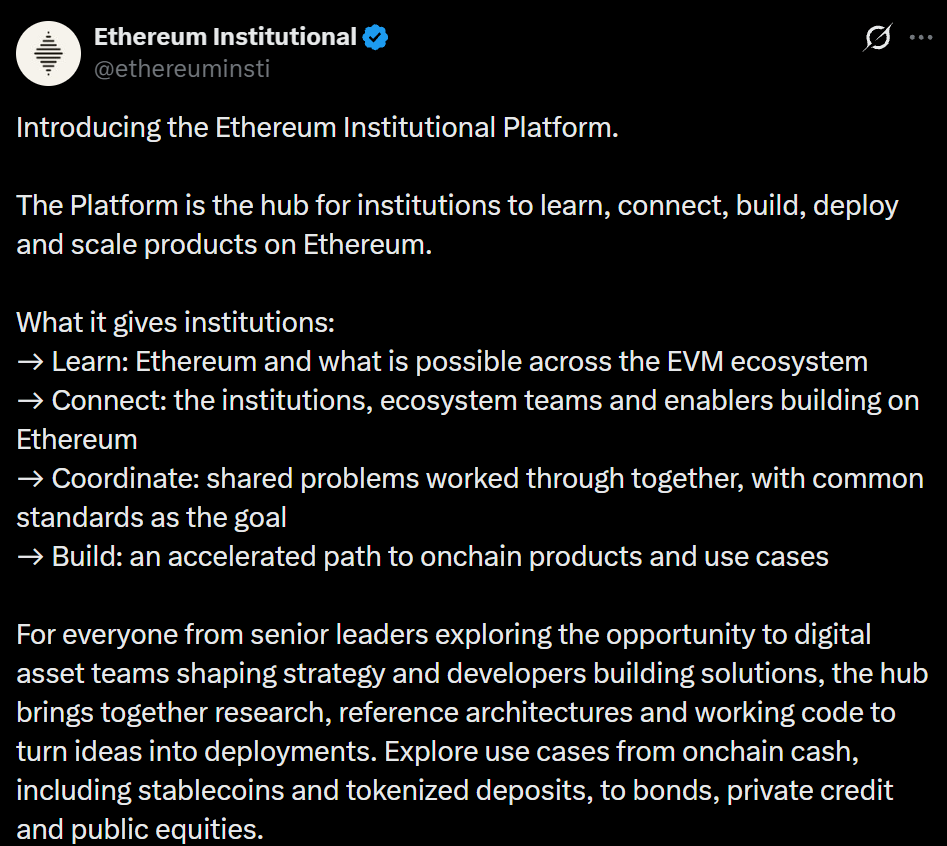
Source: Ethereum Institutional Post
This explains what the Ethereum Institutional Platform offers, who is behind it, and which real products the group already tracks.
The official announcement calls the platform a hub where institutions can learn, connect, build, deploy and scale products on Ethereum.
It lists four things the hub gives them:
Pillar | What it means |
Learn | Understand Ethereum and what is possible across the EVM ecosystem |
Connect | Meet the institutions, ecosystem teams and enablers building on the network |
Coordinate | Work through shared problems together, with common standards as the goal |
Build | Follow an accelerated path to onchain products and use cases |
The post says the launch is planned for the coming weeks, so the hub had not opened when it was announced. The official website describes the EVM world as Ethereum, its layer 2 networks, and every other chain that runs the same technology.
The announcement says the hub serves everyone from senior leaders exploring the opportunity to digital asset teams shaping strategy and developers building solutions.
For them, it brings together three things:
Research on the ecosystem
Reference architectures, which are shared design blueprints
Working code that teams can use to move from idea to deployment
The Ethereum Institutional Platform therefore mixes learning material with practical tools. The post also invites readers to explore use cases such as:
Onchain cash, including stablecoins and tokenized deposits
Bonds
Private credit
Public equities
The group is an independent nonprofit founded in 2026 with anchor funding from BitMine, SharpLink, Joseph Lubin, and Mihai Alisie.
It was founded by the enterprise team of the Ethereum Foundation, with David Walsh, Marius Smith, and Matthew Dawson as co-founders.
The site says it is not the foundation and does not speak for the protocol. It also says the nonprofit structure was chosen to stay neutral and avoid favoring any single product or vendor.
The site lists five focus areas from day one:
Education and engagement with banks, asset managers, custodians, fintechs, market infrastructures and sovereign institutions
Intelligence, meaning neutral research on how the network works and what it enables
Marketing, which showcases real deployments and use cases
Industry discovery and requirements, which gathers institutional needs so standards can take shape
Events, which bring institutions and ecosystem teams together
The deployments page links to a tracker of 115 live deployments, each dated to the month it was first seen and linked to its source.
The homepage splits them by type of institution:
Type of institution | Deployments |
Asset managers | 41 |
Banks | 39 |
Fintechs | 18 |
Public sector | 8 |
Market infrastructure | 8 |
Corporates | 1 |
Total | 115 |
Recent entries shown on the official homepage include:
Amundi: a tokenized share class of its Core STOXX Europe 600 index fund (November 2026)
BlackRock: a tokenized Hong Kong dollar money market fund (November 2026)
Deutsche Bank: ETH custody for institutional and corporate clients (November 2026)
Invesco: a tokenized government money market fund for stablecoin reserves (November 2026)
NRW.BANK: a tokenized security settled in central bank money (November 2026)
J.P. Morgan: a deposit token (October 2026)
These examples sit in the same areas the Ethereum Institutional Platform highlights, from deposit tokens to digital bonds.
The homepage also shows public figures, each credited to its own data source:
Measure | Figure shown | Source and date shown |
Tokenized assets on mainnet | $20.8B (39.8% of the total) | Token Terminal, read 16 Nov 2026 |
Stablecoin supply on mainnet | $146B | growthepie, to 24 Nov 2026 |
ETH staked | 44.2M ETH (value securing the network: $79.5B) | ethereum.org, read 18 Nov 2026 |
Live layer 2 networks | 81 | growthepie, Nov 2026 |
Median fee on mainnet | $0.04 | growthepie, 7 days to 24 Nov 2026 |
The site also describes a four-step way to work with the team: tell them what you are building, blueprint a solution together, close the gaps, then bring in the right partners. It says a team member replies within two business days.
The announcement shows how seriously the group is pushing institutional adoption, with one hub for research, code and shared standards.
How useful the Ethereum Institutional Platform proves will depend on its launch and on what institutions actually build with it. Readers should follow the official channels for the launch date.
This article is for educational and informational purposes only and is not financial or investment advice. Crypto assets are high risk, their prices can be very volatile, and you can lose some or all of your money. Always do your own research and consider speaking with a licensed financial advisor before making investment decisions.
Frequently Asked Questions (FAQ)




Owned by:-
DCG Tech FZCO, UAE
Delivery Partner:-
Gabbar MediaTech Pvt Ltd.
Copyright © 2026 Coin Gabbar. All Rights Reserved


