Ethereum News: $2.45M ETH Move and Glamsterdam October Upgrade Test


Ethereum News: ETH Moves, Glamsterdam Testing and Quick Slots Proposal
Ethereum had an eventful stretch, with movement on several fronts at once. The Ethereum Foundation shifted a chunk of ETH to a new wallet, developers locked in a testing date for the next major upgrade, MetaMask rolled out a fresh anti-scam feature, and a handful of large wallets made notable trades. Here is a rundown of what happened and what it might mean for the network going forward.
At a Glance
-
Ethereum Foundation sent roughly $2.45 million in tokens to an unlabeled Gnosis Safe wallet; it still holds about $235.46 million in tokens and $23 million in USDC.
-
Glamsterdam upgrade heads to public testing on Sepolia on October 6, with client software due by September 29.
-
MetaMask launched Added Protection, a feature that forces transactions to match their preview or fail automatically.
-
The Quick Slots proposal (EIP-8198) aims to cut Ethereum's block time from 12 seconds to 10 seconds.
-
On-chain trackers spotted large whale rotations between BTC, ETH, and HYPE this week.
Ethereum price today is at $2509.4, up 2.3% over 24 hours. Ethereum recorded about $15.6 billion in trading volume, while its market capitalization stood near $306.4 billion.
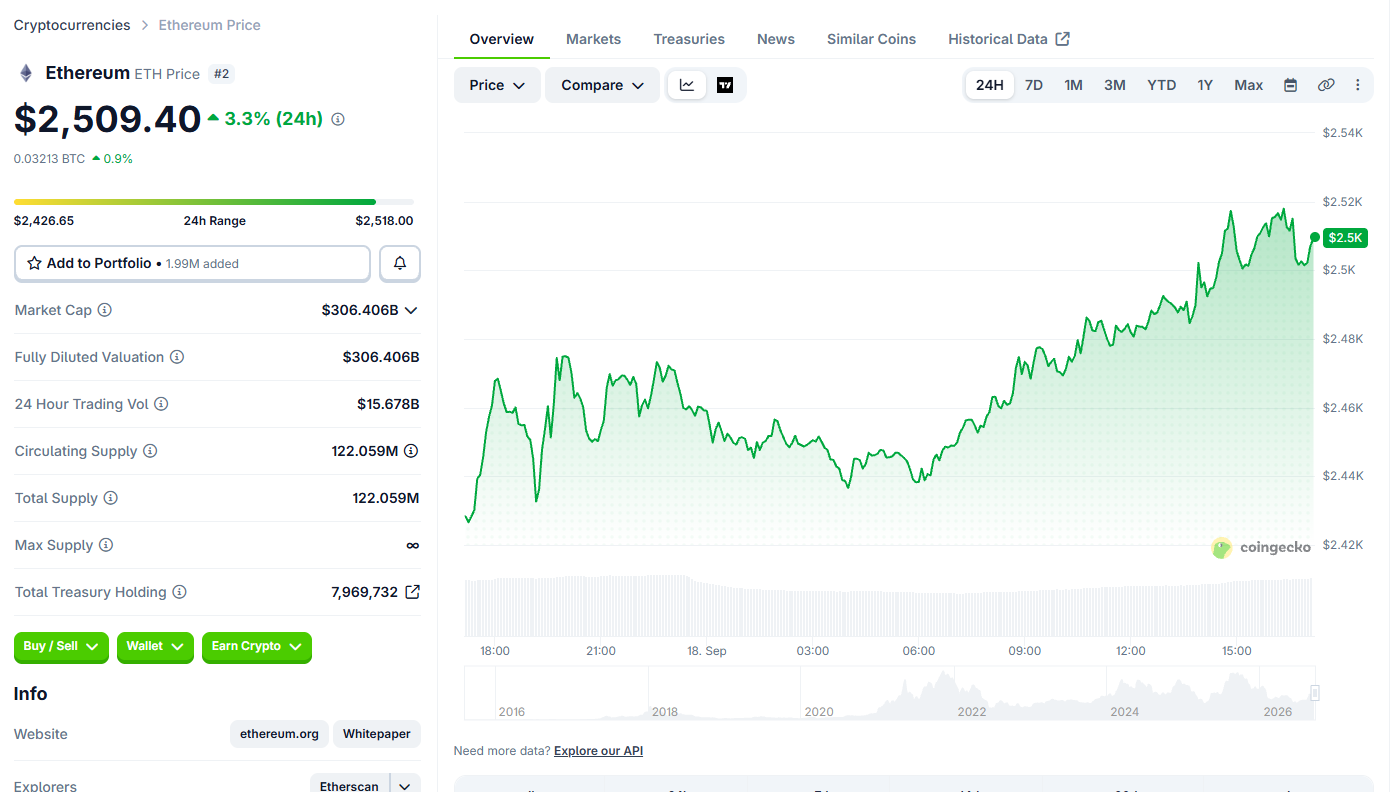
Source: Coingecko Data
Ethereum Foundation Moves $2.45 Million in ETH to Gnosis Safe
According to monitoring from on-chain analytics firm Arkham, the Ethereum Foundation moved approximately $2.45 million worth of ETH to a Gnosis Safe multisignature wallet that carries no identifying label. Because the destination wallet isn't tagged, it isn't yet possible to say whether it remains under the Foundation's control or whether the funds were sent to an outside party.
That distinction matters: a transfer to a Foundation-owned wallet would likely be routine treasury management, while a transfer to an external address could suggest a sale or a grant payment.
Arkham's data shows the Foundation's labeled address still holds a substantial reserve on top of this transfer.
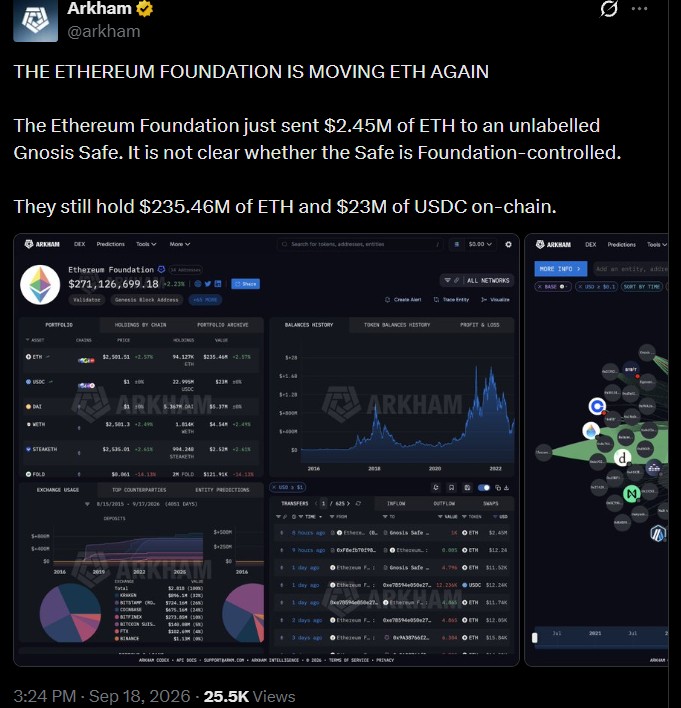
Source: Arkham Data
| Ethereum Foundation On-Chain Details | Latest Data |
| Amount transferred | ~$2.45 million in ETH |
| Destination | Unlabeled Gnosis Safe multisig |
| Remaining ETH holdings | ~$235.46 million |
| Remaining USDC holdings | ~$23 million |
| Sale confirmed | No |
| External transfer confirmed | No |
Glamsterdam Testnet Date Set for October 6
Ethereum developers have confirmed that the Glamsterdam upgrade will begin public testing on the Sepolia testnet on October 6. Client teams face a tight window, needing to ship Sepolia-compatible software by September 29, which leaves only seven days for security review before testing starts.
Developers also flagged a specific risk: since Sepolia's test ETH is free and builder identities can be reused, bad actors could repeatedly win block auctions and then withhold transaction payloads, disrupting the test environment without threatening any real funds. A second test run on Hoodi is tentatively planned for October 27. No date has been set yet for the Glamsterdam mainnet activation.
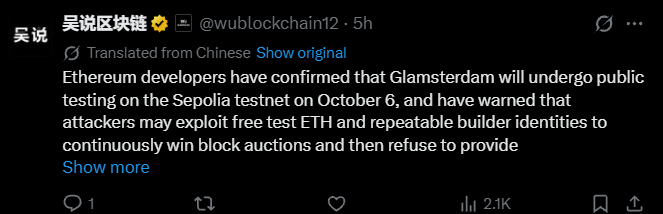
Source: Wu Blockchain
MetaMask Adds Protection Against Red Pill Attacks
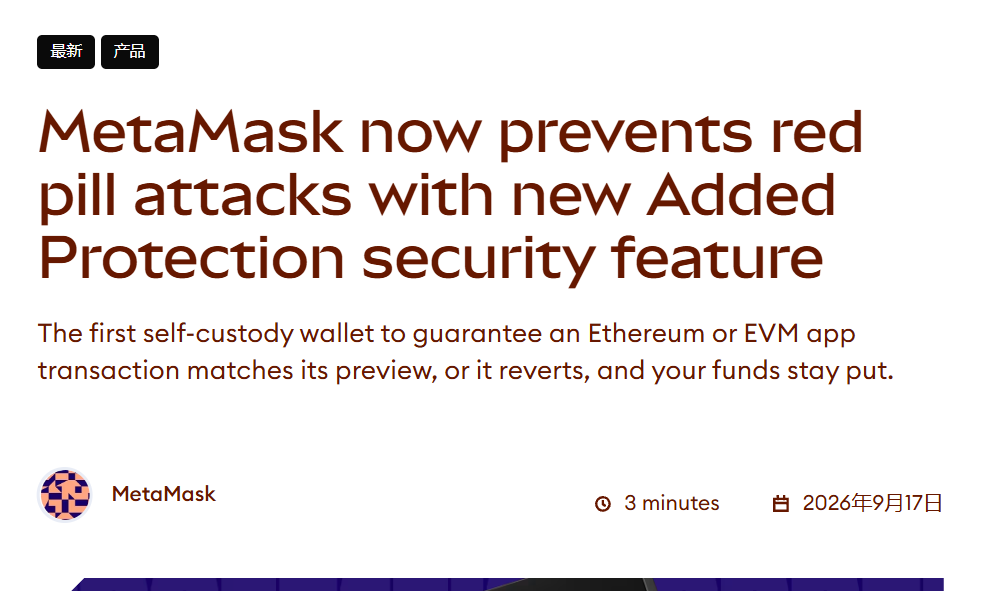
MetaMask introduced a new security feature called Added Protection, designed to stop what the industry calls "red pill attacks." In this type of scam, a malicious contract detects when it's being simulated and shows a harmless preview, then behaves completely differently once the real transaction is signed.
Added Protection closes that gap by locking the simulated preview into the transaction as a strict requirement. If the actual on-chain result doesn't match what the wallet showed beforehand, the transaction automatically fails, and the user loses only the network gas fee rather than their assets.
The feature is turned on by default and is already live in extension version v13.45 across 13 EVM networks that support EIP-7702 smart accounts, with a mobile rollout expected to follow. Users who prefer to manage risk on their own can still switch it off from the confirmation screen.
Source: MetaMask
Ethereum Quick Slots Proposal Targets 10-Second Blocks
Research group Ethlabs reports that the Ethereum news is advancing a proposal known as Quick Slots, formally EIP-8198. The plan calls for a structural change at the consensus layer: removing the hardcoded assumption of a fixed 12-second block time and turning it into an adjustable runtime parameter instead. The first step would shorten block time from 12 seconds to 10 seconds, with further reductions possible later depending on network performance and client limitations.
Ethlabs says the proposal already has backing from major DeFi players including DefiLlama, Doppler, Derive, Ondo, Railgun, Lido and Ethena.
Supporters argue that faster blocks would narrow arbitrage windows, cut losses from loss-versus-rebalancing (LVR), improve pricing accuracy on decentralized exchanges, and speed up transaction confirmations. Paired with the FOCIL proposal (EIP-7805), backers believe it could also strengthen censorship resistance without pushing up node centralization or entry barriers for validators.

Source: EthLabs
ETH Whale Activity Shows Heavy Rotation Across Major Assets
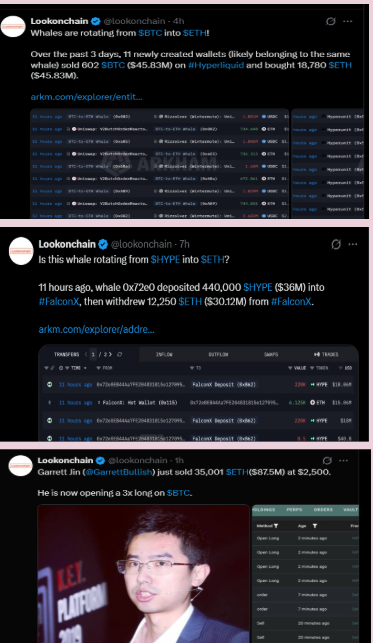
On-chain tracker Lookonchain flagged several large wallet movements this week. Trader Garrett Jin withdrew 35,001 ETH (about $85 million) from Binance, moved it to Hyperliquid, and later sold the position for roughly $87.5 million at a $2,500 price point before opening a 3x leveraged long on BTC.
Separately, eleven newly created wallets, believed to belong to a single large holder, sold 602 BTC (about $45.83 million) on Hyperliquid over three days and used the proceeds to buy 18,780 ETH, an apparent rotation from bitcoin into ether. In a third case, a wallet tracked as 0x72e0 deposited 440,000 HYPE tokens (around $36 million) into FalconX and then withdrew 12,250 ETH (about $30.12 million), suggesting another shift toward ETH exposure.
Source: Lookonchain
What Recent Ethereum Developments Mean for ETH and the Network
Taken together, these events show activity on multiple layers at once: treasury movement from the Foundation, technical groundwork for faster and more secure infrastructure, and shifting positioning among large holders. None of these individually confirms a directional trend for price, and the unlabeled wallet transfer in particular remains unresolved.
What can be said with confidence is that Ethereum's development pipeline, from Glamsterdam to Quick Slots, is progressing on schedule, and wallet-level security is improving through tools like Added Protection.
Ethereum News Today Timeline: September-October 2026
| Date | Ethereum Development |
| Sep 17 | Quick Slots (EIP-8198) proposal gains attention |
| Sep 17 | MetaMask announces Added Protection |
| Sep 18 | Ethereum Foundation transfers ~$2.45M in ETH |
| Sep 18 | Glamsterdam testing schedule confirmed |
| Sep 29 | Deadline for Sepolia-compatible client software |
| Oct 6 | Glamsterdam public testing begins on Sepolia |
| Oct 27 | Tentative Hoodi test date |
| TBD | Glamsterdam mainnet activation date |
Ethereum News Today: Key Takeaways for ETH Users
This week's ETH news spans an unresolved multisig transfer from the Foundation, a confirmed testing timeline for the Glamsterdam upgrade, a new MetaMask feature aimed at preventing preview-manipulation scams, a proposal to shorten block times, and visible rotation among large holders between BTC, ETH, and HYPE.
Readers should treat the whale movements as data points rather than signals of where the market is headed next, and keep an eye on the September 29 and October 6 dates as the next concrete checkpoints for Glamsterdam.
Disclaimer: This article is for informational purposes only and does not constitute financial, investment, or trading advice. Cryptocurrency markets are highly volatile and carry significant risk. Always conduct your own research and consult a qualified financial advisor before making any investment decisions.









