

Kyrgyzstan crypto sanctions have landed on the EU table. As of November 27, 2026, the plan has not taken effect and needs the unanimous approval of 27 EU member states, according to a November 26 update from Wu Blockchain. This crypto news today is about policy, not price.
The European Commission presented its 22nd EU Russia sanctions package on November 23, 2026.
In von der Leyen's official statement, she promised a crackdown on payment networks, including third countries that help Moscow evade restrictions.
The statement does not name Kyrgyzstan, so that detail rests on Wu Blockchain's report.
Not yet. Per Wu Blockchain, the proposal would bar European operators from direct or indirect transactions with crypto service providers established in the country, aiming to stop crypto sanctions evasion.
If approved, Kyrgyzstan could become the first country on the list.
Wu Blockchain also covered this news in its tweet on X, which carries the clearest summary of the plan so far.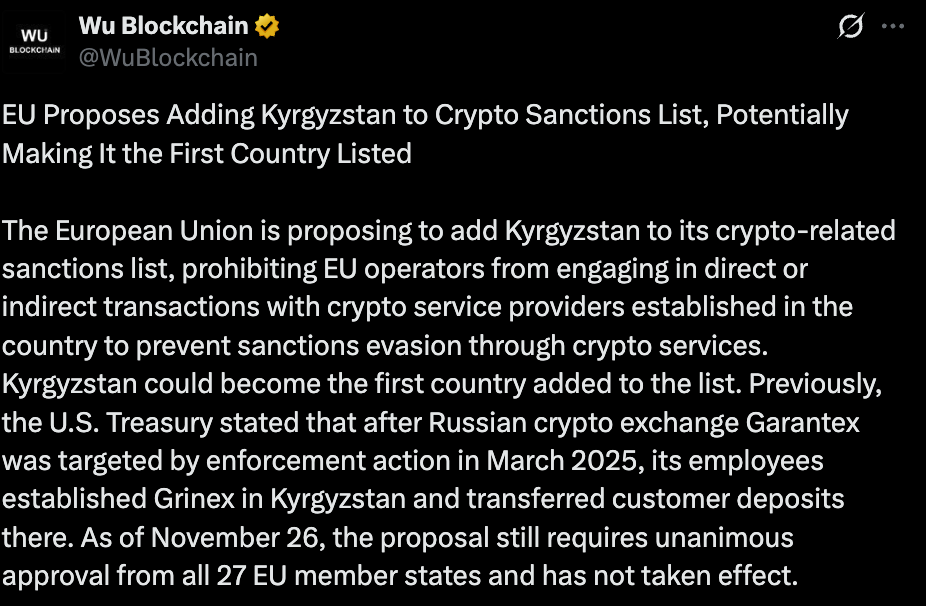
The tool behind this move already exists. The Council announced on July 23, 2026 that its 21st package introduced, for the first time, a full third-country ban on digital-asset services. The same package hit 14 platforms and a Kyrgyz bank.
The table below shows where the process stands today.
Step | Date | Status |
21st package adopted | July 23, 2026 | In force, country-ban tool created |
22nd package presented | November 23, 2026 | Proposal only |
Member state vote | Pending | Unanimity required |
The Grinex Kyrgyzstan connection comes from the US Treasury press release dated August 14, 2025:
On March 6, 2025, US authorities seized Garantex's web domain and froze over $26 million.
Garantex then moved customer deposits to Grinex, which Treasury calls its successor.
Treasury designated Grinex and six associated companies in Russia and the Kyrgyz Republic.
The A7A5 token, a ruble-backed asset, is issued by Kyrgyzstani firm Old Vector.
Treasury also says Garantex processed over $100 million in illicit transactions since 2019. That history explains why Kyrgyzstan crypto sanctions are now under discussion.
A Kyrgyzstan crypto ban would work at country level instead of naming firms one by one.
Any Kyrgyzstan crypto exchange could fall under the crypto service providers ban because of where it is established, based on the Council's description of the tool.
Kyrgyzstan crypto sanctions of this kind would also be a first for the new mechanism, since earlier rounds listed individual platforms only.
The Commission has meanwhile launched a Crypto Sanctions Task Force, according to the statement.
Analysts following crypto news may read the proposal as a first test of the country-level tool.
All 27 governments must agree, so the final text could differ from what the Commission presented.
EU sanctions Kyrgyzstan only if no member state blocks the listing. For now, Russia crypto sanctions policy is moving from single platforms toward whole jurisdictions, and the wider EU sanctions list may grow if the vote passes.
Whether Kyrgyzstan crypto sanctions survive the vote is the open question.
Disclaimer: This article is for information only and is not financial, legal, or investment advice. Digital assets are volatile, and you can lose money. Verify details with official sources before making any decision.
Frequently Asked Questions (FAQ)




Owned by:-
DCG Tech FZCO, UAE
Delivery Partner:-
Gabbar MediaTech Pvt Ltd.
Copyright © 2026 Coin Gabbar. All Rights Reserved


