Russia Crypto Trading: What the New Exchange Rules Mean Starting Today

Russia Crypto Trading: Licensed Exchanges Face New Rules Before Launch
Today, 22 November 2026, marks a major turning point for digital currencies in the country.
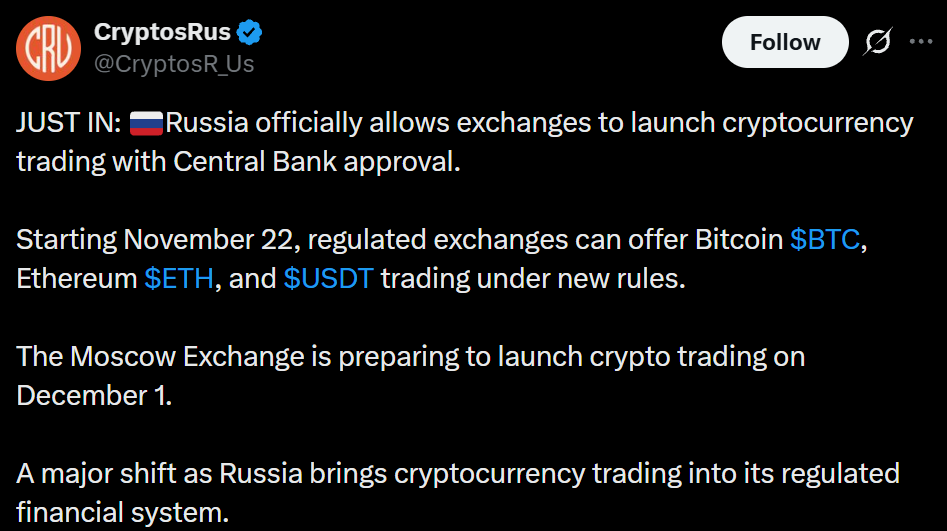
Russia crypto trading can now move into the regulated financial system because the new ordinance from the Central Bank allows licensed exchanges to begin offering cryptocurrency deals, provided the regulator first approves their rules.
Moscow Exchange is already preparing to open its own market on 1 December. This article explains what changed, which duties exchanges must follow, and what comes next, in simple language.
Source: Post on X
What Changed on 22 November 2026?
According to the official announcement from the Bank of Russia dated 11 November 2026, exchanges are authorized to begin cryptocurrency trading from 22 November 2026, but only after the regulator agrees to their trading rules.
The framework rests on an ordinance registered by the Russian Ministry of Justice.
It sets requirements for organised trading in digital currencies and digital rights, and the full ordinance text is available on the regulator's website.
A Russian-language version of the notice is also published.
Put simply, permission now exists, but every venue must get its rulebook cleared first.
Nothing launches automatically just because the date has arrived. Think of it like a driving licence: the law now allows driving, but each driver still needs to pass the test before getting on the road.
Key Duties for Exchanges Under the New Ordinance
The Bank of Russia's notice lists clear obligations. Venue operators must:
-
Register participants, including brokers, trust managers, and central counterparties
-
Maintain registers of orders and transactions
-
Monitor the operations carried out on their platform
-
Calculate price indicators: current, weighted average, market and closing prices
-
Provide information on the progress and results of sessions to the Bank of Russia, following the procedure already used for other assets
These steps mean every order and deal leaves a record, prices are measured in a standard way, and the regulator receives results in a format it already knows.
Moscow Exchange's Planned Launch on 1 December
As shown on its official website, Moscow Exchange is preparing to launch digital currency trading on 1 December 2026.
Bitcoin (BTC), Ethereum (ETH) and USDT are the assets expected at the start. Please note that the regulator's notice does not name specific coins, and 1 December is the venue's own plan, not a date fixed in the ordinance.
| Date | What Happens | Status |
| 11 November 2026 | Regulator announces the ordinance on organised digital currency deals | Published |
| 22 November 2026 | Venues may start, once their rules are approved | Allowed from today |
| 1 December 2026 | Moscow Exchange's planned start (BTC, ETH, USDT) | Planned |
How Russia Crypto Trading Will Work Under Regulated Rules
After a venue's rules are approved, orders will go through registered participants such as brokers.
Each order and transaction will be entered into official registers, and prices will be calculated through defined indicators.
Results are then reported to the supervisor. For everyday readers, this means Russia crypto trading is shifting into a framework with records, supervision and standard price measures.
Why it matters:
-
Clear records: orders and deals are registered
-
Defined pricing: four official price indicators are calculated
-
Oversight: the Central Bank receives information on results
-
Known participants: brokers, trust managers and counterparties are registered in advance
What Readers Should Keep in Mind
-
22 November is a permission date, not a guaranteed launch day
-
Each venue needs the regulator's concurrence on its rulebook first
-
1 December is Moscow Exchange's plan, so check its official website for confirmation
-
Digital currencies carry risk, and this article is information, not investment advice
Conclusion
The Central Bank's ordinance gives exchanges a clear legal path to list digital currencies, with strict registration, record-keeping, pricing and reporting duties.
Russia crypto trading has now taken its first formal step inside the regulated market, and all eyes are on Moscow Exchange's planned 1 December start.
Until each venue gets its rules approved, follow official announcements for confirmed dates.
Disclaimer
This article is for educational and informational purposes only and is not financial or investment advice. Crypto assets are high risk, their prices can be very volatile, and you can lose some or all of your money. Always do your own research and consider speaking with a licensed financial advisor before making investment decisions.






