Fidelity vs Schwab Crypto: Coins, Fees, and 2027 Plans Compared

Fidelity vs Schwab Crypto: Key Differences at a Glance
Fidelity Crypto is for US citizens aged 18 or older in states where it is offered. Schwab Crypto is open in all states except New York and Louisiana, and it is not offered in US territories or outside the US. Neither is available internationally.
This Fidelity vs. Schwab crypto comparison looks at coins, fees, and withdrawals. Both brokers sell crypto inside a familiar brokerage login, but they differ on coin choice, cost, and retirement accounts. Fidelity also sells crypto IRAs, while how crypto taxes work for brokerage accounts stays the same for both. This guide uses pages checked on 28 November 2026.
Glossary
Spot crypto: Buying the coin itself rather than a contract on its price.
Futures: A contract to buy or sell at a set price later.
Allowlist: A saved list of approved withdrawal addresses.
S-1: An SEC registration form filed before a public offering.
What crypto can you trade on Fidelity and Schwab?
Fidelity offers 8 direct coins: BTC, ETH, SOL, LTC, AAVE, LINK, UNI, and FIDD, a USD-pegged stablecoin issued by Fidelity Digital Assets. Its Crypto IRA lists 7 of them, without FIDD. Schwab offers 5: BTC, ETH, SOL, AVAX, and LINK.
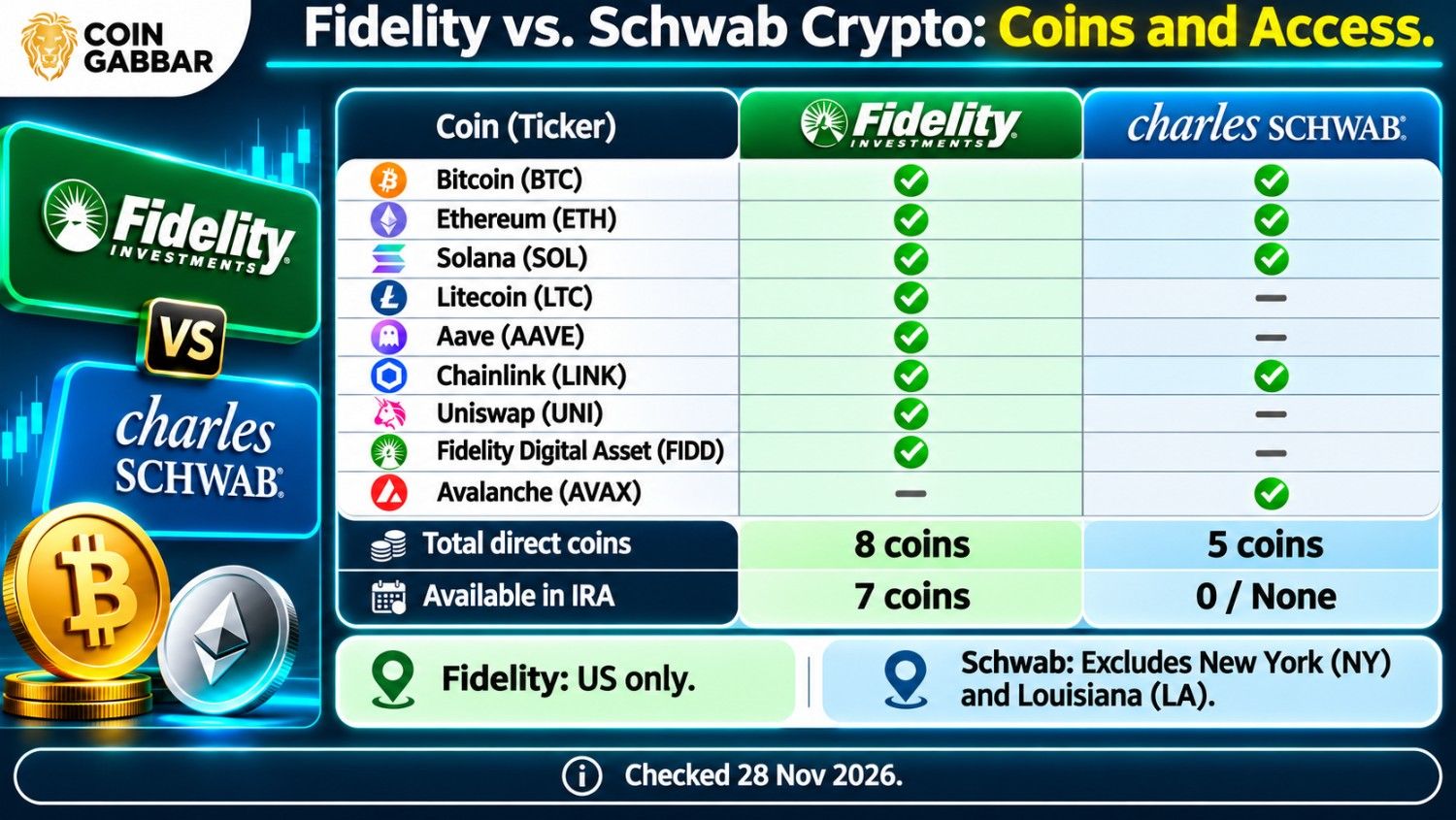
Fidelity's list is longer and includes DeFi tokens. Schwab's list covers the largest names. According to Schwab's crypto page, more assets are "coming soon," with no dates given.
Feature | Fidelity | Schwab |
Direct coins | 8 (7 in IRA) | 5 |
Stablecoin | FIDD | None listed |
Region | US states where offered | US except NY, LA |
Source: Fidelity and Schwab product pages, checked 28 Nov 2026. Fidelity's coin list comes from our research pack and should be reconfirmed.
Fidelity vs Schwab Crypto: fees compared
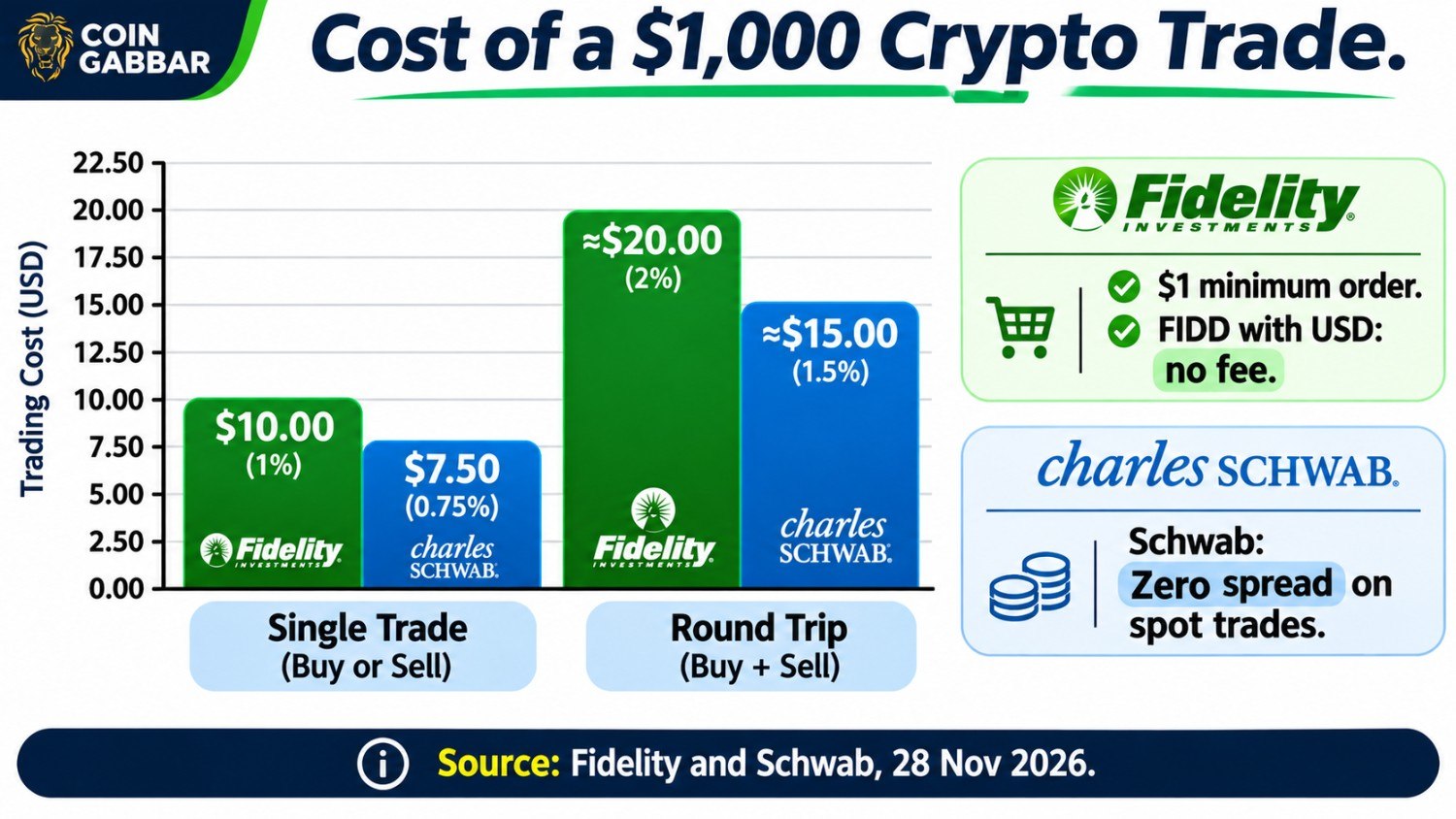
Fidelity charges a 1% fee on buys and sells in crypto accounts and crypto IRAs, with a $1 minimum order. Fidelity's help pages say FIDD trades against USD carry no fee. They also say there is no holding or custody fee. Before 4 December 2025, the 1% sat inside the price rather than being shown as a separate line.
Schwab's page lists 0.75% with zero spread, citing an April 2026 Barclays report.
On a $1,000 buy, that is $10.00 at Fidelity and $7.50 at Schwab. A round trip costs about $20.00 against about $15.00, before any price movement. Schwab is cheaper per trade, but Fidelity lists more coins.
Can you withdraw crypto to your own wallet?
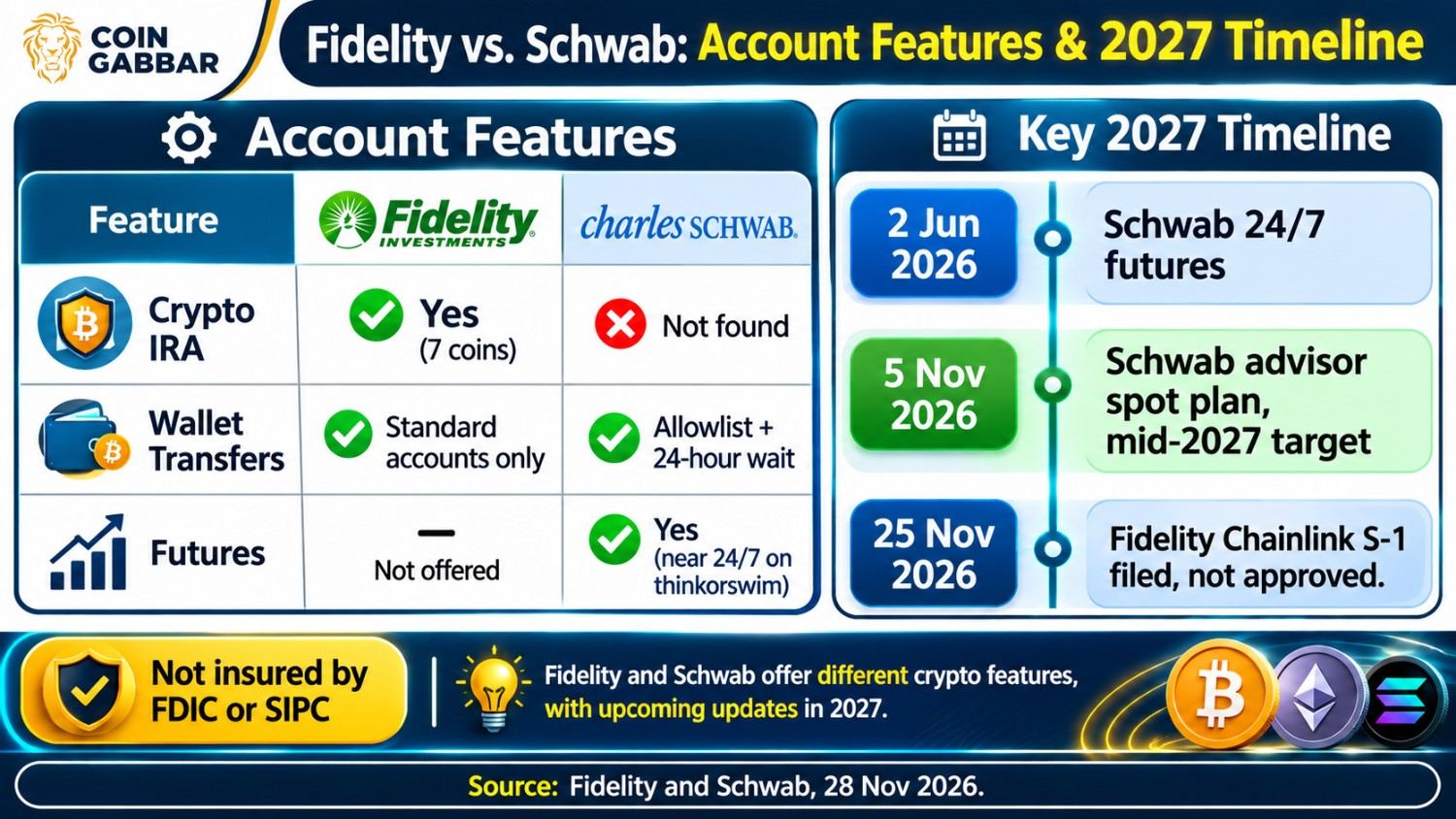
Fidelity supports crypto transfers for standard crypto accounts 24 hours a day, except during maintenance, according to its withdrawing crypto help page. Crypto IRAs are ineligible for transfers.
Schwab's crypto FAQ says enrolled clients can receive and send supported coins, subject to address screening. To send, you must first allowlist the address and wait 24 hours. Schwab says it is enabling transfers in stages, so check your own account.
Fidelity vs Schwab Crypto: Which is better for crypto in an IRA?
Fidelity is the clearer choice. It offers traditional, Roth, and rollover crypto IRAs, and you must link a brokerage IRA of the same type. Fidelity Management Trust Company is the custodian, and the IRA allows no direct withdrawals or transfers of coins.
We found no spot for Crypto IRA on Schwab's crypto page. That page does not mention IRAs at all, so ask Schwab before assuming either way. The answer to "which broker lets you hold crypto in an IRA" is therefore Fidelity, based on the pages we checked.
Does Schwab offer 24/7 crypto futures trading?
Yes, for select contracts. On 2 June 2026, Schwab announced that select crypto futures on thinkorswim could trade nearly 24 hours a day, seven days a week. The contracts cover Bitcoin, Ether, Solana, and Ripple. You need an approved futures account.
Futures give price exposure without holding coins, so they are separate from the spot coins above. Schwab's FAQ also says supported spot crypto trades nearly 24/7, apart from maintenance windows. Fidelity's Crypto trading window, per our pack, runs from 1:00 a.m. to midnight ET.
What are Fidelity and Schwab planning for 2027?
Two plans are in the pipeline, and neither is a retail launch.
First, Fidelity filed a Form S-1 for a Chainlink fund on 25 November 2026. The SEC filing is a preliminary prospectus marked "subject to completion." It shows a bracketed placeholder ticker, FLNK, and says the trust will not stake its LINK. The fee is blank. It is not approved or launched.
Second, InvestmentNews reported on 5 November 2026 that Schwab plans spot trading for advisors by mid-2027. That is the advisor channel. Schwab's retail clients already trade spot crypto.
Expert Opinion
Schwab's own advisor-services head says ETFs are likely to remain advisors' preferred way to allocate to crypto, as InvestmentNews reported. That points to a split. Spot coins suit self-directed trading, while funds and ETPs suit allocation. Keep these categories separate when you compare brokers: spot coins, IRAs, ETPs, and futures each carry different costs and rules.
Which broker should you choose?
Choose Fidelity if you want a crypto IRA or a wider coin list. Choose Schwab if you want a lower per-trade fee, wallet transfers from a taxable account, or futures on Think or swim. Test both with a small order first. See how to compare crypto exchange fees and how to secure a crypto wallet before moving coins.
Key Takeaways
Fidelity lists 8 direct coins. Schwab lists 5.
Fidelity charges a 1% fee. Schwab charges 0.75%.
Fidelity offers a direct Crypto IRA. We found no Schwab equivalent.
Schwab allows wallet transfers after an allowlist step. Fidelity blocks them in IRAs.
Neither broker insures crypto with FDIC or SIPC.
Disclaimer: This article is educational and not financial, tax, or legal advice. Crypto is volatile and can lose value. Neither broker's crypto is FDIC- or SIPC-insured.