Wall Street Is Moving Securities On-Chain: How DTCC Tokenization Works

Wall Street Is Moving Securities On-Chain: How DTCC Tokenization Works
A share in your brokerage app is really a line in a ledger. Now that ledger is getting a twin on a blockchain.
DTCC tokenization lets a security held at the Depository Trust Company (DTC) have a token on a blockchain. DTCC says the owner keeps the same rights.
This guide shows what the token stands for and how it is made and retired. It covers what changes in settlement and collateral. It also shows how the token differs from regular crypto tokens.
Why Is DTCC Tokenization Happening Right Now in 2026?
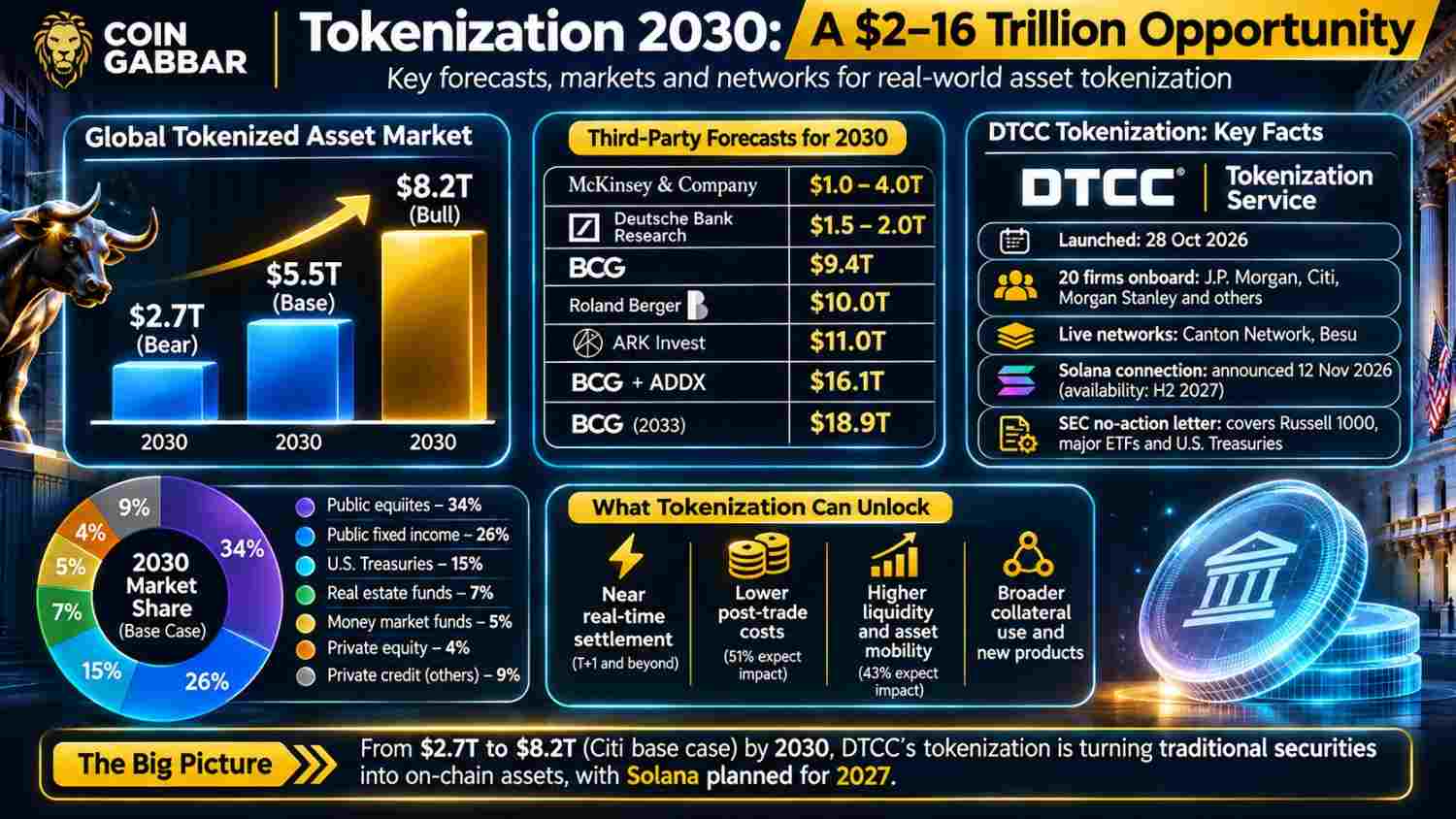
DTC is a unit of the Depository Trust & Clearing Corporation (DTCC). It launched its Tokenization Service on 28 October 2026. Twenty firms have signed on, including J.P. Morgan, Citi, and Morgan Stanley. More than 150 firms gave input. Our guide to real-world asset tokenization sets the background.
Limited production trades came first, in July 2026. Only two networks are live today. They are the Canton Network and DTCC's private Besu network. Partners include BitGo, Fireblocks, Ondo, Tradeweb, and Virtu.
What Does a Tokenized Security Actually Represent?
DTCC calls the token a digital twin of an asset held at DTC. DTC holds more than $114 trillion in assets, so the twin sits on a huge base.
Think of a coat check. You hand in a coat and get a ticket. The ticket is not the coat. It points to it.
The token works the same way. It does not create a new share. DTCC says tokenized securities keep the ownership rights, investor protections, and economic entitlements of their traditional counterparts.
The SEC's December 2025 no-action letter covers three groups. They are Russell 1000 stocks, ETFs that track major indices, and U.S. Treasury securities.
Who Owns the Share: Custody Versus Ownership Rights?
Today, ownership is shown by a certificate or an electronic record. EisnerAmper notes that in a tokenized setup, custody is shown by control of a cryptographic key. Firms such as Fireblocks and Coinbase Custody are building tools for that.
Think of a house key and a deed. The key lets you in. The deed says who owns the house. A wallet key is the key, not the deed.
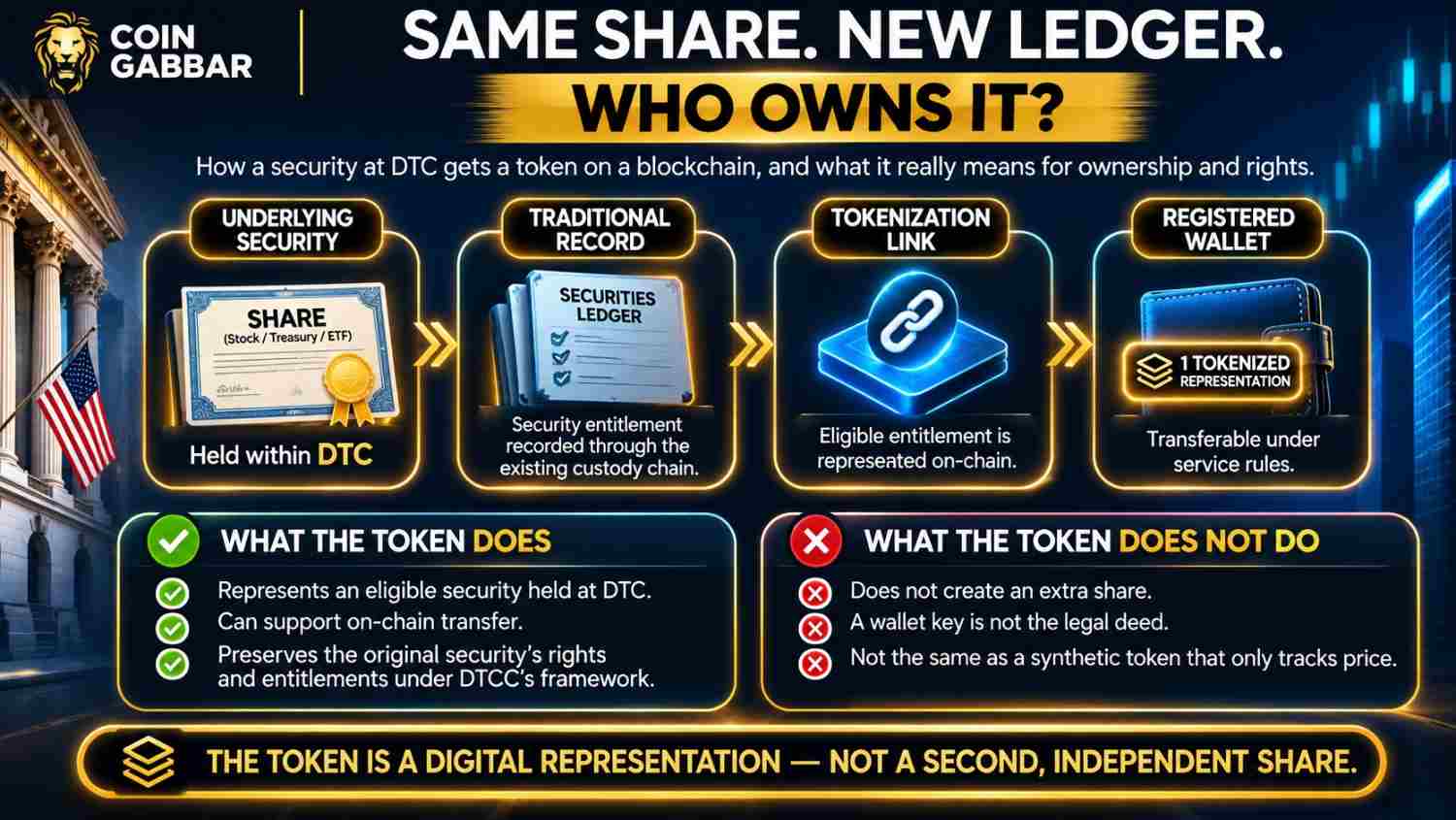
EisnerAmper describes three kinds of tokens. Issuer tokens record who owns what on-chain. Custodian tokens give an indirect stake through a security entitlement. Synthetic tokens give price exposure only.
Synthetic tokens typically give no stock, voting, or information rights. Always ask what rights a token carries.
How Does Minting and Burning a Tokenized Security Work?
DTCC's service mints tokenized versions of assets held at DTC. Eligible users can convert entitlements between traditional and tokenized forms. They can send the tokens to digital wallets of their choice.
Burning is the reverse of minting. It retires the token.
Here is a made-up case with one token per share. A user converts 100 ETF shares and gets 100 tokens. It later converts 40 back. Then 40 shares are in the traditional form, and 60 tokens remain on-chain.
The launch release does not publish step-by-step rules for these conversions. Check DTCC's service rules before you rely on any detail.
How Do Transfers and Settlement Change With Tokens?
DTCC says tokens let investors move assets more efficiently and reach new liquidity pools. The service runs on two networks today, so it is still early.
Speed matters here. The U.S. moved from T+2 to T+1 settlement, and even that one-day gap locks up billions in capital. It acts as a backstop against failed trades. EisnerAmper says blockchain settlement could cut the gap to near real time.
Here is the gap in plain terms. Under T+1, a Monday trade settles on Tuesday. Blockchain settlement could shrink that wait. So the pitch is simple: less waiting, less idle cash.
Why Does Collateral Mobility Matter to Wall Street Firms?
Collateral is an asset pledged to back a trade. Firms must often post more when markets move. Banks close at night, but markets don't. Picture a call for more cash at midnight. A bank wire waits for morning. A token could move at once.
DTCC says investors can mobilize collateral within minutes. Others test similar ideas. EisnerAmper says the exchange group ICE is working with BNY and Citi on tokenized deposits, so firms can post margin after bank hours. A Forbes writer describes Franklin Templeton and Binance letting clients post tokenized money market fund shares as collateral.
The launch release does not explain collateral workflows or haircuts. Treat "minutes" as a goal, not a fact.
How Is Regulated Tokenization Different From Crypto Tokens?
A regular crypto token can be made by anyone, and its rights depend on the issuer. A DTCC token starts from an asset held at DTC. DTCC says it keeps the rights and protections of the original.
Access differs too. Anyone with a wallet can hold a regular token. DTCC opened first to 20 firms and adds users on a rolling basis.
The legal base differs as well. The service rests on a December 2025 SEC no-action letter, which EisnerAmper calls a three-year pilot. Canton and Besu are live, and Solana would add a public chain.
What Risks and Open Questions Remain for Tokenized Shares?
A plan is not a launch. Solana access is expected in the second half of 2027, and only 20 firms have signed on. Most investors will likely reach tokens through brokers.
Relief is not law. A no-action letter is SEC staff relief for a pilot, not a new statute. Rules could change when the pilot ends.
Forecasts vary a lot. The same Forbes writer cites estimates from $2 trillion (McKinsey) to $16 trillion (Boston Consulting Group) for tokenized assets by 2030.
Simple mistakes are a risk too. Wallet keys and smart contracts add places for errors. None of this is a reason to panic. It is a reason to read the fine print.
What Do Key Tokenization Terms Mean for Readers?
DTC: the U.S. depository that holds securities for brokers and banks.
Security entitlement: an indirect claim on a security held through a custodian.
Tokenization: showing an asset with a token on a shared digital ledger.
No-action letter: an SEC staff statement that it won't recommend enforcement if a firm follows set terms.
Mint and burn: create or retire a token.
What Should Readers Watch Next in DTCC Tokenization?
Watch for a list of live tokenized securities. The launch release does not name them.
Watch the Solana timeline. Also watch what collateral value DTC grants tokens after the pilot.
DTCC tokenization is a story about plumbing, not coins. Our Solana hub tracks the chain side. Keep it simple. Ask what you hold, who holds it, and what rights it carries.
Expert Opinion: Is Tokenization a Pipe Upgrade or a New Market?
CoinGabbar analysis suggests DTCC tokenization is a pipe upgrade first and a new market second. The basis is simple. DTCC says the tokens keep the rights of the originals.
The real test comes in 2027. Watch collateral value and public-chain access. This view is not a forecast.
Disclaimer: This article is for information only and is not financial, legal, or tax advice. Tokenized securities are subject to securities laws and may not be available in every country. Returns are never promised or assured. Prices are volatile and rules may change, so all the money invested can be lost. Readers should consult a qualified adviser before investing.