Genomic Data Privacy: Can Scientists Analyze DNA Privately?

How Does Genomic Data Privacy Enable Scientific Research?
-
Genomic data privacy tools let labs run math on encrypted DNA data.
-
Studies from 2025 and 2026 scored 110,000 variants and ran a small test on Ethereum.
-
Encryption guards data in use. It does not prove a risk score is right.
-
This is research. It is not routine hospital practice yet.
Can scientists study your DNA without ever seeing it?
Partly, yes. Genomic data privacy tools make this possible in lab tests today. The lab locks the genetic data first. A computer then does the math on the locked data. Only the approved answer comes out.
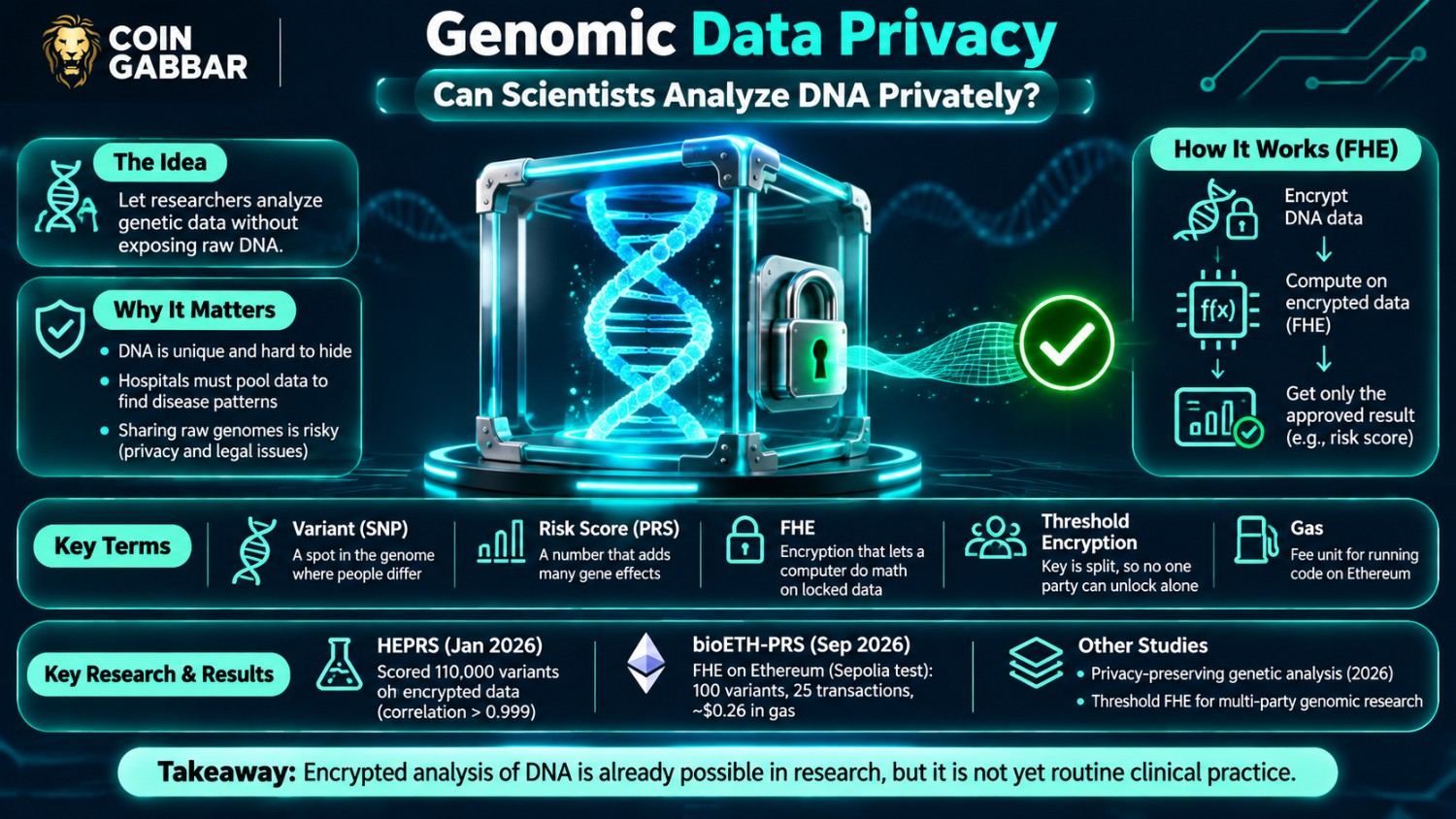
Genomic data privacy matters because DNA is hard to hide. Hospitals need to pool data to find disease patterns. But sharing raw genomes is risky. A tool called fully homomorphic encryption can run math on locked data. This guide covers four recent studies. It shows what they proved and what they did not.
Key Terms in Genomic Privacy
-
Variant (SNP): one spot in the genome where people differ.
-
Risk score (PRS): a number that adds many small gene effects to estimate disease risk.
-
FHE: encryption that lets a computer do math on locked data.
-
Threshold encryption: the key is split, so no one party can unlock data alone.
-
Gas: the fee unit for running code on Ethereum.
Why Is Genomic Data Privacy So Hard to Protect?
Your DNA is unique, unless you have an identical twin. The US National Human Genome Research Institute says so. So removing a name does not make a genome anonymous. In a 2013 Science study, Gymrek and colleagues traced personal genomes to named people. They used surnames and public family-tree sites.
How Can Researchers Compute on Encrypted DNA Data?
For genomic data privacy, the main answer is FHE. A hospital locks a patient's gene data. A computing service does the math on the locked values. The hospital then unlocks the result. The service never sees the DNA.
A common job is a risk score. Each variant count (0, 1, or 2) is multiplied by a weight. Then the results are added. Take three made-up variants: 2 × 0.20 + 1 × 0.10 + 0 × 0.30 = 0.50. This example is ours, not a real patient's score.
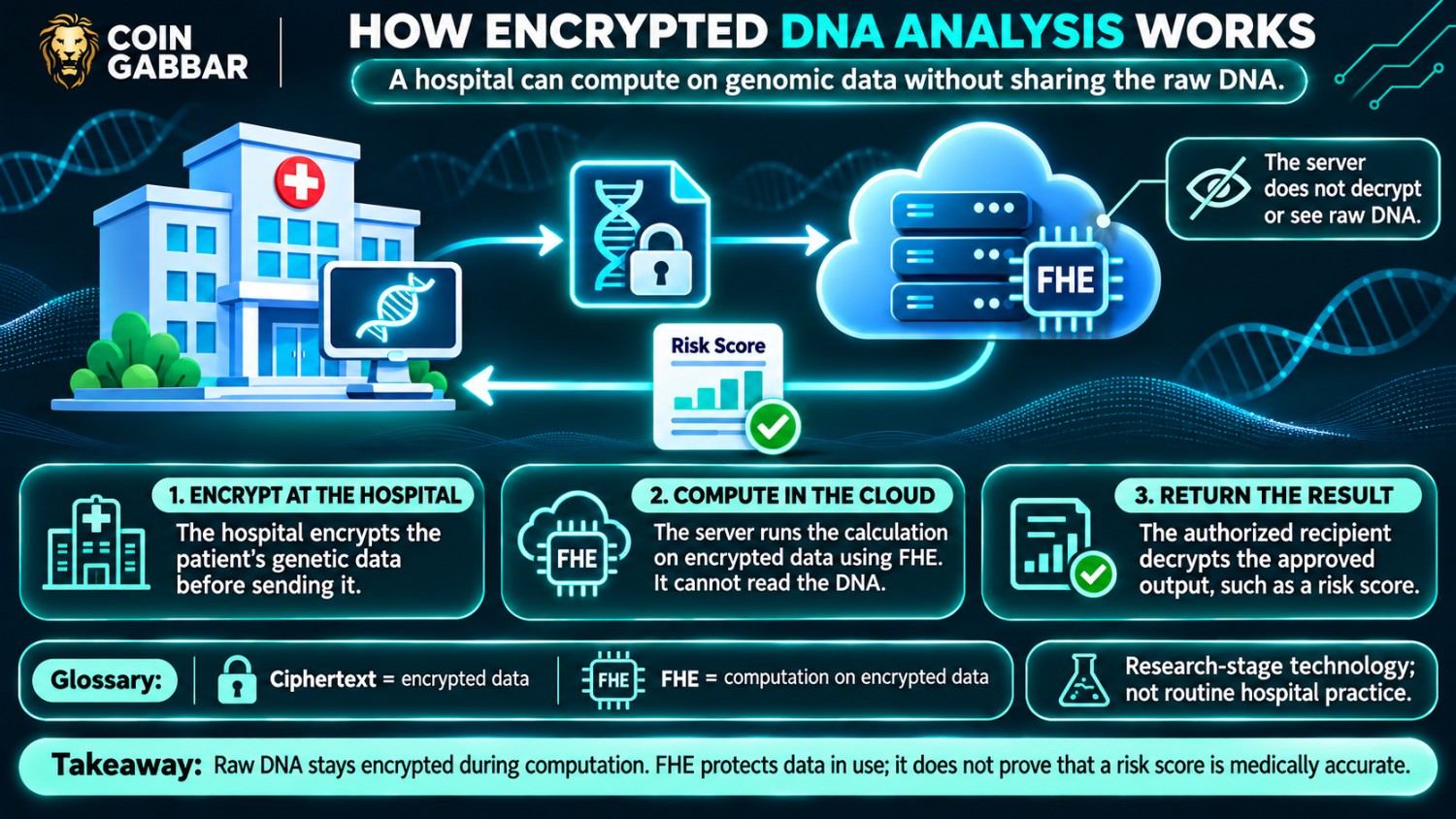
FHE can do the same sum on locked numbers.
What Did the HEPRS Study Show About Risk Scores?
A team led by Elizabeth Knight built HEPRS, an open-source tool. It scored a 110,000-variant schizophrenia model on encrypted data. Locked scores matched normal scores with a correlation above 0.999. One person took about 4.9 seconds and 3.3 GB of memory (Cell Reports Methods, 26 January 2026, HEPRS study).
There is a catch. One evaluator still runs the math. The authors warn that the client and evaluator could team up to leak the model weights.
Can Ethereum Run Private Genetic Calculations?
A September 2026 paper, bioETH-PRS, tried it. It used smart contracts on an FHE-enabled Ethereum design. Four contracts handle sample records, models, the math and result release (Briefings in Bioinformatics, 15 September 2026, bioETH-PRS paper).
The public Sepolia test used 100 variants with public weights. It took 25 transactions, about 20.71 million gas and 269 seconds.
Scale is the gap. HEPRS handled 110,000 variants off-chain. The Ethereum test handled 100. That is a 1,100-fold difference. It is our own sum, and the setups differ. Private weights were not tested on Sepolia. Nothing at whole-genome size was shown.
Trust also remains. The authors say trust is moved around, not removed. The chain records the steps. It does not prove the locked math was done right.
Can Hospitals Work Together Without Sharing DNA Files?
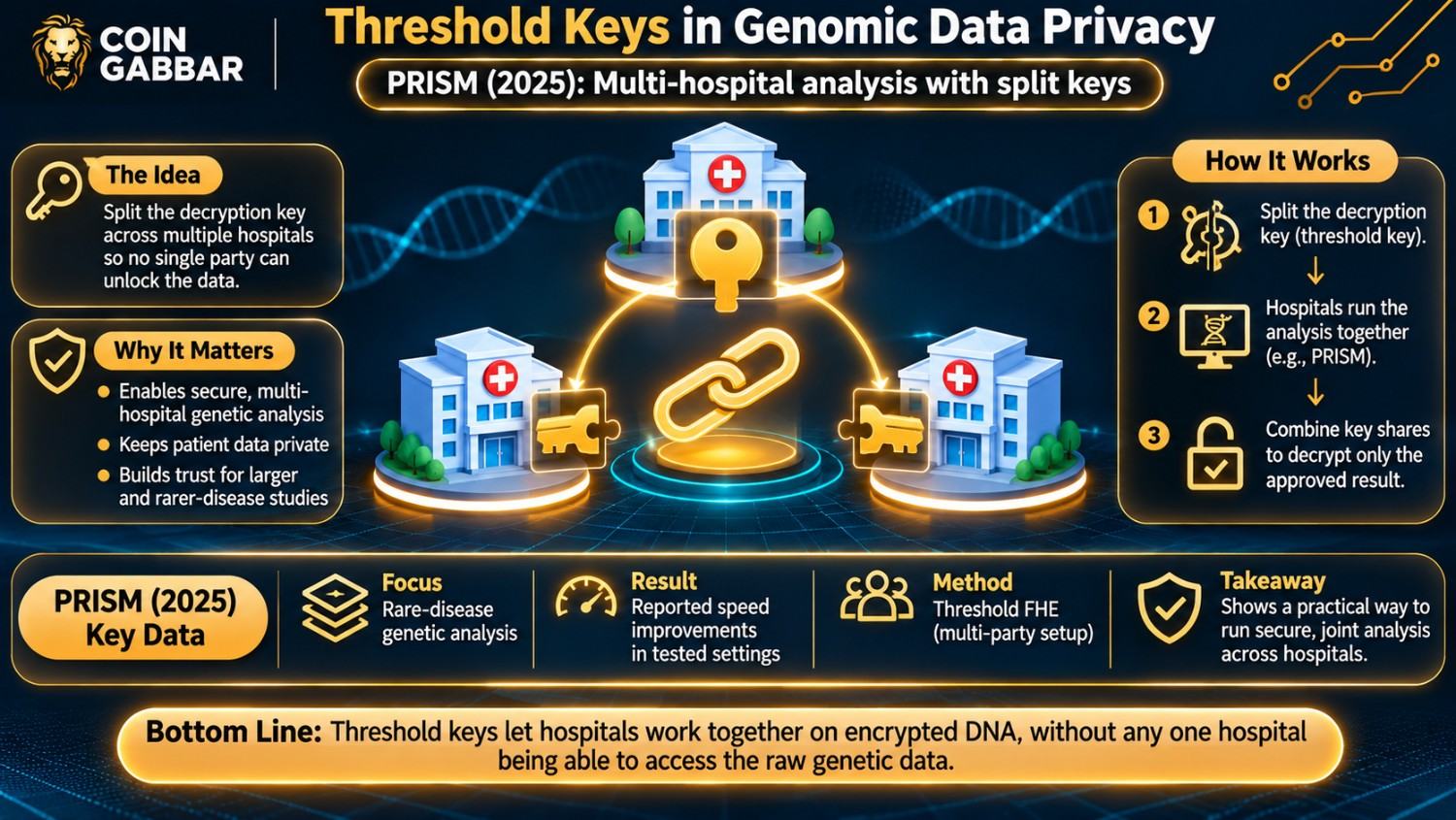
So far, yes, in studies. PRISM filtered rare-disease variants on encrypted data (Bioinformatics, 2 October 2025). It used threshold encryption. Its fast mode cut one 1.6 million-variant task from 4 minutes 14 seconds to 15 seconds. But the output grew from 10.5 MB to 201 MB. Speed can cost storage.
A Singapore team went further (Bioinformatics, 20 February 2026). It mixed two privacy methods across two real patient groups. Results matched plain math. Neither project used a blockchain.
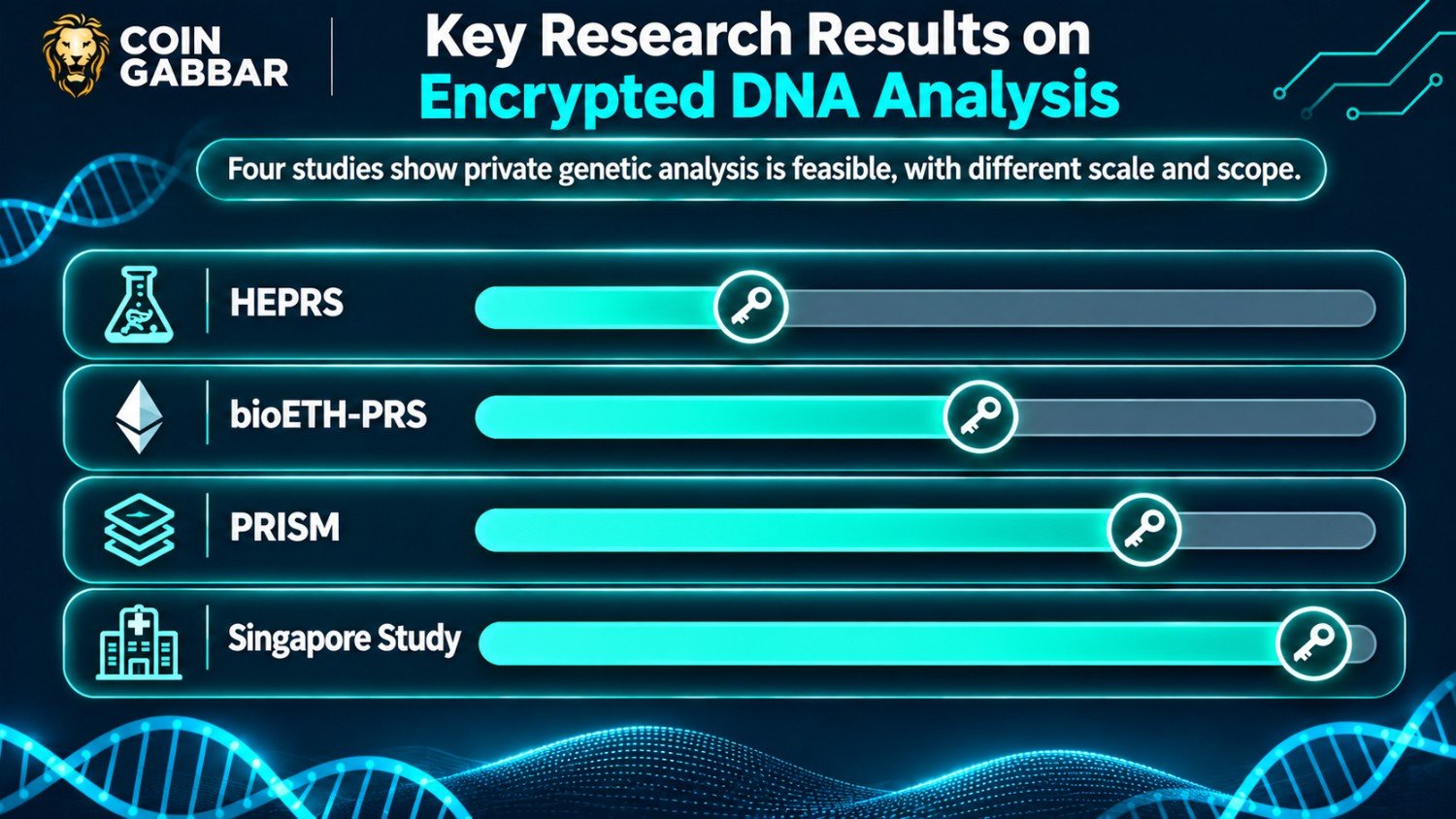
| Study | Goal | Method | Key result |
| HEPRS, 2026 | Risk scoring | CKKS FHE | 110,000 variants, 4.9 s each |
| bioETH-PRS, 2026 | Smart-contract scoring | TFHE on fhEVM | 100 variants on Sepolia |
| PRISM, 2025 | Rare-disease filtering | Threshold FHE | 1.6 million variants in 15 s |
| Singapore study, 2026 | Multi-group statistics | FHE plus MPC | Matched plain results |
What Still Threatens Privacy After Encryption?
Plenty. Genomic data privacy needs more than encryption. Other gaps remain:
-
Re-identification: DNA itself can point to a person.
-
Fake inputs: nothing proves the data belong to the listed patient. The bioETH-PRS authors flag this.
-
Output leaks: repeated yes-or-no questions can reveal facts.
-
Public metadata: on a public chain, some sample details stay visible. Our guide to private and public cryptocurrencies shows why.
-
Weak models: a correct score is not a diagnosis. A 2026 Nature Reviews Genetics review by Iftikhar Kullo lists poor accuracy across populations as a barrier.
Rules still apply too. The NIH expects researchers to protect participants. Encryption helps. It does not replace consent.
CoinGabbar Expert View on Genomic Data Privacy
CoinGabbar analysis suggests the blockchain is the least proven layer in genomic data privacy. HEPRS, PRISM, and the Singapore study worked without one. The scale gap is large. And the bioETH-PRS authors say trust is only moved. A chain may still help with permissions and audit trails. See our piece on blockchain privacy solutions.
Final Takeaway: Genomic data privacy may come to mean sharing the power to compute, not the DNA itself. The 2025 and 2026 studies are promising, but early.
Disclaimer: This article is educational. It is not medical, legal, or investment advice. The methods are research-stage. The author is not personally invested in any project mentioned.
















