Fully Homomorphic Encryption Blockchain: Can Contracts Stay Private?


Fully Homomorphic Encryption Blockchain Explained
A hospital wants a risk score. A lab owns the model. Neither side wants to hand over raw data. Fully homomorphic encryption blockchain research tests an odd fix: let a computer do math on data it can't read. Recent experiments now run that idea inside smart contracts. The results are real, small, and honest about the limits.
On a public chain, Ethereum smart contracts expose inputs and state to anyone who looks. Encryption could change that. The catch is cost, trust, and proof.
What Are the Key Takeaways on Encrypted Blockchain Computing?
Fully homomorphic encryption lets a server compute on data it can't read.
The best fully homomorphic encryption blockchain test so far ran 100 genetic variants on a public testnet.
Off-chain work reached 110,258 variants, far beyond the chain tests.
Speed, proof of correct work, and standards are still open problems.
What Is Fully Homomorphic Encryption and How Does It Work?
Fully homomorphic encryption (FHE) is a method that lets a computer run calculations on encrypted data without holding the secret key. The server returns an encrypted result, and only the key holder can decrypt it. Data stays protected in storage, in transit, and during processing.
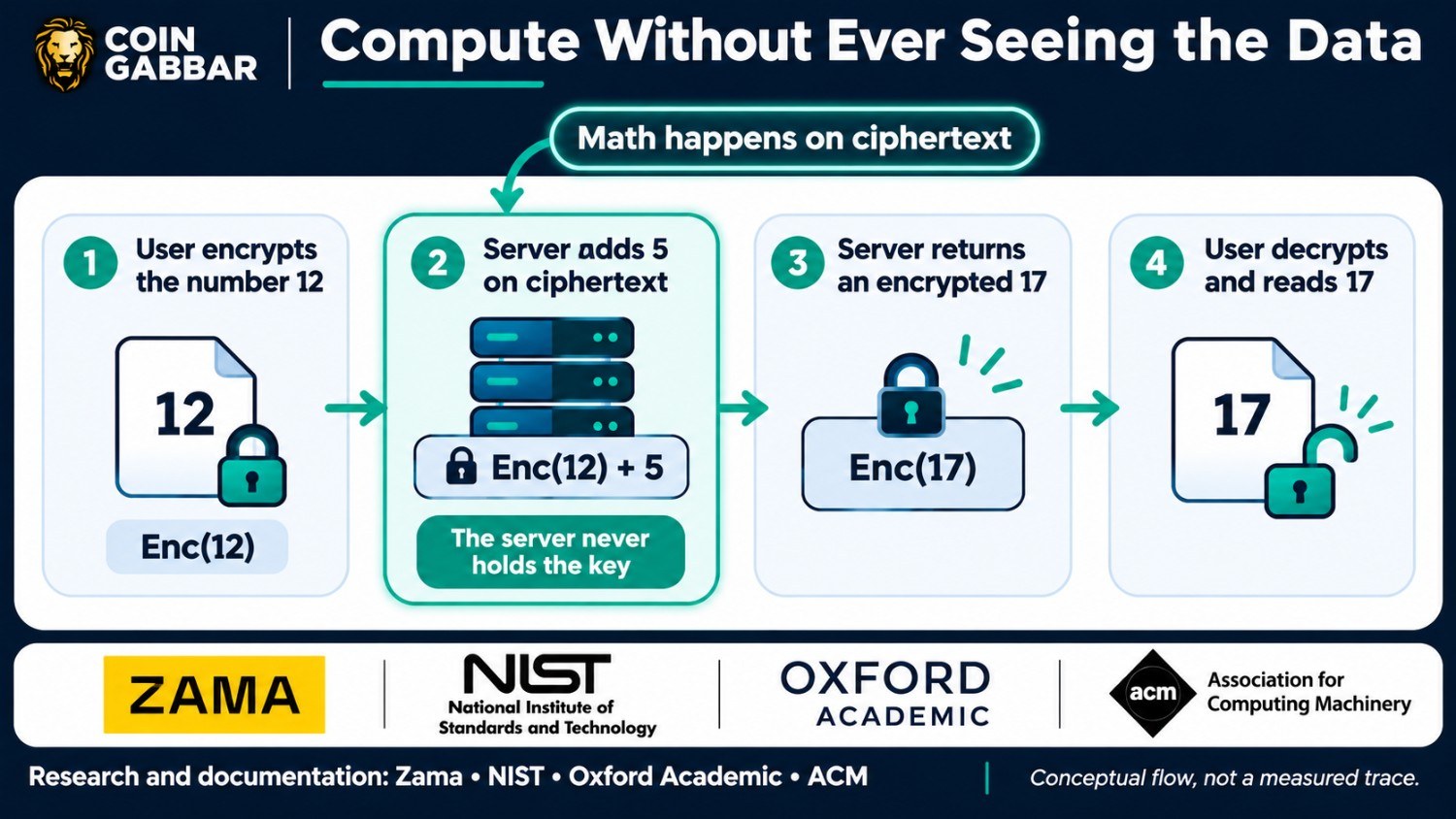
A simple case: a user encrypts the number 12 and asks a cloud service to add 5. The service works on ciphertext and returns an encrypted 17. Only the user can read it.
The idea stayed theoretical until Craig Gentry's 2009 construction. It introduced bootstrapping, a refresh step that clears the noise that builds up as operations pile on.
Which FHE Schemes Matter: TFHE, CKKS, BFV, and BGV?
Scheme | What it handles | Typical use |
BFV and BGV | These schemes handle exact integer arithmetic. | BFV and BGV suit counting, sums, and database-style work. |
CKKS | This scheme handles approximate real-number arithmetic. | CKKS suits statistics and machine learning. |
TFHE | This scheme handles gate-level logic with fast refresh. | TFHE suits comparisons and chain-based contracts. |
The choice of scheme sets what a system computes well and what it computes slowly.
How Can Fully Homomorphic Encryption Blockchain Systems Work?
Public chains need a shared, checkable state. Encrypted values break that habit, so designs split the job. Zama's fHEVM, shown below, keeps the contract on the chain and moves heavy encrypted math to an executor. A gateway relays decryption requests, and a key management system guards the private key.
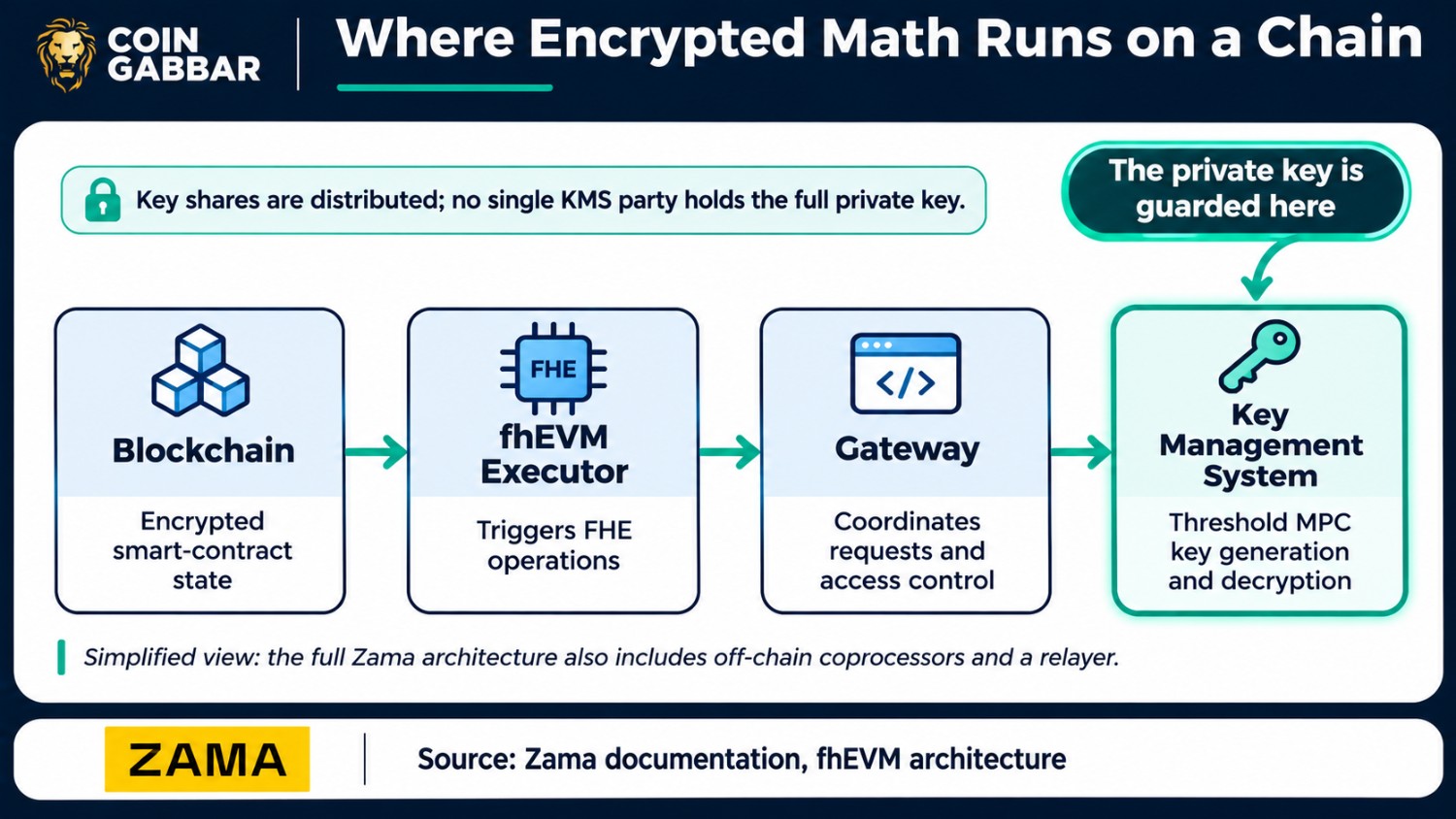
A fully homomorphic encryption blockchain therefore adds parts that need trust. The bioETH-PRS authors sum it up this way: trust is redistributed, not removed.
Cost is a second barrier. The bioETH-PRS preprint says routine use likely needs a purpose-built FHE rollup or application chain. A Layer 2 architecture is one route.
What Did the bioETH-PRS Experiment Show on Ethereum?
The bioETH-PRS study from the University of Texas at Austin scored disease risk on encrypted genetic data through four smart contracts. A polygenic risk score adds many gene variants, each with a weight, into one number.
Test | Result |
Sepolia testnet, 100 variants, public weights | The run took 25 transactions, about 20.71 million gas, about 269 seconds to result and about 8 seconds to decrypt. |
Local simulation, up to 5,000 variants | The streaming path used 35.4% to 37.2% less gas than the classic path. |
Accuracy check on 200 public-weight scores | Each of the 200 scores matched an independent calculation on the tested inputs. |
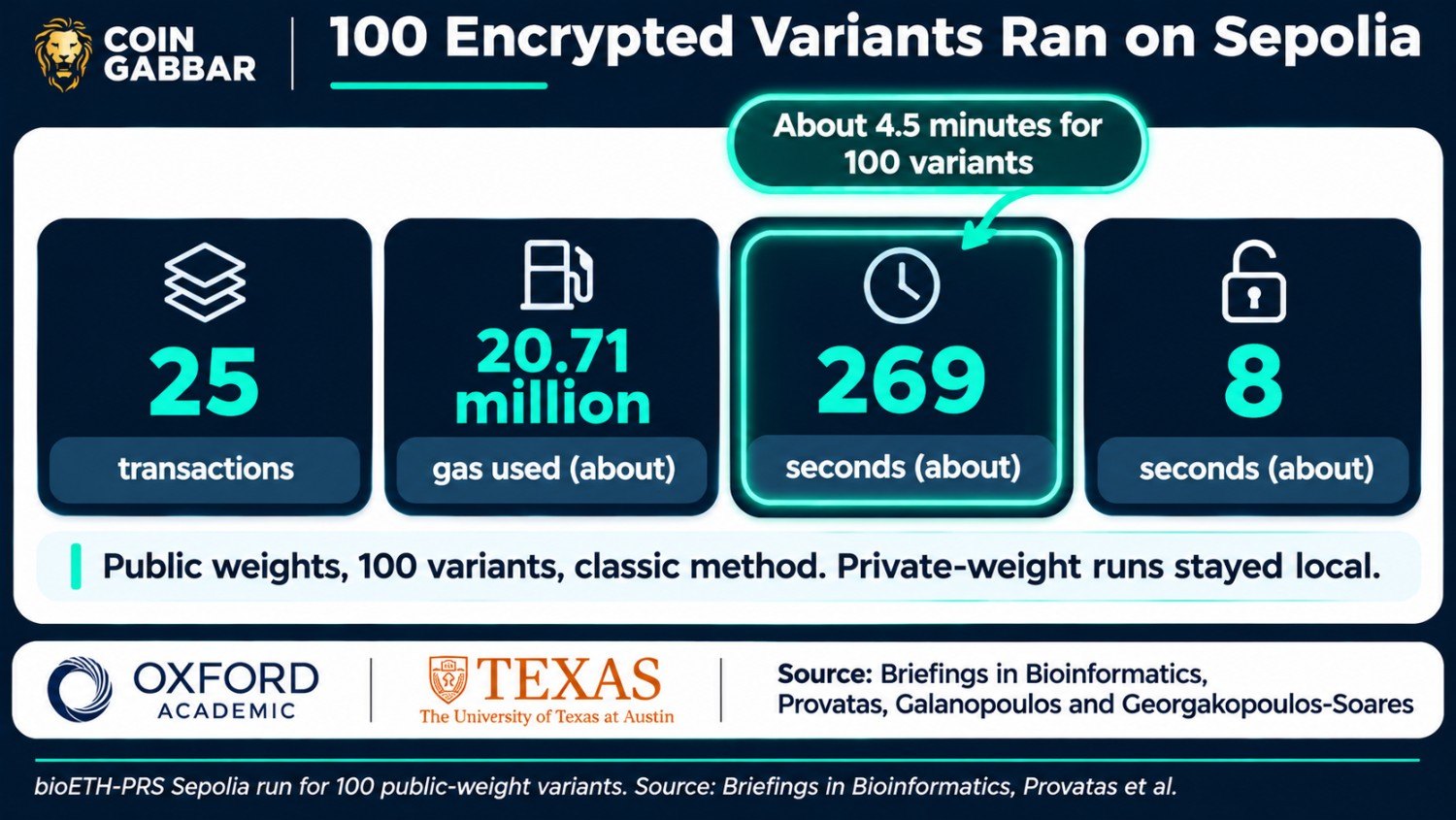
The limits matter. Private-weight runs stayed local. The contracts can't prove that encrypted data came from the registered person.
How Did HEPRS Protect Genetic Data Without a Chain?
The HEPRS preprint used CKKS to score 110,258 variants for schizophrenia risk off-chain. Encrypted scores tracked plaintext scores with a correlation above 0.999. The preprint reports roughly 4.9 seconds and 3.3 GB per person, though its sections give slightly different figures. Its authors describe encrypted work as about three orders of magnitude slower than plaintext.
Off-chain work is far ahead of the fully homomorphic encryption blockchain runs so far.
How Does FHE Compare With ZKPs, MPC, and TEEs?
Technology | Main job |
FHE | It computes on encrypted data. |
ZKP | It proves a claim is true without revealing the data. |
MPC | It lets several parties compute together without sharing inputs. |
TEE | It processes data inside protected hardware. |
These tools can work together, because each covers a different gap. Privacy coins hide payments on separate chains, which is a different job from private computation. The guide to private and public cryptocurrencies covers that split. Private AI queries remain a proposed use.
The decentralised AI inference guide shows how AI can run without big tech.
What Still Limits Fully Homomorphic Encryption Today?
Proof is the first gap. A recent verifiable FHE review in ACM Computing Surveys studies integrity and open problems. Encryption hides inputs, but it doesn't show that the server ran the right program.
Leakage is the second. In bioETH-PRS tests, repeated queries with fixed thresholds still let estimated weights correlate with true weights at 0.9388.
Standards are the third. NIST IR 8214C lists FHE under Class S, special primitives NIST has not specified, and invites threshold FHE submissions. Parameters, bootstrapping cost and key handling add engineering work, and a fully homomorphic encryption blockchain inherits that burden.
What Does CoinGabbar Expert Analysis Say About FHE?
CoinGabbar analysis suggests that three results sit at different maturity levels. HEPRS shows scale off-chain. bioETH-PRS shows a small run on-chain. Verifiable FHE research shows what is still missing.

CoinGabbar's own calculation: scaling the Sepolia run in a straight line to 110,258 variants gives about 22.8 billion gas and about 27,600 transactions. The streaming path's local rate of 413 transactions per 5,000 variants would cut that to about 9,100. A fully homomorphic encryption blockchain at a genome scale therefore looks far off.
What Do the Key Terms in Encrypted Computing Mean?
Ciphertext: scrambled data that only the key holder can read.
Bootstrapping: a refresh step that resets built-up noise.
fhEVM: an Ethereum-style environment built for encrypted values.
Coprocessor: a helper service that runs heavy encrypted math.
Threshold decryption: decryption that needs several key holders to cooperate.
Disclaimer: This article is educational content, not financial, investment, or legal advice. Research results describe tested conditions only, and live systems may behave differently.